Day 218. Leknessund in Solund to Mjomna in Gulen
Posted by: James on August 6, 2009Distance 39km | Time 8.5hrs | Ascent 0m | Descent 0m
 The weather forecast said it would be wet and windy in the morning but it was much better than predicted and my lie in was scuppered. I got up at 0800 and had the kayaked packed and on the water for 1000. As I paddled out of the bay I chatted with a local who was cleaning some old wooden crab pots. It was not this road to Leknessund but the next on west to Avloyp which was the Millionaires Road I mentioned yesterday.
I rounded the corner and paddled the km I battled with yesterday. There was a slight wind but I made much better time. This was a grey and wild landscape with barely any earth where trees grew let alone for cultivation. As I paddled down Hersviksund the village of Hersvik appeared. It was a green oasis in the grey landscape. There were a few fields here but this would have been a former fishing community.
I left this sound and went north round the top of Huoy island where there were many islets, and a few even with trees and cabins. There seemed to be a lot of mink here which would have hammered the bird population nesting here.
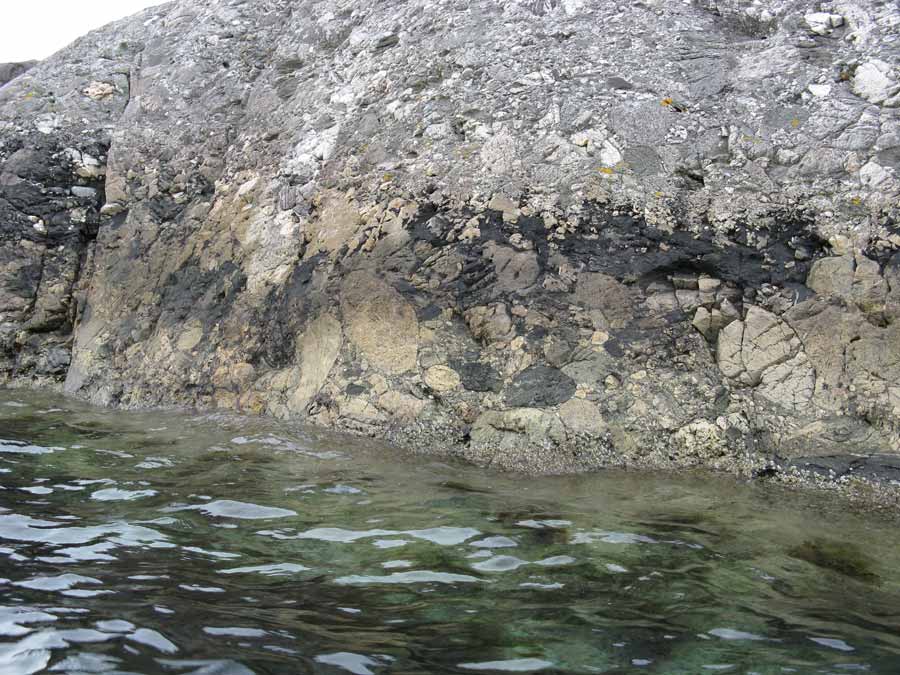
I noticed that all the rock here was conglomerate. That is pebbles, cobbles and boulders which have been laid down in a river bed or estuary and then the spaces in between filled with sand and silt. This whole deposit which could have been even a kilometre thick and as vast as the Nile or Amazon delta now was then metamorphosed into rock by tremendous heat, pressure or both. This conglomerate rock extended the whole way to Sognesjoen.
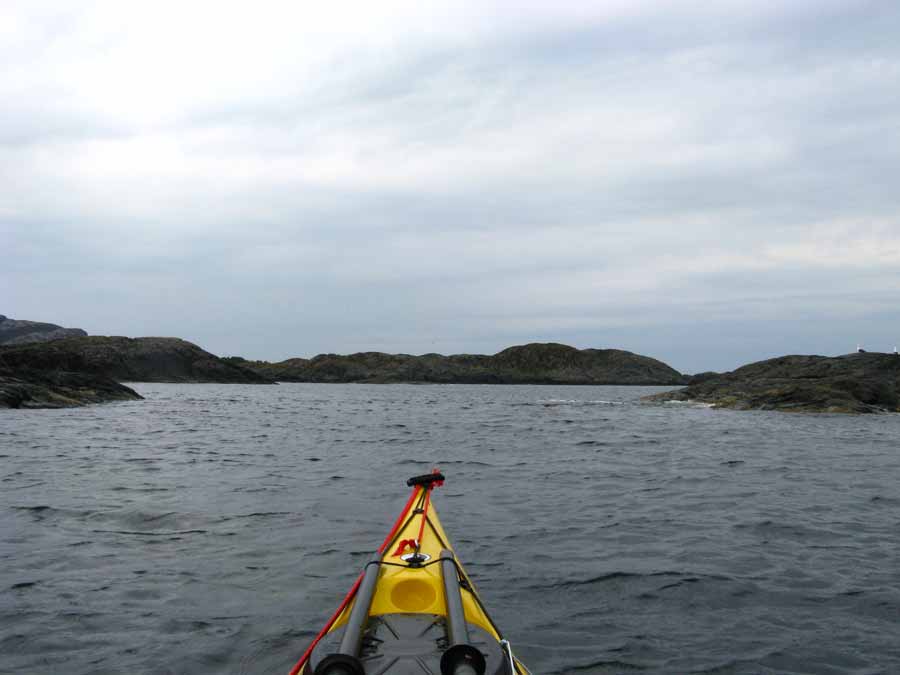 I crossed the barely open Lagoyfjord for 4-5 km and reached the tiny hamlet of Avloyp. The wind was almost absent and the weather clement. After Avloyp I entered a mass of small and medium sized islands. Rich Lennox in Askvoll had been right to send me this way. I slowly paddled through channels between this conglomerate rock looking at the constituent pebbles and boulders and marveling at the barrenness of the archipelago. There were a few pockets of spruce where earth had accumulated but mostly it was sparse heather and grey rock. You could see it had not been long since the ice retreated from here.
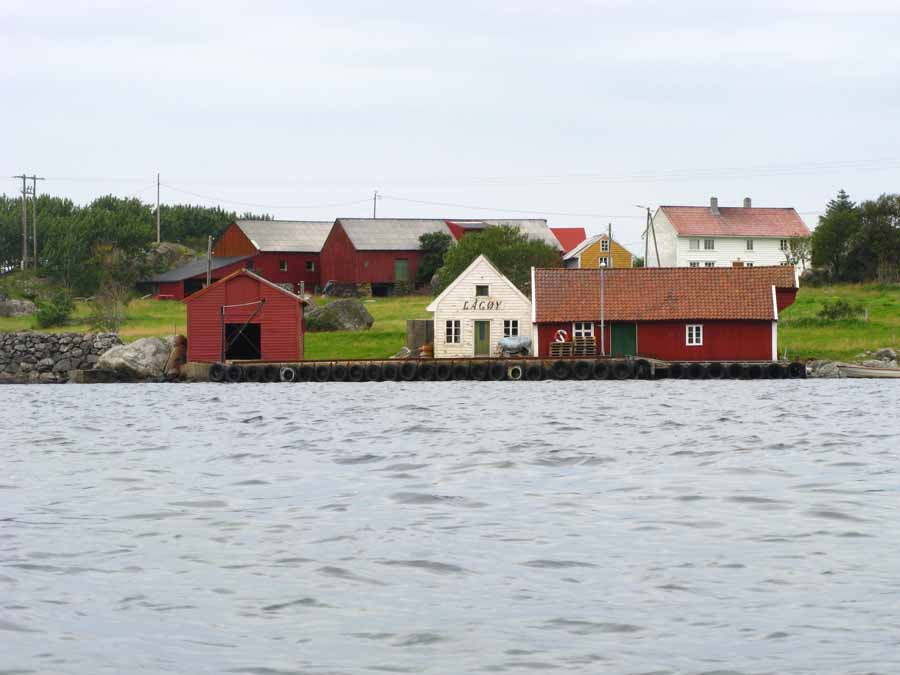 I paddled over to Lagoy, where someone had tried some farming once, and then headed down the Liasund sound towards the town of Solund. On the way down the sound I passed many other islands including Faeroy until the sound narrowed. There was the very pretty sheltered town of Solund on the east side with a few shops and the main church of this council. While on the west side was the village of Steinsund. Both these places were refreshingly lush and green but the grey outcrops even burst through the spruce woods and lawns here.
I paddled under the bridge connecting these two settlements and then headed south down Indre Steinsund until it opened up into Sognesjoen. Sognesjoen was the sea end of Sognefjord, perhaps the longest, largest and deepest fjord in the world. From the sea to the very end of one of its arms called Lustrafjord it is 250 km long. It has about 15 arms many of which are famous fjords in themselves. The total coastline of Sognefjord must be over 2,000 km.
It was made by a river of ice which drained a large part of the icecap westwards. This river scoured a deep trench into the rocks until it reached the sea. The river of ice then started to float and carve icebergs which drifted away. Therefore at the very west of this fjord where it meets the sea it is not that deep, as the ice did not carve the rock so relentlessly here. Further east in the fjord the ice has carved a trench well over a km below the current sea level. When the ice melted the sea flooded into this trench and created the fjord.
Today there are a few dozen glaciers and an ice sheet which feed the rivers which flow into the fjord so there is a tremendous amount of fresh water flowing into the fjord. It all has to leave through the 5 km wide mouth across Sognesjoen. In addition to that the whole fjord has to fill up and empty with at least a metre of tidal water twice each day and these create strong currents.
These currents then flow into the oncoming swell and waves and it can become a difficult sea. I was therefore keen to cross while I could. As it was today it was perfect. I hardly noticed a tide, there were no waves and the swell here was just a metre and within an hour I was on the other side by the island of Hille. I stopped here for a pause and rang Tom Amundsen who was also paddling the Norwegian coast. He finished yesterday so I congratulated him and hope to see him when I paddle past Sandnes in about 10 days.
There was no conglomerate rock here but a return to the old gneiss basement which forms the bedrock of Western Norway. The conglomerate north of Sognefjord would have probably have been sitting on this far older gneiss. The remnants of the Caledonian Mountains in Norway which virtually run its whole length are huge chunks of rock which were pushed up onto this gneiss platform.
Otherwise the landscape on this side of the fjord was similar to the archipelago on the north side. There were masses of grey rocky islands and most were not that high. Between the islands in the channels and sounds were plenty of salmon farms.
The seagull chicks were almost full grown now but retained the juvenile brown plumage and beak. Nearly all could fly quite well. They still could not catch food and whined continually for their parents to regurgitate food. They followed their parents across the skerries whining and jabbing the parent’s beak with their own with relentless insistence.
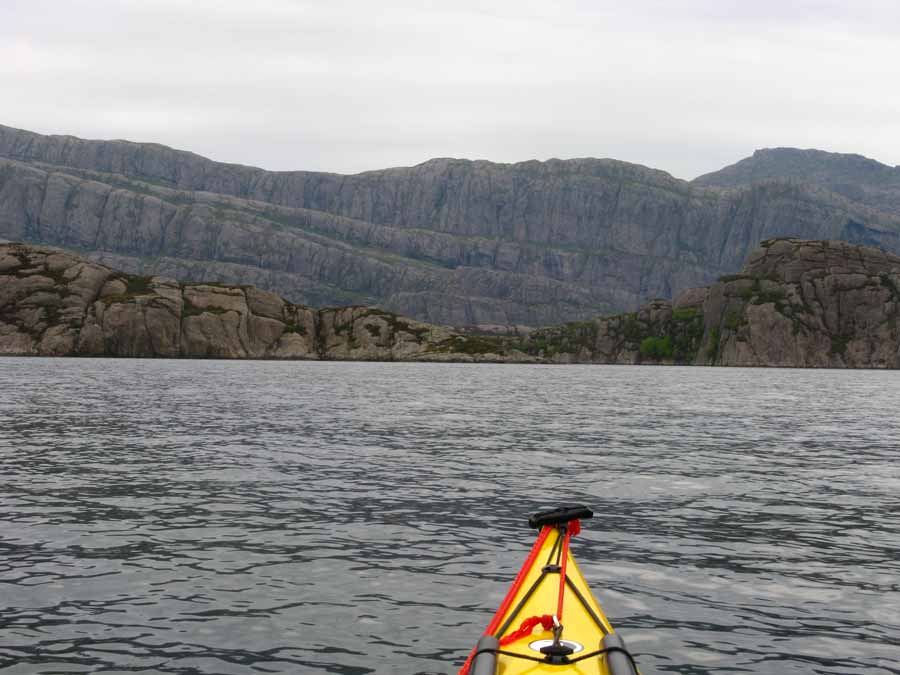 As with the north side of Sognesjoen there were very little camping spots. The ice scoured rock did not offer good landing places either and there were no beaches at all. I therefore homed in on the hamlets among the islands where there was usually some landing place and a field or two. So I set my sights on Mjomna some 6-7 km further south.
Mjomna did indeed have a beach and a field and I had the tent up by 2000. There was also a hardware shop here and an old Lutheran church which was the usual white. I think there were about 20 houses and I should imagine the population was around 50. There was virtually no mobile reception however so I could not update from here that evening.
 I sat outside on a table near the hardware store and on the jetty where the express boat arrived from Bergen and then minibuses ferried the passengers to the outlying communities from here. I had finished the blog by 2200 and then went back to the tent to make the usual simple supper.
It had been a very good day paddling through the almost alien landscape which was different to but just as barren as Finnmark.