Day 160. Tones to Maasoy
Posted by: James on June 9, 2009Distance 30km | Time 6.5hrs | Ascent 0m | Descent 0m
I woke at 0800 with the sun beating down onto the tent and warming it so much I was overheating inside it. It was a rare problem. I had to open and tie back both ends so there was a through draught to cool me down again. I noticed an otter or mink swimming across the bay. Leaving the ends of the tent open I went back to sleep for another 4 hours until 1200. There was little hurry today after yesterday’s effort.
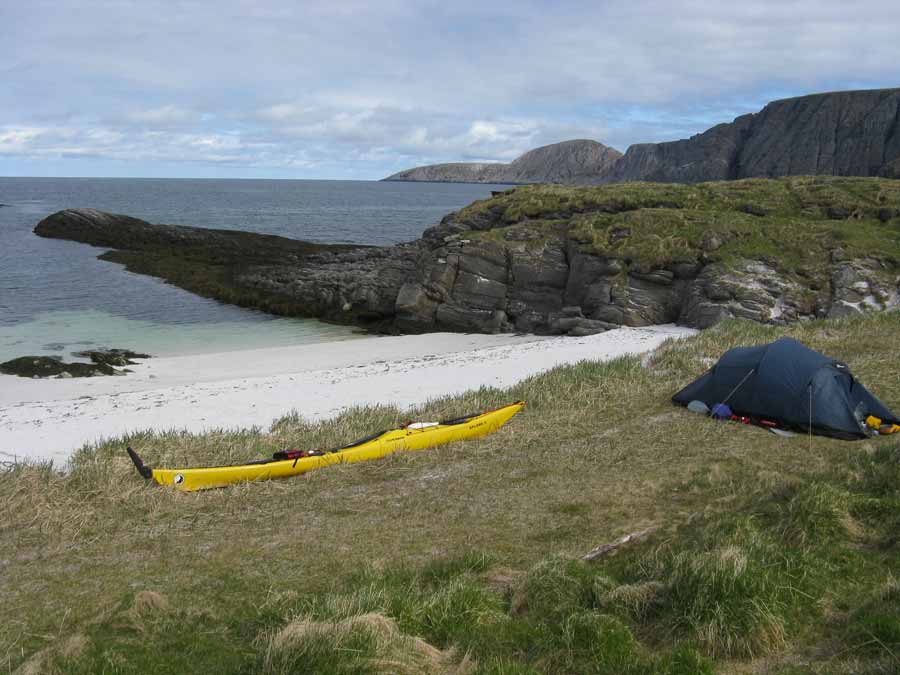 I got up at midday, had a simple breakfast of salami and potted meat and then wandered about the meadow stretching. The many hundred blackback seagulls were still on the grass slopes high above me guarding their nests. This really was an idyllic spot. It was difficult to make the decision to leave but the weather was perfect. I carried everything down the beautiful white sand packed the kayak and pushed off at 1500 gliding over the crystal clear water with its green hue due to the white sand.
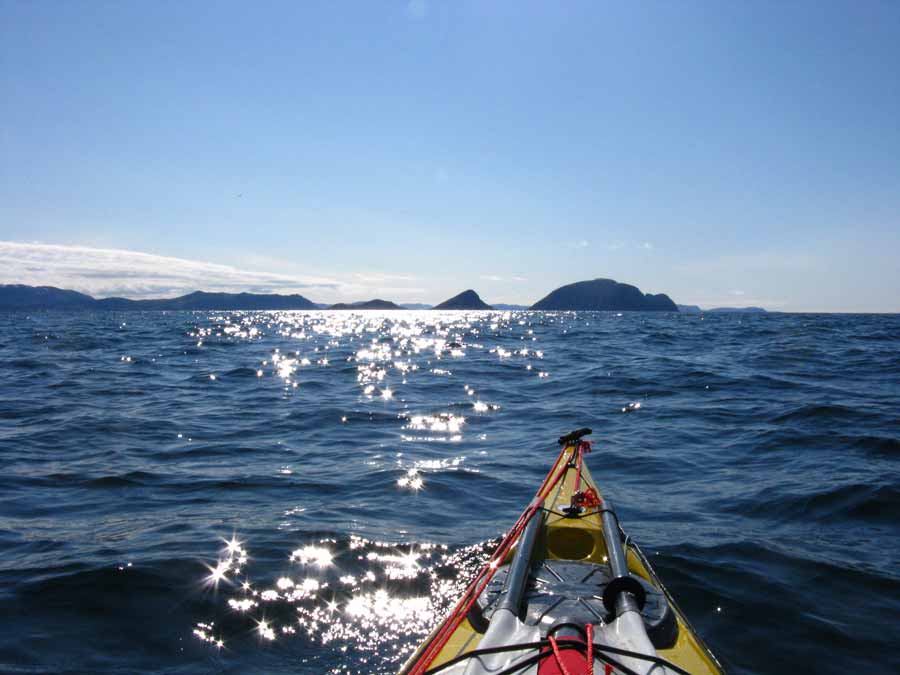 I did not really have a destination but from now it was all south as I had rounded the most northern point in Europe last night. First on the list was Store Stappan. This was the largest in a rugged archipelago of rocky islands and skerries some 8 km due west. Store Stappan was a renowned bird colony and was also a Nature Reserve. It was apparently not allowed to land on the island after the 4th June so the nesting birds would not be disturbed.
There was a light following wind but a slight current against me as I crossed the open water to the largest and most northerly of this island group. I was paddling quite lazily without much strength or vigour. The sun was out and the light was strong and bright.
As I neared Store Stappan I noticed there were more and more puffins, the odd guillemot, tystie and even some razorbills. I did not see any gannets however which I thought had a colony here. Here and there were currents welling up as the tide passed over underwater skerries.
About 2 km from Store Stappan the number of puffins increased and soon there were many groups of 20 or more. As I approached they took off and joined the throng already circling around me and the kayak. Occasionally one would come close trailing it feet and turning quickly. The nearer I got to the island the more puffins took off and joined this whirlwind.
Soon I could see a vast raft of puffins on the northeast side of the island. When I was 100 metres away the whole raft of some 10,000 birds took off and started circling round me. I was amazed there were no collisions. As I approached the island I noticed more and more rafts on each side. A lot of these rafts also contained razorbills and guillemots who seemed a lot more confident and less reluctant to take to the wing.
I was quite surprised the puffins were so wary of me. A year ago I visited the Shiant Islands in the Outer Hebrides which is home to about a quarter of a million puffins. Here I could paddle right into the midst of the raft and they would lazily move out of the way at the last minute. They were a far cry from this distrustful bunch.
When I reached the northeast tip of the island I paused and started to slowly cruise south down the east side. There were kittiwakes, razorbills, guillemots and shags lining the guano covered outcrops and crags above the shore. Above this were steep grassy slopes which went up some 300 metres to the craggy ridges on top of the island. In these grassy slopes were many tens of thousands, if not hundreds of thousands, of puffin burrows. The sky was teeming with puffins flying to and fro from these burrows.
As I surveyed the slope a white flash would suddenly appear. This was a puffin with its white chest emerging from it burrow into the light of day. It would then survey the surroundings for a minute or two before launching off the slope and with a quick wing beat of tiny wings make for the sea.
Above this frantic puffin activity were at least 5 sea eagles circling above. There were no seagulls or ravens harrying them here although they must have been around. The sea eagles would have been looking for carrion, fish and dead birds. I don’t think they had the speed or agility to catch the fast puffins.
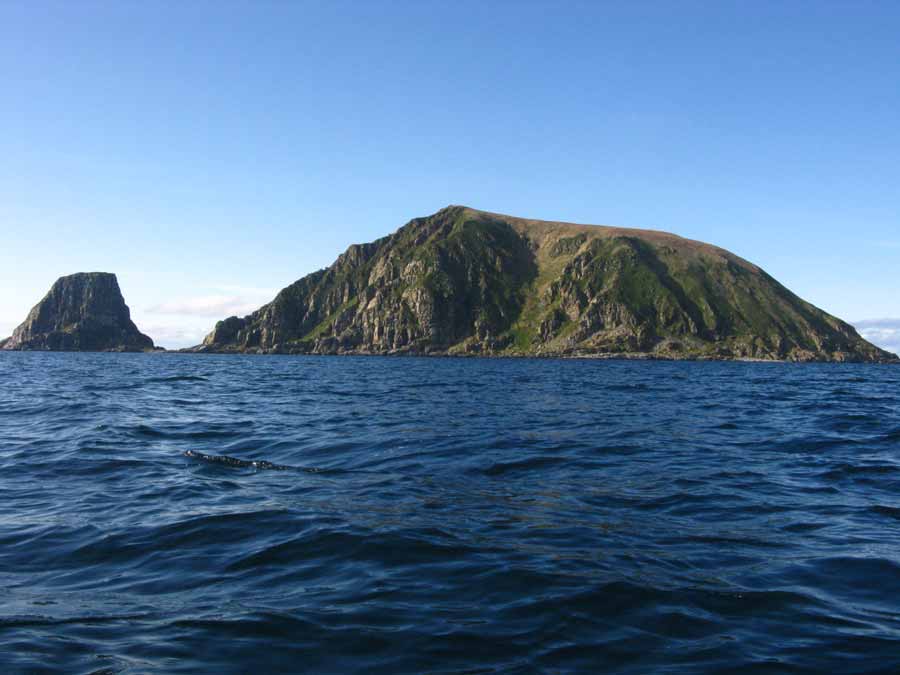 After a good hour watching this birdlife I reached the southern end of the island and the close neighboring island of Kirke Stappan. There did not seem to be much bird life on this island despite it being quite similar. I paddled between the islands and continued round Store Stappan. The vast slope on the south side also seemed to be riddled with puffin burrows. I don’t know how many puffins were here but the colony seemed on a comparable scale to the Shiant Islands and there were 250,000 there.
There was a steep outcrop on the north west of the island which I did not investigate. I assumed that if there were gannets breeding here it would be on that but I did not see any circling above.
I now turned south west. With the wind behind me I decided to go to Maasoy. There seemed to be a bay on the south side of this island with a few cabins on it. It was a good 10 km across the ocean to the northeastern tip of the island. With the light wind behind me I set off. It took a couple of hours before this craggy tip was within touching distance. On the journey over I could look straight into the deep sound, called Mageroysundet, which separated Mageroy from the mainland. There seemed to be a current coming out of it in the ebbing tide.
Once at Maasoy I paddled in the shade down the east coast. In the waters here were many tystie. Tystie are usually quite solitary birds compared to their cousins the common guillemot yet they were gathered here in groups of 20. They tend to nest in crevices and cracks neared the waterline and their nests are harder to see.
Towards the south of Maasoy were two bays. As I approached I saw there were some proper houses rather than cabins here. When I rounded a large spit of rock I found myself looking into a deep sheltered bay with the spit acting as a natural breakwater. At the end of this bay was an idyllic sight
A large beach of light sand was spread across the end. Above this was a village complete with a white church and some 20 houses spread across a large pasture. As a gazed into this tranquil sight bathed in the evening sun I noticed people walking and even a car. I had not expected anyone here at all.
I paddled in, rammed the kayak up the sandy beach again and went up to the narrow road between the beach front and the spread crescent of houses. It was 2130. Just then a tractor came ambling along. I flagged it down but it was going to stop anyway. It is not every day someone comes paddling into the bay. I asked the driver, a 70 year old man called Astor, if there was anywhere to stay. Not officially he said but I am sure I can find a corner for you to sleep in. He pointed to a small homestead and told me to wander over when I had the boat up and was organized, then drove off slowly towards it.
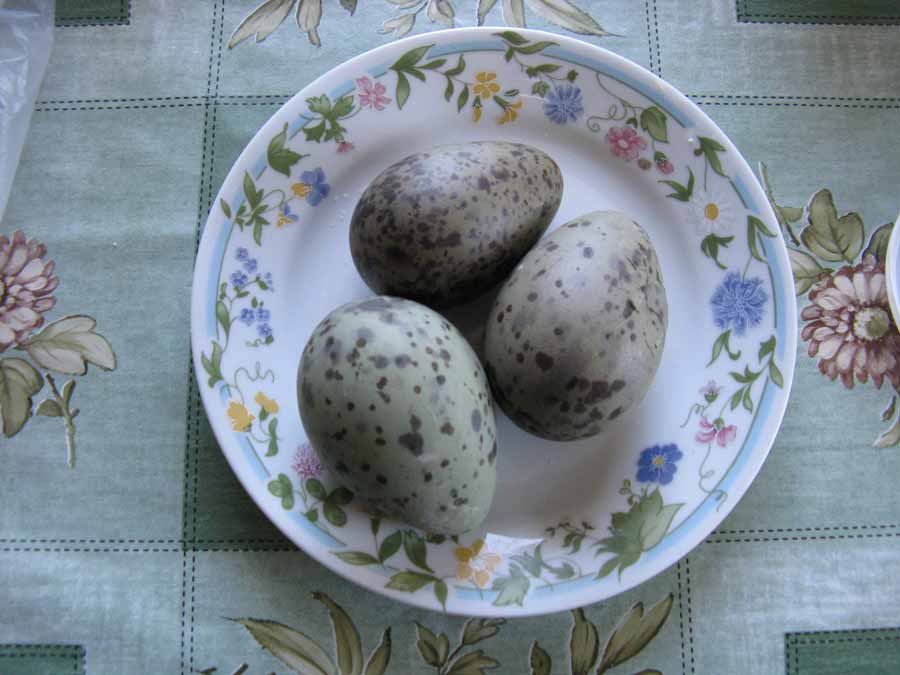 After I secured the boat and unpacked what I needed I went over. Astor welcomed me in and sat me down at the table. I could see he was a character. There was one dish I had wanted to try since I started paddling in Finnmark and I was about to be served it and that was seagulls eggs; herring gull to be precise.
The eggs were large; about twice the size of a hen’s egg. They were dark green speckled with dark spots. The shell was very thin. Inside the white was opaque and not as firm as a hen’s egg and the yolk was a bit drier and quite yellow. I ate five but which stage I was completely full. Astor told me the best eggs were tystie and puffin.
We then retired to his living room where he poured me a large Glenfiddich. He told me all about the island. There were 24 people living here. Two of them were teachers for the two pupils, one of which was his 16 year old grandson who soon joined us. There was a ferry 5 days a week and a shop owned by the community. There was a couple of fishing boats and a small processing plant here. Many of the houses were also holiday homes for people who had some family connection to the island and visited every summer at least.
He told me Svaerholt, like many places in Finnmark, was evacuated by the Germans towards the end of the war before the place was burnt. Then after the war people who had been evacuated never returned from Mid or South Norway, or only a few returned and the community was then abandoned in the 1950’s. Enough people returned to Maasoy to make it a viable community again.
Astor had recently lost his wife of some 50 years. I did not touch on the subject as it was clearly painful still. However this was a very close community and he had a daughter and grandchild here. We chatted late into the evening as the midnight sun appeared through a saddle in hills across the bay. We eventually went to bed at 0230. It was way too late for me but Astor enjoyed the company and he was a fascinating and outspoken man.
It was another superb day. Despite the late start and the long stay at the Store Stappan watching the puffins I still managed a respectable 30 km. Maasoy was a lovely place, and idyllic community in the summer and Astor was a great and interesting host.
June 10th, 2009 at 8:52 pm
Fantastic progress and so glad you’re getting better weather. Driving sleet on Lecht road today on way to work. New snow on the Cairngorms!