Jul
15
2009

Day 196. Leka to Royrvik

Posted by: James on July 15, 2009

Distance 36km | Time 7.5hrs | Ascent 0m | Descent 0m

Day 196.1 A navigation beacon on the shore of Leka is iconic of the entire coastI did not finish all the writing the previous night so started again after breakfast at 0830. I did not finish until around 1130. Then by the time I packed up and carried everything down to the water and cast off it was already 1300. There were many Germans at this camp site and most seemed to spend their holidays fishing and then taking the chilled and filleted catch back to Germany at the end of the holiday.

Day 196.2 A larger raft of Eider ducks with large ducklings in towInitially I went between the islands of Leka and the smaller Madsoy to the east of it. This area had three large salmon farms in full operation which was quite a high density. The whole thing was pretty automatic with a large barge storing the food pellets and with the generators. These pellets were then blow down tubes to the cages on a regular basis controlled by automatic timers. There were usually two rows of six round cages to each farm.

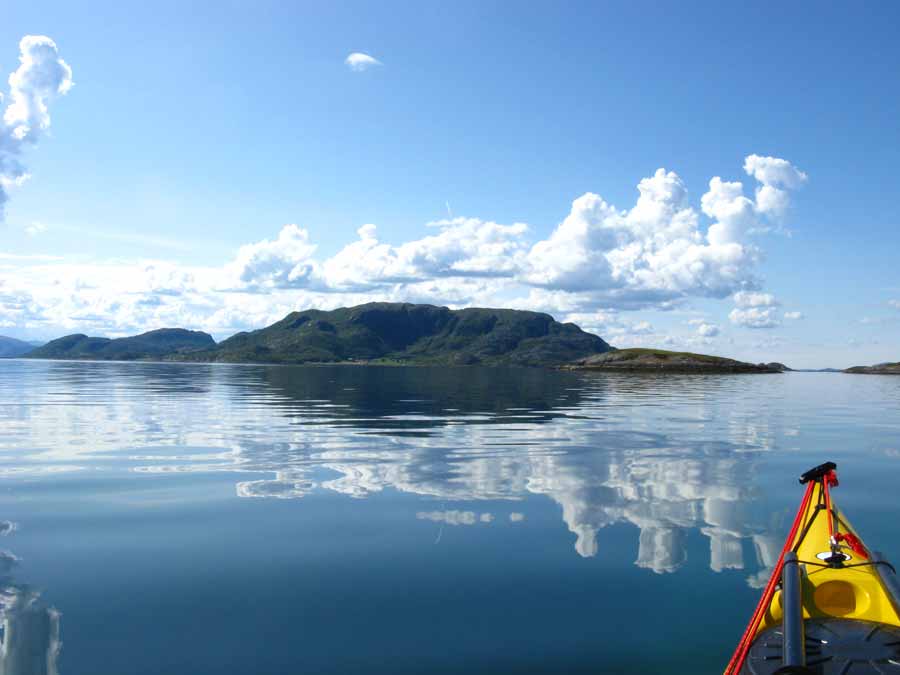
Day 196.3 Looking north from the ruined house on Risvear to some of the islets in this clusterAfter Madsoy I sneaked through various islands and some more open stretches to the archipelago at Risvaer. This was quite a fascinating cluster of islands consisting of perhaps 20 smaller islets and the two main islands which were connected by a short sandy causeway at low tide. On each of the islands near the causeway was a large and substantial house built of timber logs and clad in planks. Sadly both houses now stood in ruins and were completely covered in sheep dung and wool.

Day 196.4 Looking south east from Risvaer to farms on the mainland where perhaps the descendants are nowRisvaer had been an old trading hamlet up to some 60 years ago. Motors did not exist then and Coastal Norway was a poor place. Folk had to live near the fishing grounds as they had to sail or row there when the weather was good. It was for this reason many of these small communities existed. When engines were put in boats they could be larger go out in more weathers and go longer distances. Folk then started to move from these scattered communities in the ocean and started to drift to the mainland swelling the larger villages there into towns.

Risvaer was not only a fishing hamlet but a trading centre also for people to come and buy supplies and sell excess fish. Trading boats would ply up and down the coast with supplies and the Hurtigruten would also bring supplies and post keeping places like Risvaer going as a hub in the local fishing and sea faring communities. When these communities dispersed to the mainland the hubs like Risvaer collapsed and the merchants left.

Now on Risvaer there were about 40 sheep. They lived in the lower floor of the two windowless but substantial houses. Had it not been for the log walls they would have blown away long ago. The sheep were the rustic variety again which did not need tending. They spent the whole year here finding shelter in the houses or behind crags. They lambed without a farmer’s watchful eye and their dark shaggy fleeces they shed when necessary. They were almost feral but had ear tags. Once a year I suspect the farmer arrived and took some of the older sheep and lambs for the table.

Day 196.5 One of the ruined houses on Risvaer with a large shackle for anchoring previous boatsI lingered long on Risvaer exploring the place and reflecting on the lost pride and glory that must have existed here with families growing up and cows being milked on the islands meadows. Every trace of that was now gone except for the massive stone quays and these two derelict houses.

From Risvaer I continued to the Island of Gjerdinga. This had a small hamlet connected by ferry to the mainland. It had avoided the fate of Risvaer as it had more sustainable farms and the migration must have been later. It now had embraced tourism and many of the old houses were restored as leisure houses by descendants of the original inhabitants and were also rented out to Norwegian and European tourists. It seemed to sustain the place as it was thriving and the small car ferry was full with some 8 cars, which is not bad for an island with perhaps a km of gravel road and 30 houses or cabins.

Day 196.6 As I approached Royrvik there were many well kept farmsFrom Gjerdinga I crossed across the narrow shipping channel to the mainland and followed it for some 10 km along the shoreline. A few freighters passed me going slowly as the signs requested and I barely noticed their wash. The shore here and the islands seemed very lush and pleasant. Although the tide was falling I barely noticed it helping me. The following wind was a good help however.

I soon reached the area where the sound opened up into a basin with a couple more wooded islands. To the west of this basin was the town of Royrvik and to the east the industrial spread of Ottersoy. Due to the islands I did not see Royrvik but hoped it made up for Ottersoy which was a wasteland of concrete and industrial buildings. There was a bridge connecting the two and I had previously decided that it was my goal for the day.

I paddled under the bridge and continued to a place on the map called Flosand just south of it. I thought from the name it would have a beach. It had many and I approached the one on the north some 2 km south of the bridge and another world from the buildings of Ottersoy. This was back to tranquil agricultural Norway again.

There was already someone on the beach with a kayak. He had a leisure cabin nearby. We got chatting and he was extremely helpful and showed me a great place to camp. We chatted more as I set up the tent. He then invited me over for drinks once I was sorted out. I was 2100 so I quickly ate and went over the fields to his at 2130 on this beautiful evening with a gentle north breeze.

He and his wife welcomed me warmly. A lot of drinks were offered but I declined the whiskey as I still harboured thoughts of doing the blog later. So I went for coffee. While this was brewing I was given a towel and encouraged to enjoy the copious hot water in the lovely bathroom.

We chatted for a good two hours. It is always a pleasure to chat with intelligent thoughtful Norwegians. They form the majority and the shallow rabble I meet at Skogsholmen in their cabin cruisers a few days previously were the exception rather than the rule luckily. I learnt a lot about the changes in society which had and still is affecting Norway. By the time I left at midnight and returned across the fields to my tent overlooking the bay the blog was doomed.

It had been a mixed day. It was a dull wasted morning writing followed by a great afternoons exploring on Risvaer and a nice paddle to Royrvik. All this was then topped off by a warm evenings chat with characteristically nice Norwegian hosts. There was also a tinge of sorry in that I had reached Royrvik as this was perhaps the end of the coastline called Helgelandskyst with its small flat island clusters and large steep lush mountains rising from the sea. Helgelandskyst was a paradise really in this good weather and a perfect place for beginners to explore and intermediates to arrange their first week long expedition.

Jul
14
2009

Day 195. Torghatten to Leka

Posted by: James on July 14, 2009

Distance 44km | Time 10hrs | Ascent 0m | Descent 0m

Day 195.1 Torghatten seen from Torgfjord to the southI was up at 0600 which after the early night was quite easy. The sun hit the tent rising above Torghatten soon afterward. It did not take long before I was packed and ready. I had to be quite sharp as the estuary I was beside dried out completely at low tide and it would have been a long carry if I left it to 1000. As I was setting off one of the owners of the nice farm came down for a small chat.

The morning paddle was again in completely windstill conditions. I made my way through a maze of skerries to the edge of the more open fjord called Torgfjord. This was a shipping channel for the Hurtigruten ferry amongst others so I checked for ships before crossing over to some islands on the other side near a peninsula by Skalvik near Somna.

Day 195.2 One of the warm sandy beaches on Lyngvaer with a view north to TorghattenContinuing south I went towards the cluster of islands at Lyngvaer. I pulled up in a sandy bay where the water was warm I noticed when I stepped out of the boat. There was a good view here to the north towards Torghatten. Just round the corner from this bay there was the ruined fishing works on these islands. Two wharfs were bleached and windowless and would soon be flattened by a storm. They were probably abandoned in the 1970’s.

Apart from the derelict buildings this was a pretty group of islands with the occasional sandy beach and many channels between the islands. There were a lot of ducks around the shores of these islands all with ducklings now. The ducklings were various sizes but most were a bit bigger than tennis balls. Here and there a heron took off, very wary of me in my yellow kayak.

Day 195.3 Calm seas as I head across to Kvaloy from LyngvaerI went round the outside of Kvaloy where there were much rockier steeper islets offshore These were of a different character from those further north I had passed through Helgelandskyst. I passed to the outside of the largest called Gimlingen and then started across the mouth of Bindalsfjord to the peninsula on the south side.

Day 195.4 The grassy grazed beach at  Nord Gutvik would make a nice campsiteThe weather was changing fast now and the wind was up to a force three, there was occasional drizzle which was enough to make the smooth rocks on the south side shine in the sun and I noticed a bank of fog rolling in from the west engulfing the islands to the north of Leka. I reached land near the hamlet at Nord Gutvik where there was a wonderful beach with grazed grass. It was just 1500 and I was thinking about stopping as I needed to write.

I saw there was a camping place on the island of Leka just some 10 km away. I phoned them and they said they were near the sea and they had a cheap cabin available. I said I was en route. The crossing of Lekafjord was quite choppy and I had to paddle vigorously into the waves. This was again a shipping channel and I did not want to linger in it. Before long I was approaching the fish farm on the north side.

I paddled south down the coast with a force four against me passing the quay where the ferry from Gutvik on the mainland connected the island to the world and then on through a small channel and across an open bay until I reached the small breakwater for the camping place. The 200 metres from the water turned out to be 800 metres up a hill which irritated me.

Taking the minimum I needed I started up the track to the camping. It was located in a nice hamlet with cows in the meadows. The lady at the camping place was something of an amateur geologist and she soon dispersed my irritation with the difficult access by explain a bit about the island and lending me a nearly broken bike to go the km to the shop.

On my trip to the shop I noticed how relatively affluent the island was and how well organized everything here was. There were lots of notices about communal events and activities and lots of information on the natural history of the place. The inhabitants seemed proud of their island.

I bought some supper and returned to the cabin. The cabin was made from red boulders and cement under a grass roof. It was an unusual construction. I read that these red boulders were in fact serpentine and the campsite owners used this stone as it was an island icon.

Geologically Leka was a very interesting place. It was unlike the surrounding basement rock on the mainland which was mostly 1800 million year old gneiss on which the Caledonian Mountains were sitting in places, mostly further east. Leka was only some 500 million years old and was formed from the oceanic crust. Usually this crust is heavy and is forced under the lighter continental crust as continents collide. In the case of Leka however a fragment of oceanic crust was thrust on top of the continental crust and then turned on its end. Erosion has then exposed the layers. This geological structure is called an ophiolite and it is very rare. Other cases are just found in Oman, Cyprus and California.

The rocks on Leka illustrate this ophiolite perfectly. In the very east at Madsoy are the top layers of the oceanic crust, namely pillow lavas and basaltic dykes. Then on the central east section of this island are the second layer of oceanic crust namely gabbro. Then on the central west of the island we find the deepest parts of oceanic crust which are formed under the gabbro namely dunite and then on the very west of the island we find the rock harzburgite which is really the top of the mantle and lies under the oceanic crust.

I settled down for the evening quite early at 2100 after supper to write the blog for 4 hours and did not get to bed until well after midnight.

It had been an OK day. The morning was nice easy paddling with a bit of wind in the afternoon. The campsite was not as easy as I hoped and I wasted a good hour in getting to it. However it was worth it and Leka proved to be a nice and interesting island.

Jul
13
2009

Day 194. Ervika on Vega to Torghatten

Posted by: James on July 13, 2009

Distance 29km | Time 7hrs | Ascent 0m | Descent 0m

Day 194.1 Sedum in flower on one of the dry islets of DypninganI was up at 0730 and after breakfast wandered around the campsite taking a few photos and packing the boat at the low tide. A few people came by and chatted as they walked out to the point. My plan today was to go over to Torghatten where I had been tipped on a good campsite right to the south of the unique mountain. It was not far and I hope to arrive early.

I eventually started paddling on the mirror calm water at 0930. I wore no shirt and just had a life jacket on top. It was still too warm. It was the type of day where I could spot puffins from at least half a km away. Indeed in these still conditions I managed to see porpoises on at least three occasions. They were all individuals rather than a group.

I paddled across the south side of Vega heading away to the south west all the time towards a cluster of islands called Dypingan, which lay about 5 km of the south east of Vega. When I reached them I landed for lunch. I noticed there were a lot of Tystie around.

This collection of islands were composed of some 10 low rounded small islets composed of sharp ridged rock with some arid type of vegetation on them. The place was covered in goose droppings who must have feasted on the grass before migrating further north. Due to the dry weather a lot of the grass was browning but the sedum was in flower covering large areas in bright yellow.

There were many seagull chicks on the island. Their parents watched from a good distance as I wandered about. These seagull chicks, although only a week or two old, were already quite streetwise and either stayed still, hoping camouflage would work and them when I got too close and they realized they were spotted they dashed for the taller vegetation of nettle and angelica.

After a good pause and explore on these remote islets I paddled across the open Vegafjord to the archipelago of Buroy near the mainland. It was a 10 km crossing and went quite quickly but the wind was getting up a bit and I had to put the jacket on.

Day 194.2 An old robuer at the entrance to the secluded bay by Helloy islandI paddled through the islands of Buroy and then reached the south west tip of the larger island of Torget. There was a narrow, almost hidden entrance between the island of Torget and the smaller island of Helloy off its south west tip. These two islands enclosed a bay with many sandy beaches within it. At the far end of this bay was another narrow opening but this one was so shallow it allowed tractors to cross the sand at low tide to reach Helloy and the few cabins and farms on it.

As I paddled over this sandy ford and then through the narrows Torghatten appeared. Tom had told me there was some nice campspots to the south of the hill so I headed over the next bay towards them. This crossing of 2 km was all in shallow sandy waters with much weed and the occasional rock. I found one good place to camp below a small footbridge over an inlet. It was directly south of a lovely farm and the mountain.

Day 194.4 Looking from my camp place to the oild farm and then to Torghatten with the hole through itThe farm I found out was some 160 years old. It was owned by great grandparents who had seven children. These seven had 25 offspring and they now jointly owned and maintained the farm getting together once a year to tackle some larger projects and revel in the surroundings under the mountain.

There was a path from this lovely farm up to the mountain. What was remarkable about this mountain was it had a hole through it. The mountain was some 260 metres high and the hole was about half way up. I climbed up a path on the south side through birch woods thick with flowers and wild roses, the usual pink but a lot of white also, to the entrance of the hole.

The hole was vast. It was about 20 metres across and at least 40 high. It went right through the mountain for about 300 metres. This hole must have been formed by waves when the land was lower and the weight of the ice depressed the land. When the ice melted the land slowly started to rise and this hole, once formed would have risen above the sea level.

Day 194.3 Looking from thge hole in Torghatten down onto the old farm and the skerries and Islets typical of HelgelandskystThere was a great view southwards to the quaint farm the inlet and then the typical Helgelandskyst seascape of islands and Islets. I walked through the hole to the north side where there was a great view to the town of Bronnoysund some 15 km to the north and more seascapes of islands.

After a few phone calls I returned to the tent and got there around 2100. I was quite sun burnt from the bare topped paddling today and after supper crashed out at 2200 instead of doing any writing. The writing was taking up far too much of my time anyway and on average costing me about 10 km a day in lost distance. On the other hand it was forcing me to rest. It was nice to get an early night and the ground was soft.

It had been another magnificent day from start to finish. The weather, the scenery and the birdlife was fantastic.

Jul
12
2009

Day 193. Husvaer in Heroy to Ervika on Vega

Posted by: James on July 12, 2009

Distance 46km | Time 11.5hrs | Ascent 0m | Descent 0m

Day 193.1 The islands of Buoyene had wonderful sandy channels and a herds of rustic sheepI was up at 0700 and after breakfast took the boat out of the workshop down to the floating quay and packed it. I was finished at 0900 when everybody started to appear for breakfast outside. I said my goodbyes to Bent and Inge Skauen who were excellent hosts, the other two couples working here and also Pal and Guro; two of the very nice guests.

Bent Skauen had recommended a route through the islands to Vega and a camping spot on the south west tip of this island. It was not direct but I wanted to see the best rather than blast down. I left at 0930 on a beautiful morning.

After passing through the maze of islands and the social cluster of houses which composed Husvaer I passed under the bridge connecting it to Brasoy and then entered a relatively island free basin. Initially I headed south east towards Skaalvaer, which had a fine Lutheran church on it.

My description of a vaer a few days ago was wrong. It is not a geographical term but refers more to a social cluster where people gathered to set up houses close to the fishing grounds. More often than not these social clusters were on flat archipelagos of the sort found on the Helgelandskyst.

I went down the west side of Skaalvaer keeping close to the island and following a network of sandy channels just deep enough to kayak over. The white sand was turquoise and green in the sun. I stopped on Maasoy and then headed south west past another Hestoy island and into a wonderful archipelago of grassy islands separated by shallow sandy straights. This cluster of Islands was called Buoyene.

Buoyene was a collection of some 20 odd islands. There was a lot of curlew nesting around them and they flew around with their distinctive curved beaks making a wide a vocal range of calls. There was also a herd of very rustic sheep on the islands. I think at low tide they could cross from one island to another to make use of the grass. The sheep looked wild enough to almost be feral. There were perhaps kept for their fleece to make specialty wool.

From the Buoyene islands I passed yet another Hestoy before heading down a duck filled channel to reach Skogsholmen. Hest means horse and Hestoy must be islands where horses were put to graze in former times. I moored up at the jetty at Skogsholmen on the south east of the island in amongst the cabin cruisers. It was a Sunday.

Day 193.2 The old boiarding school on the beautiful Skogsholmen was now a quaint questhouse and resturantSkogsholmen was a fertile and leafy island which had a well known guesthouse and restaurant on it. This was located in the restored school. The school was built in the 1940s and was a boarding school for the children of the Vesteroyene islands, which are found around Skogsholmen. With the downturn in the smaller scale fishing industry in the 1960s and a migration away from these islands the school was closed in 1972. The door was locked and it was abandoned to the elements for some 40 years. It was then restored with some 8000 man hours of works to put right 4 decades of neglect.

I walked the half km up the track to the school passing some of the 8 old farms which subsisted on the island. The island had a very nice feel to it indeed. There were a few guests at this lovingly restored guesthouse. Two were nice older ladies who looked like the type who might have come here for a week’s watercolour painting and reading. They seemed to fit and belong to the atmosphere.

Many of the other guests however had arrived by cabin cruiser. They were a tasteless noisy bunch who had overindulged their appetites on the spoils of oil but had not developed the wisdom to temper this indulgence. In contrast to the watercolour ladies this rabble of 40 year olds sat on the balcony drinking beer and smoking roll ups. They were as unappealing as the British on Costa del Chav, complete with barbed wire tattoos around the bingo wings. If the walk had been more than half a km from the jetty they would not have managed it.

The island was extremely dry and there was a water shortage. You could see areas where the grass was browning due to the lack of water. The woods here were extremely lush and green with an abundance of wild flowers despite the dryness. It almost felt like a Greek island in this temperature.

I returned to the kayak after a meal and then continued south. It was getting on now as I had explored all morning and I pushed on through a less dense scattering of islands to the north of Vega. Vega Island is a UNESCO World heritage Site. It has been populated for some 11000 years since the ice sheet disappeared from Scandinavia. In the last 1500 years the island inhabitants have developed a subsistence based on fishing, hunting, some agriculture and not least the collection of eggs and down from Eider ducks.

Eider ducks nest around these islands in their thousands. The islanders encourage them by building duck houses which the ducks like to nest in away from predators like seagulls. In return the islanders take some eggs and collect all the down from a nest which is about 15 grams. It takes about 80 nests to make a good duvet with at least a kg of down.

Day 193.3 A small Nordlandsboat at the hamlet of Valla on VegaI paddled to the picturesque village of Valla and hoped to see some Vega culture but it was a small village at the end of the road. I then paddled down the west side of Vega between it and the Island of Sola. There was a strong wind against me of about force 5. And progress was slow.

The west side of Vega was rocky, mountainous and barren with the shoreline being of boulder beaches. It reminded me of Finnmark and while it was beautiful in its own right I had had enough of it. I felt a bit disappointed and was anxious I had missed the north and east side which would have given me more of a cultural insight. The beach on the south west tip did not capture me and I paddled on without stopping and started heading east along the south coast.

Day 193.4 One of many otters on the south west tip of Vega islandThe south coast was teeming with otter. I saw four of them in a few km. It was a wild coast like the west coast but with a few more trees, mostly pine and birch with a few rowans also. After some four km I came to a lovely beach at Ervika. I landed on the sand and found a nice place to camp on the edge of the beach in a sandy meadow full of purple marsh orchids. I eventually had the tent up at midnight and it was getting somewhat dark.

Day 193.5 The beach at Ervika on the south west tip of Vega islandIt was a fantastic day. The islands from Skaalvaer to Skogsholmen were enchanting. The journey down the west side of Vega was perhaps a mistake but it was rectified by the beach at Ervika, and I can explore the east side on my next trip here.

Jul
11
2009

Day 192. Husvaer in Heroy weather and rest day

Posted by: James on July 11, 2009

Distance 0km | Time 0hrs | Ascent 0m | Descent 0m

Day 192.1 The building and jetty at the Havnomaden kayak centre at HusvaerI had a free day today to repair the kayak and clean equipment and cloths and check things over. I got up reasonably late and then started to clean the kayak of some of the sand which had accumulated in the holds and were abrading the dry bags.

I also went along to the shop to get tonight’s meal and also 4 days worth of food from the limited choice. The next half week was not going to be a gourmet experience even by my standards.

With the supplies in I returned to the workshop. There was a local there building a kayak of strip wood from drawings. The place had all the tools to do this. I got chatting to him and he seemed the island handyman who could turn his hand to most practical things. His name was William Pedersen and his son was around to help him with his kayak project.

William quickly offered to help me. I needed an extra pair of hands to do some of the jobs as it was just too difficult to hold a bolt inside the kayak and operate a screwdriver on the other side. Plus with his practical skills he was able to find solutions which I thought were impossible.

A washer and nut was attached to the bolt which held the back toggle in place. The washer and nut was omitted by the factory and the bolt had simply ripped its thread and come off. This was a difficult operation as the washer and nut had to be attached some 2 foot beyond arms reach. William glued the washer and nut onto a baton and extended down the stern hatch while I screwed and eventually got a bit of the nut.

Next were the rudder pedals. I dismantled the good job Bjorn in Tromso had done but the foam we used then had perished. We found some very firm foam with the texture of plastic and using the holes Bjorn made were able to tie wrap the shaped foam bits into place. The rudder worked wonderfully after that with almost 20mm of this hard foam on the surface of the control pedals.

Finally William and Bent helped me glue some sleeping mat on the footwell floor to help protect my heels from the hard surface. My heels had been giving me a bit of trouble despite the fact they were cushioned by the neoprene of my boots.

With all this done I rinsed off the drysuit which I had not used for a week but would not dry as it was encrusted in salt which attracted any dampness, and packed the food. Bent also showed me some hidden gems to visit on Vega tomorrow and photocopied some charts to help me navigate the maze of islands around here.

In the late afternoon the 1.4 size spraydeck arrived by express post from Oyvind in Asker and I was finally ready to set off again after the service. Williams’ help had been invaluable and the workshop and the tools at the Havnomaden Kajakksenter were perfect. I just could not have done these jobs on my own on a beach somewhere.

After supper in the evening I went down to the pub below where more locals and guests had gathered. It was another wonderful arty evening with great craic as the Irish would say. I would be sorry to leave the comfort and familiarity of this place but I am quite sure I will be back. I want to come back and explore more of the Helgelandskyst at a later date and this place is the spiritual home of kayaking in this wonderful area.
It was a useful day with good company. I was now ready to continue south with all the small niggling things which needed to be done completed.