Day 158. Kjollefjord to Svaerholt
Posted by: James on June 7, 2009Distance 27km | Time 5.5hrs | Ascent 0m | Descent 0m
 I slept well and long and did not get up until 0930. I walked over to the hotel for the included breakfast and ate well, as it would be lunch also. The weather was bright and sunny and the skies were blue with a gentle northwest wind coming down the fjord. It would be against me but it was only force three, and it was forecast to drop.
I packed the kayak and chatted with a couple of fisherman before I cast off at 1200. The wind was still a force three as I paddled out of the mouth of the harbour. Once past the breakwater I could look down the fjord to the rock outcrops at the end known as Store Finnkjerka.
Despite the wind I made good time up the fjord at about 6 km and hour. I followed the south side which was not as barren as the north side but not far off. There was a bay, Mostadvika, half way up with a nice stream but landing looked difficult and there was no flat land for camping.
 After Mostadvika bay the south side of the fjord became more and more impressive as it grew in height to 300 metres again. The first massive outcrop was Svartberget and then the rampart of cliffs continued all the way for the 3 km to Finnkjerka. They were so high it was impossible to capture them with a camera.
 I soon approached Finnkjerka. There were in fact two structures which were unusual and one of them resembled a church, hence the name. It was only about 35 metres high however, if even that much. I stopped here to take a few photos and prepare myself for the almost 20 km crossing in the shelter of the last bay.
 Once I had gone past the last headland into the wide Laksefjorden I expected the wind to increase to a force four. However it was completely still with the rolling swell having a smooth glassy appearance. It was so calm I easily spotted the fins of a couple of porpoises which were gently surfacing at the headland where the currents would encourage the smaller fish they eat to gather.
 I looked over to the northern tip of the Svaerholt peninsula and the whole journey was under blue skies and at this instance wind still. I could not believe my luck. Svaerholt peninsula was very remote and it jutted out into the Nordishavet on its own between it more famous neighbours of Kinnarodden and Nordkapp. At the end of the Svaerholt peninsula was a large prominentary called Svaerholtklubben which was a bird colony
Just to the south of this prominentary was a bay called Svaerholtbukta. There were some old houses in the bay apparently and some good camping spots. It was my destination.
 The weather remained fantastic for the whole crossing. It was so still I could spot puffins from about 300 metres. Usually on a long crossing there is a bit of angst the weather will deteriorate badly half way across but there was no such worry today. However, as always the destination took a long time to start to get nearer, as the Nordkinn peninsula started to recede with a spectacular line of cliffs continuing south from Finnkjerka also. Nordkinn peninsula really was a complete plateau supported by these cliffs round its whole convoluted coastline.
The weather remained calm for the whole crossing but a bank of cloud was building in the north and this reached me as I reached Svaerholt. Rather than go straight into the bay where I could see the houses I detoured round to the cliffs at the bird colony first. It was a massive colony and the cliffs were plastered in kittiwakes mostly. I had seen also some guillemots and razorbills on the crossing so assumed they would be here also.
I had also seen a lot of puffins on the crossing. Puffins do not nest on ledges but in burrows or in holes beneath boulders. They also nest in colonies. Puffins are therefore much more vulnerable to predators such as weasel, stoat, mink and even fox. They have to nest in areas inaccessible to these predators such as islands or the top of sea stacks. I had seen many puffins for the last fortnight but still not spotted an area where they might be nesting.
After my reconnaissance trip to the bird colony I paddled into the bay. I did not take the kayak right up as after a rest I might want to paddle the 20 km to Helnes Fyr lighthouse on the next peninsula. It would have been criminal to waste the weather.
I ate some snacks and then started to explore. It once seemed there was a small community here. The houses could have been pre-war even too remote to have been burnt. There was a barn with living quarters attached to it, numerous small cabins, a house Norman Bates would have felt at home in and some ruined buildings along the shore. Behind all this was a small graveyard with about 8 graves all from before the war.
All the cabins and the Norman Bates style house were locked with very rusty padlocks which would be seized solid. I peered through the windows and could see peeling paint, damp mattresses and browned newspapers on the rough tables from the 1990’s. It seemed that once the community was abandoned around the war the cabins were kept as places to fish and collect eggs in the summer months. However it now seems even the cabins are abandoned.
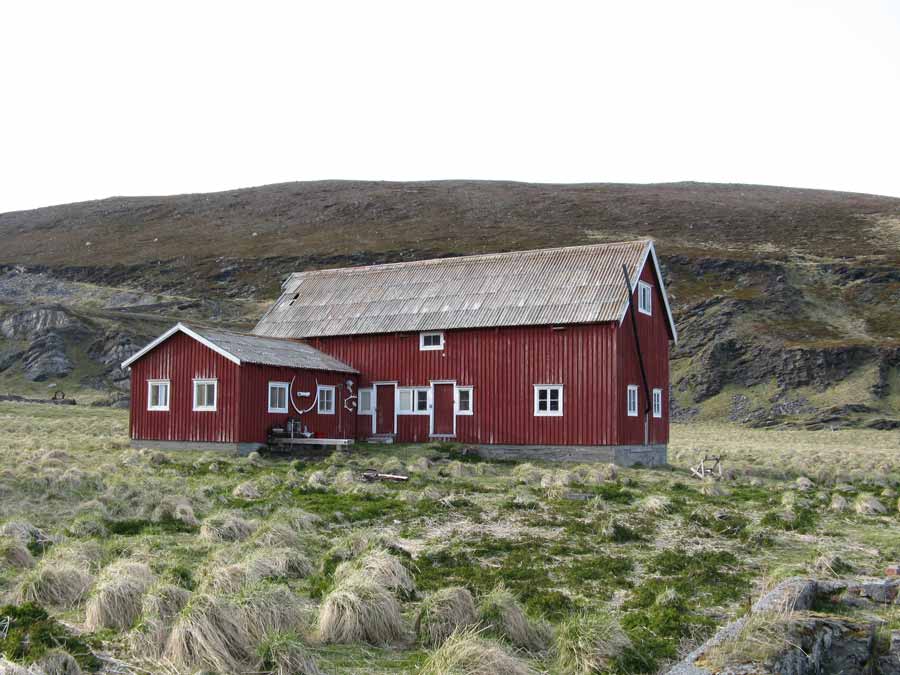 The barn was open and I went in. It still had the stalls for animals and a lot of old wooden barrels. The roof had a few holes in it and the doors to the hay loft upstairs had blown in. At one end was a room someone had been trying to turn into a cabin. There were 6 bunks, a table and chairs and a rusty stove. Its many windows let a lot of light in and it seemed a comfortable space. The view from the windows was marvellous. There were binoculars left here and I can think this place is sometimes visited by keen birdwatchers who visit the colony.
I was dithering to stay or not when it started to sleet and there were some gusts of wind. This was forecast to arrive. I decided to stay and carried the kayak and equipment up and secured it. I then took the necessary items to the barn. It was actually very comfortable. There was water from a brook nearby.
In the evening I wrote the blog from the Kinnarodden day. Looking out of the window I could see all the activity in the bay. An eagle was perched on a rock waiting for some carrion, and normal and golden plovers flew around the hummocks of grass. There were many thrushes nesting in the vicinity and even in the roof of the barn, and on the crags nearby where I spotted a nest with 6 eggs.
Reindeer and their newly born calves wandered around the barn oblivious to me inside and I could get a good view of them from my lookout. If I went outside they would all bolt. They were eating the grass shoots and leaving the young nettles alone.
Svaerholt also had an air of sadness to it. There must have been two or three families living here once and now it was all gone. The grass would soon claim back the graveyard and the buildings would soon collapse and be scattered by the winter storms erasing any trace of those happy summer day some 100 years ago.
It had been a very good day. The crossing was easy, the scenery was spectacular, there was plenty of birdlife and it was also interesting to explore the cultural relic at Svaerholt and spend the night in the old barn.