Archive for June, 2009

Day 166. Nordbukt on Stjernoya to Bergsfjord

Monday, June 15th, 2009

Distance 53km | Time 13hrs | Ascent 0m | Descent 0m
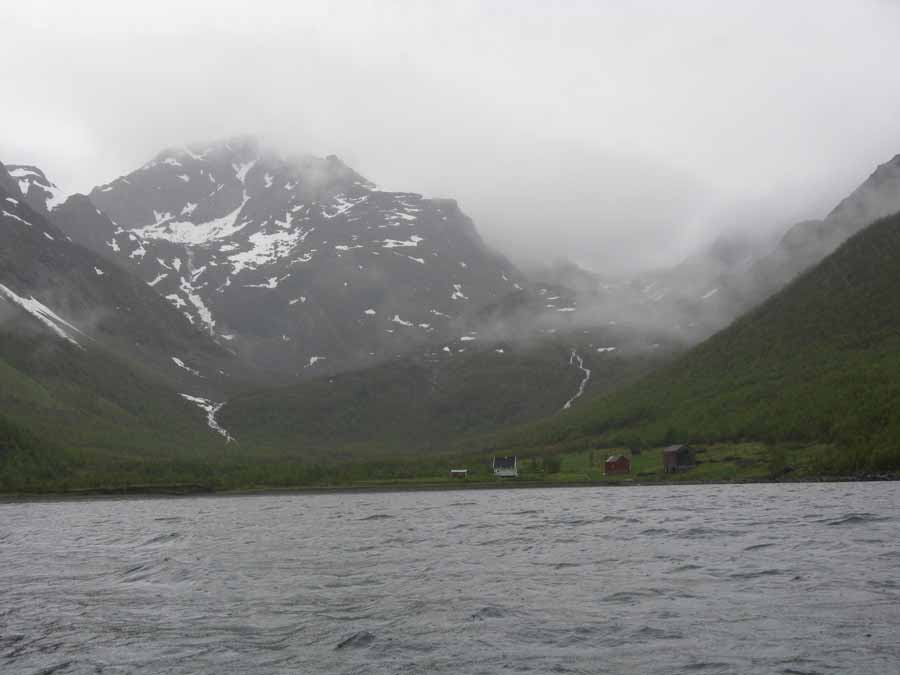
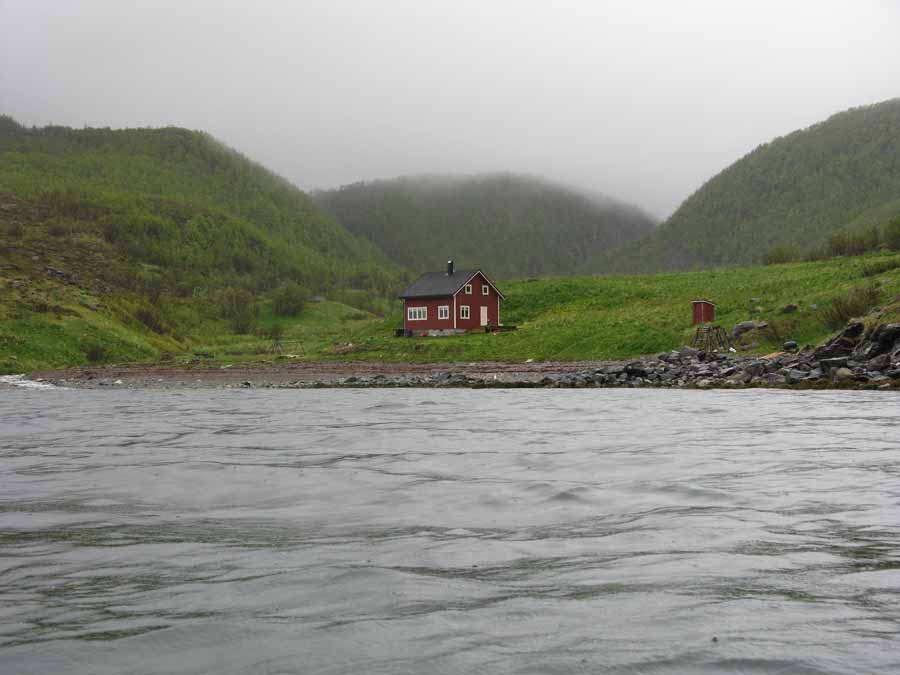
Day 166.1 The bay of Simavik on Stjernoya island contained a lonely former farmDespite the heavy rain on the tent I managed to get up at 0600 and after packing everything into drybags and leaving them in the rain I packed the dripping tent. I eventually set off at 0800 with the estuary calm except for the splash of the large raindrops. A bunch of Goosander (Mergus merganser) swan in the tidal estuary, heads often immersed looking for small fish.

The mainland on the other side of Stjernsund was just 5 km away, but it was lost in the mist and rain, as indeed were the high mountains above me. The lower slopes which I could see were very lush. Thick bunches of the succulent rockrose were now in yellow flower and a purple flower, either purple saxifrage or moss campion grew on the frequent rocky shelves. Despite the rain I could hear a lot of birdsong in the birch woods.

As I paddled along I heard some shrieking. When I looked round I saw two otters playing. They were just down wind 30 metres away, so I stopped paddling and drifted towards them. I don’t know if they were play fighting or courting but they were certainly excited emitting loud squeaks as they writhed on the surface. I got to within about 5 metres when they saw the yellow kayak and dived.

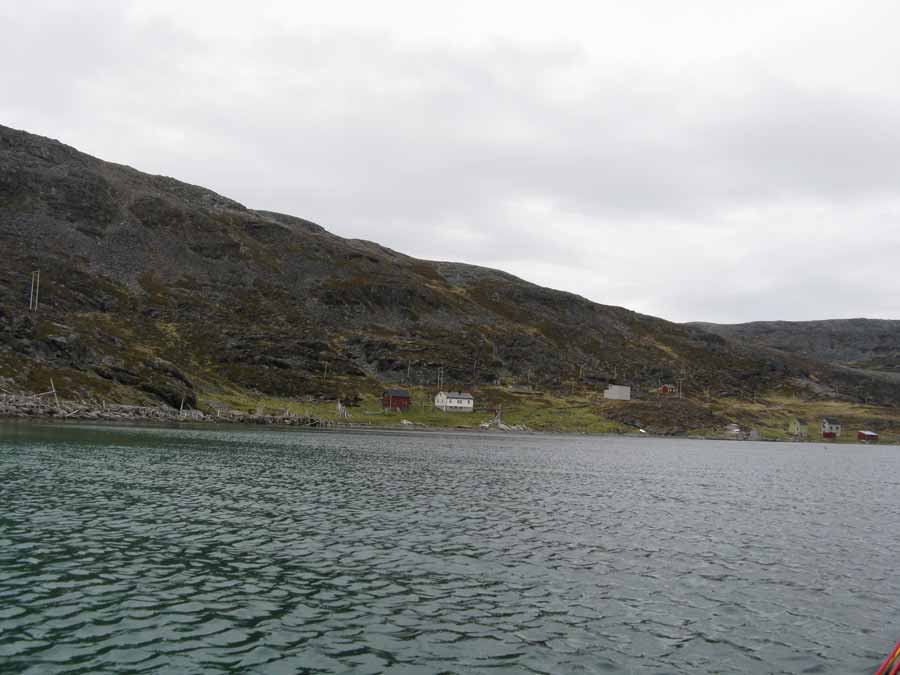
I paddled past the deep bay of Simavik with an old farm in the green pastures on the valley floor. The valley floor was cut by the raging white torrent off the swollen river. This farm was probably abandoned in the 1960s but the children or grandchildren probably maintained this ancestral connection as a leisure house now.

The next bay had a large industrial concern in it. It was an underground mine extracting nepheline syenite, a low silica feldspar type mineral, which is used in glass and ceramic manufacture. It was quite a surprise to see the large wharf with huge storage facilities to store this mineral on this otherwise empty and unspoilt island.

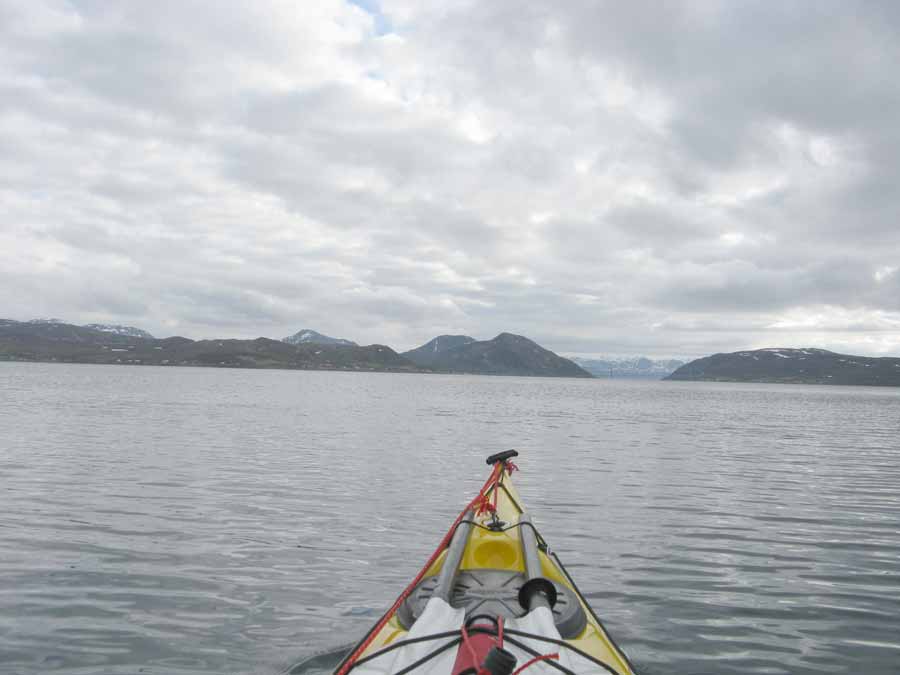
After the mine I decided to cross the sound while I could see across it and the wind was just a force three but against me. It was a slow but sure crossing. The advantage of the poor weather was that it made the other side seem much further than it was and I arrived much quicker that I expected.

I paused on the other side briefly and a redshank appeared on the rocks near me. Above were a couple of sea eagles. By the end of the day I would have seen at least 25 of these huge birds. One can only get an idea of the scale of them when you see a raven or large blackback gull harrying them.
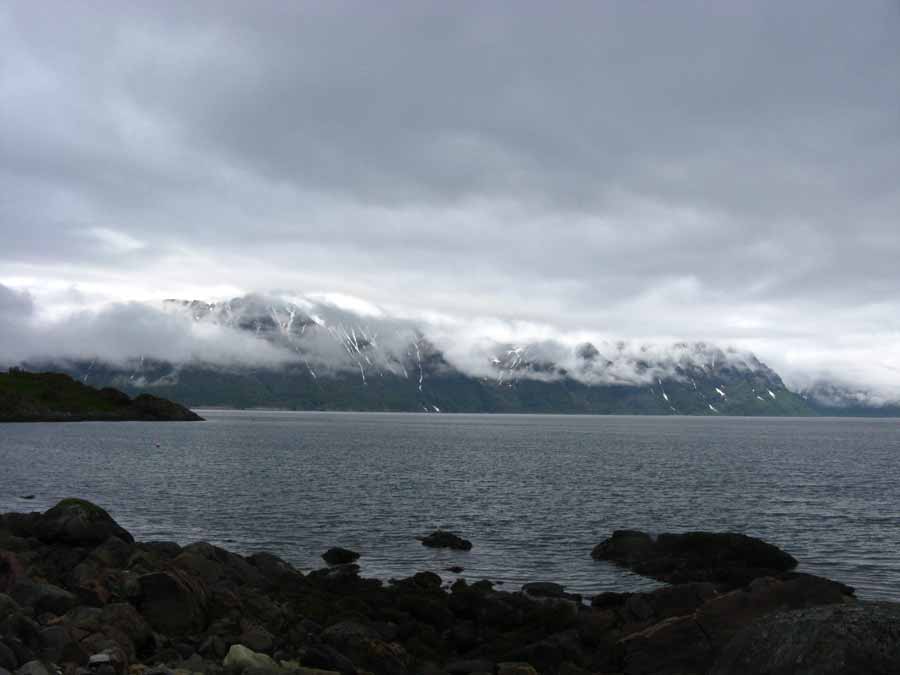
Day 166.3 Looking over to the mist clad island of Stjernoya from KlubbnesvikWith the wind and tide against me as it had been all day as I made the final journey up the coast to Oksfjord at just over 4 km an hour. It was slow going. It was a shame the weather was obscuring the mountains here because this was now classic fjord country with narrow fjords cutting deep into high mountains. My map indicated that just on the other side of the peninsula from Oksfjord was a glacier which descended from these high craggy peaks and descended all the way to the sea calving icebergs in it.
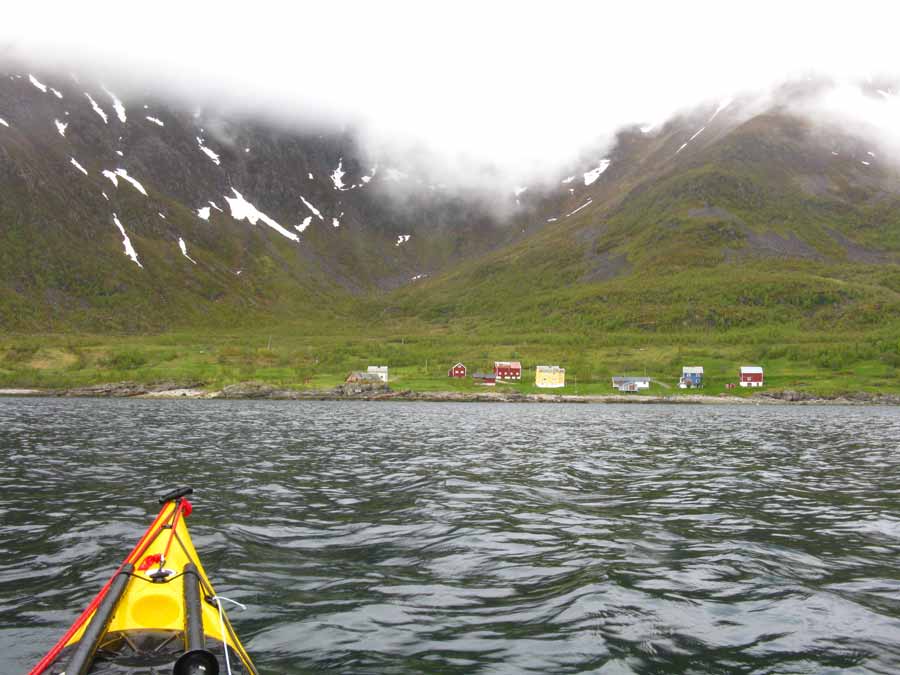
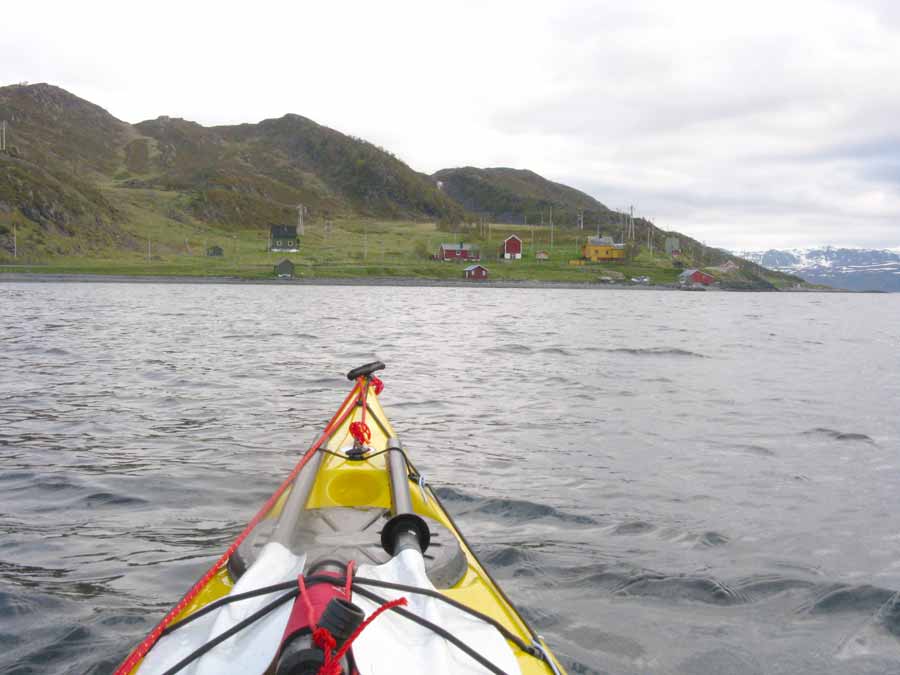
Day 166.2 Across the Oksfjord from the town of Oksford was the former homestead hamlet of Klubbnesvik which were now used as leisure cabinsI reached Oksfjord at around 1300. The town was a 3 km detour up the fjord. I knew if I went there I might get stuck, seduced by hamburgers and the thought of a hot shower, so I gave it a miss and went straight over to the simple life on the far west side where there was a tiny hamlet of 4 houses at Klubbnesvik and stopped here for lunch. There was someone on the beach.

I chatted with him. He owned one of the four houses. They were all in excellent condition and their barns and outhouses were well maintained. However these were also just summer houses and nobody lived here now and the barns had not seen animals for 50 years. The owners had moved across the fjord to Oksfjord for more modern occupations. Small holding and subsistence fishing here at Klubbnesvik had been abandoned in the 1960s in the days of their parents, who had moved from the hard life.

There was apparently some accommodation in Bergsfjord. If the weather in the exposed Lopphavet just round the corner was reasonably calm I would try and reach it. Here I could write in comfort and dry off the tent. It was about 30 km and the blatant wind and more negligible current would be against me. After a phone call to the ever helpful Bjorn of Bjornskajakks in Tromso about the rudder and some possible modifications I set off.

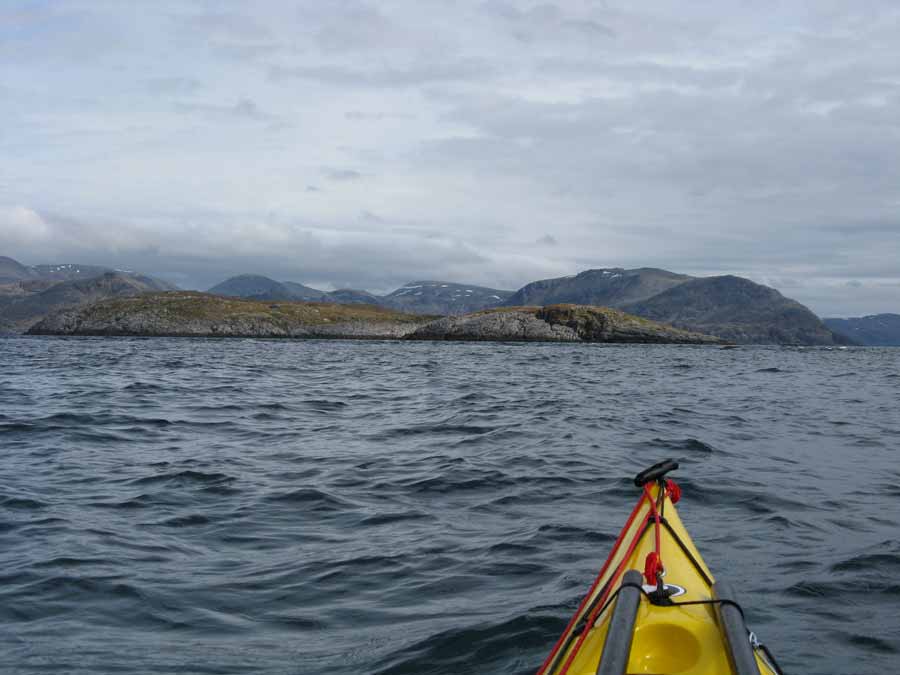
There were three main headlands to go round after Oksfjord to reach Nordre Bergsfjord. These took me out of the shelter of the sounds into the open ocean again. This ocean is called Lopphavet. The first thing I noticed was however the vegetation line in the sounds was just a metre or two above the high tide level while here the bare rock extended up a good 10 metres before vegetation to establish itself out of reach of the waves. It was not on the scale of Osthavet and Nordishavet where it was a good 30 metres but enough to show the weather here could be rough.

As I ventured into Lopphavet I hardly noticed a change. The swell was absent and the wind was still a force three and still against me. I went round the first peninsula and then crossed Nuvsfjorden to Sommarnes, a lonely and abandoned farm which was now derelict. In the bay in front of the farm was a salmon net trap. I could see a large dead salmon in the net just below the surface.

The salmon traps are constructed from a large mesh visible net the salmon can easily swim through. These are placed perpendicular to the shore for 200-300 metres where salmon pass en route to an estuary. The salmon can see this netting and will not swim through it but are diverted offshore into a V shaped monofilament net they cannot see and this is small mesh and ensnares them. I saw about 5 such set ups today along this coast.

The next and last fjord to cross was Ullsfjord. There was a hamlet here called Rokkenes on an extensive green and fertile plain from the shore to the foot of the mountains. It had no road to it and would be summer cabins only as the hamlet was certainly abandoned as a permanent settlement some 50 years ago also.

As I rounded the last peninsula, and the steep mountain of Stauren I saw many more sea eagles. At one stage there were 4 in the air around me. I could see one return to its eerie in the crags on the mountain. These birds were massive, bigger than a Golden Eagle, but without the same pride and nobility.
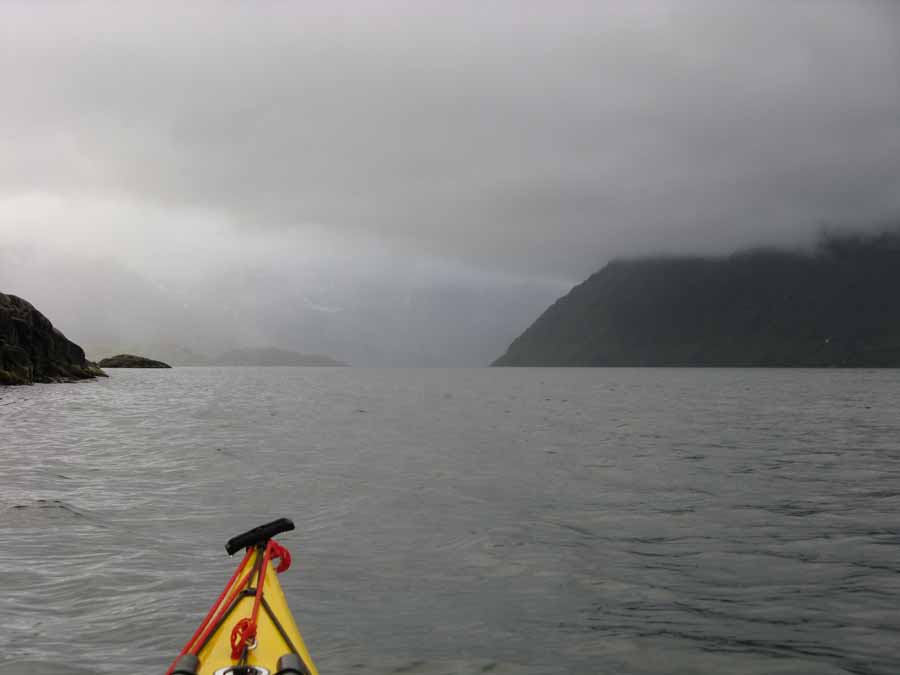
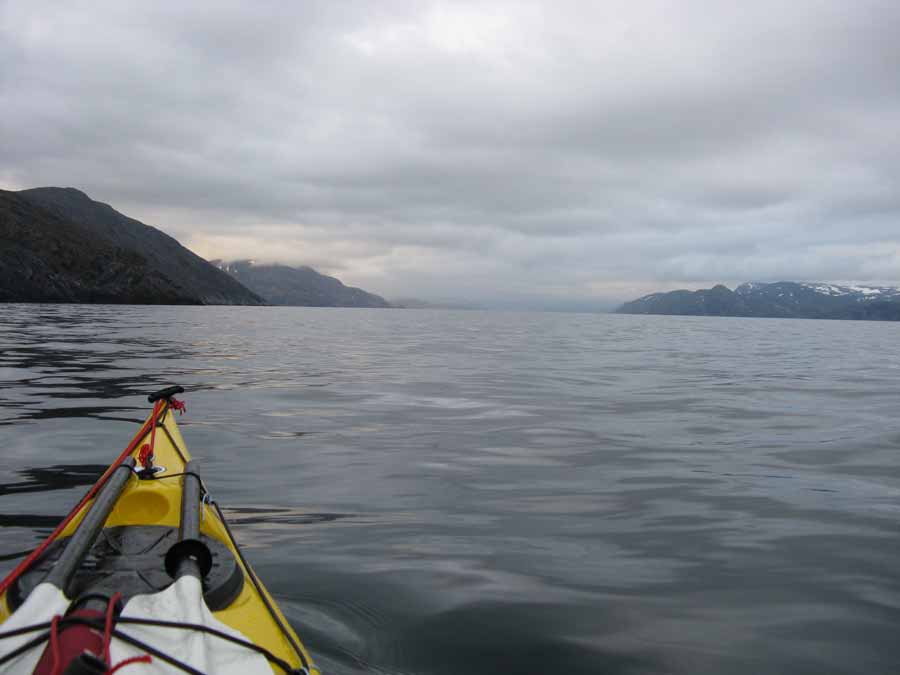
Day 166.4 Paddling down the east side of Nordre Bergsfjord in the evening with the island of Silda on the rightI had hoped the wind would be behind me for the final 12 km down Nordre Bergsfjord to the village of Bergsfjord, but it was against me. There was also the odd rain shower so the 1000 metre mountains were obscured. Across the fjord was the dark, lonely and mysterious island of Silda, which I am sure, had no permanent settlement.

I eventually rounded a point and entered the bay where Bergsfjord lay. I asked a fisherman about accommodation and he pointed me to a nearby house. The house owner appeared. He had just returned from a trout fishing trip to Scotland and knew the family whom I stayed with at Hakkstabben a couple of days ago well. He had a lovely apartment and owned the shop also. He was an interesting character. After showing me the apartment he opened the shop for me.

With the kayak on a beach nearby I unpacked the minimum, ate the just purchased supper from the shop and then had a warming and salt rinsing shower before crashing out in soft cotton. The forecast tomorrow was a force five from the west and therefore against me, so I decided to have a free day. I looked forward to explore this charming village in a bay of sandy islands surrounded by dark mountains.

It had been a really good day despite the weather. Indeed the weather made the views very atmospheric. Despite the head wind I had covered a respectable distance also.
Day 165. Hakkstabben to Nordbukt on Stjernoya

Sunday, June 14th, 2009

Distance 13km | Time 2.5hrs | Ascent 0m | Descent 0m

Day 165.2 A break in the drizzle allowed me so see some of the spectacular landscape of StjernoyaI did not get to bed until late and when I woke I was still tired. I got up at 0900. The elder sister was up and had prepared a wonderful breakfast. We chatted and I watched the grey weather outside bring in the odd shower. It was really a wet misty day; however there was just little wind.

The breakfast chat was easy and the weather outside such that it was easy to have yet another coffee. She then had to go a do an emergency driving errand to for a doctor who arrived at the jetty on a boat to treat a fracture at the other end of the 8 km road. I meanwhile found some books on the coast of Norway and immersed myself in those while the drizzle continued.

Later I went down to the kayak to try and readjust the rudder again. The rudder pedals are just so stiff it is a real effort to use the rudder. I loosened the wire and taped some foam mat onto the rudder pedals to bring them forward a bit to see if this helped. The rudder is a never ending problem and the pedals just do not work smoothly. I was starting to curse the day the Smarttrack brochure landed on Tideraces’ doorstep. Once I get to Tromso or Bodo I will try and cut this cancer from the boat and install a different system.

Once the sisters were back I started to pack up and eventually left at 1500. There was a slow drizzle as I pushed off and headed across the 5 km Rognsund to a small island on the west side in front of a farm on the main Stjernoya island. Stjernoya was also a green and lush place. The small island in front of the farm had a lot of nesting gulls on it, who were reluctant to leave their nests as I paddled past.

I saw a couple of porpoise again. All the porpoises I have seen have been in very small groups. I am accustomed to seeing them in groups of 50 or so animals. Going along the west shore of Stjernoya I also saw some long-tailed ducks.

Day 165.1 This house in Halvorik bay on Stjernoya is now a leisure cabinThere was a small current flowing south down the island and this helped carry me along to the southern tip where it flow into the other current coming east producing some turbulence. I stayed out of it by hugging the coast. Just after the tip was Halvorvik bay with an old house, now a cabin in it. It lay in a lush meadow. Like Seiland, Sternoya does not have any mammal predators. This lack of fox means there is a rich population of hares. I could make a couple out in the grass as the white remnants of their winter coast showed up when they moved. Apparently there are plenty of eagles on the islands due to the number of hares.

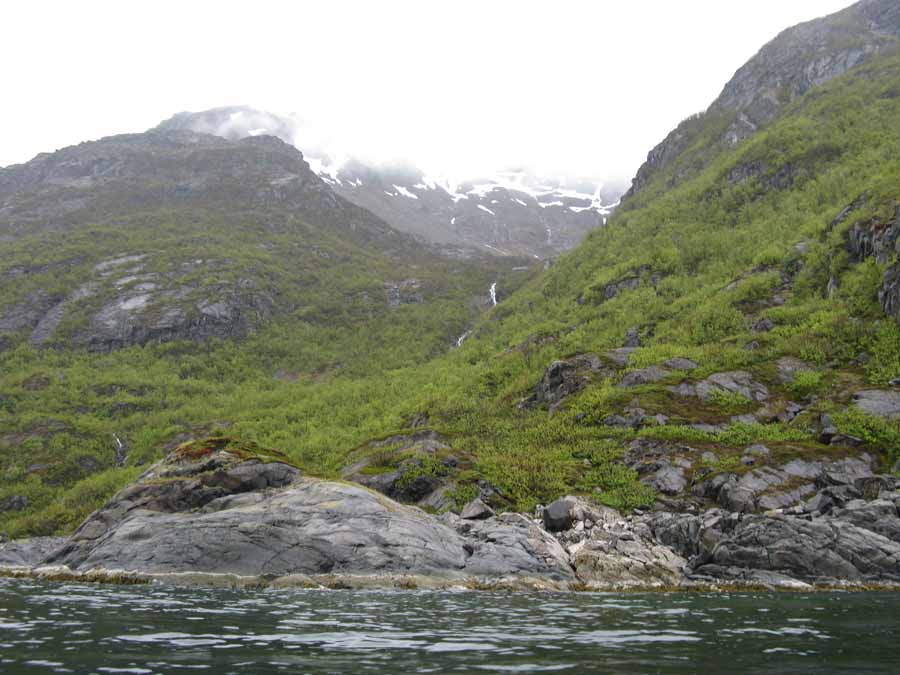
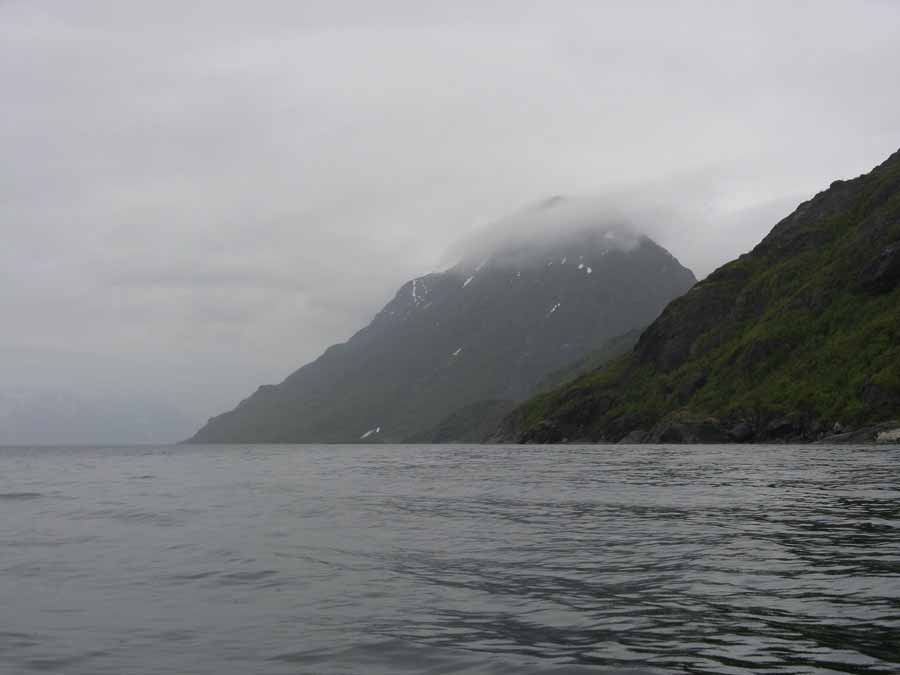
Day 165.3 The steep hills went up to lofty peaks lost in the mist. Some of the peaks are nearly 1000 metresWith the drizzle now turning to heavy rain I paddled up the south coast of Stjernoya for an hour passing a steep coastline which continued up birch and juniper clad hillsides to the bare rock and snowfields of craggy peaks above. Most of these peaks were hidden in the mist as they went up to nearly 1000 metres.

After an hour I passed a bay with a large shallow estuary and inlet and flat pastures beyond the shore. I decided to go in here and return the rudder back to its previous unsatisfactory settings as my tinkering had not worked. The rain was bucketing down so much so the sea was becoming quite still.

Despite the fact it was just 1730 and I had only done 13 km I decided to stay here rather than carry on. I would get and early night and hopefully catch the ebbing tide tomorrow morning from about 0700 onwards.

I put up the tent did the blog at once and then concentrated on supper of mashed potato with some lentil and meat mixed in. it was very simple and easy. I had everything done by 2200 and crashed out with the sound of rain still dripping onto the tent. As I did the tent zip up an otter wandered past.

It had been a short wet day with the frustrations of the Smarttrack rudder gnawing at my calm.

Day 164. Beritsjord to Hakkstabben

Saturday, June 13th, 2009

Distance 41km | Time 8hrs | Ascent 0m | Descent 0m

Day 164.1 Leaving Beritsjord with the snowy peaks of Seiland island aheadIt was a stunning morning at 0730 when I woke, with clear skies and a good breeze of force three in my favour. I guessed the tide was also in my favour but looking out onto the sound there seemed to be very little movement.

As I breakfasted in the tent a herd of reindeer came by and one almost put his nose in the tent. The sun was blasting down into the tent and took away any urgency. I eventually had everything packed and cast off at 1000.

It was a glorious morning. The wind pushed me along at a good speed and there must have been some current in my favour also as I was doing 7 km per hour down the sound even more once I passed the entrance to Straumen sound on the north side.

Day 164.2 Heading down Vargsund with the lush island of Seiland on the rightAhead of me was the island of Seiland, Norway’s seventh biggest island. The mountains of Seiland went up to 1000 metres and there were two large glaciers on the island. I could just make out one on the glaciers as I left Beritsjord.

The island of Seiland also seemed remarkably green. I found out later it had a very broad range of minerals in its rocks and these provided good nutrition to the birch forests. Indeed the island up to 300 metres was covered in the vibrant, invigorating green of fresh spring leaves. There was the odd scattered homested along the coast, which were probably now abandoned.

It was a wonderful fast and sunny paddle down the sound on the south side of Seiland island, called Vargsund. I kept to the mainland side of the sound and cruised past a number of small hamlets with green lush fields and bright green birch forests. The wealth of minerals must have extended over the sound to this side also. It was so refreshing after the harsh moonscape of the Nordkinn and Varanger peninsulas.

Day 164.3 The serene hamlet of Saraby basking in sunny meadowsAfter 3 hours paddling I had almost done 20km. I reached a pebble bay with 10 odd houses round it. It was called Saraby. They were all sitting in green pastures with the sun shining on them. Along the shore were fishermen’s sheds. I pulled up beside one where a father and son were launching a boat.

The father had recently been fishing in the fjord and had filled up his cod drying rack with about 100 fish to see him through the year. He explained it was now too late for proper dry fish as the fish would not dehydrate and harden in time to stop the flies laying eggs in it. So he had treated them in some solution and was hanging them for a few weeks to become Boknafisk. I tried Boknafisk in Mehamn and was not taken by it.

I chatted as they waited for the tide to lift the boat from the cradle. It was a very relaxed rural scene in the warm weather. It was really one of the few time this year I have experienced such hot weather. I have gone almost straight from the Nordkinn spring, which would be winter anywhere else, to summer in a week.

Day 164.4 Heading down Vargsund with Seiland island on the rightAfter enjoying this tranquil setting I continued down the south side of Vargsund. The birch trees here were getting thicker and thicker and lusher. It was now similar vegetation to only 800 metres in Jotunheimen or Southern Norway.

Day 164.5 The lush birch forest by Store Bekkarfjord on Seiland islandAcross the Vargsund was Seiland island. I needed to cross over to it so aimed for a deep inlet on the craggy shore called Store Bekkarfjord. Most of the interior of the island of Seiland was a National Park. The park also took in some coastal areas and Store Bekkarfjord was one. It was lush and green with wild craggy slopes behind it going up to steep snowfields.

Day 164.6 Store Bekkarfjord on Seiland islandThe wind was starting to increase from behind me now up to a force three. The tide was probably turning but in places the waves were steeper and unpredictable. I rode them past rocky headland after headland passing the deep Seibukta bay and then reaching Hakkstabben. It looked like it had about 5 houses. It was after 1800 and I planned to spend the night here.

Day 164.7 The hamlet of Hakkstabben with the quaint shop in the old fish wharfI beached on the pebble beach and then went up to explore the jetty area. There was a large building on the jetty, which was the post office and an old fashioned and quaint shop. Beside it was a grassy patch were I decided to camp. While I was eating some biscuits before setting the tent up two girls came over. They were running the shop and lived in the nice house with its lovely barn nearby.

They opened the shop for me and then said they had a spare room as their parents were on holiday. Would I like to stay? Just to have some space to move after a few nights in a tent and a table to sit at would have been great, but easy conversation and a great homemade pizza in addition were fantastic. I even had some time to myself later on to write the blog.

This hospitality I am finding along the Finnmark coast is remarkable. I did not find it in the interior of Finnmark when I skied up. I can only compare it to some places on the West coasts or Scotland or Ireland where small communities are both hungry for outside interaction and also are genuinely warm friendly and curious.

It had been a very good day. I had done an easy 41 km, got sunburnt and soaked up the lush green vegetation which made me really enjoy the surroundings rather than being in awe of them. The hospitality at Hakkstabben was also quite special.

Day 163. Klubbukt in Repparfjord to Beritsjord

Friday, June 12th, 2009

Distance 10km | Time 2hrs | Ascent 0m | Descent 0m

day-Day 163.1 The quiet fishing village of Klubbukta1-the-quiet-fishing-village-of-klubbuktaI did not wake until 1200. When I did my shoulders were sore. Indeed on the odd occasion through the night I had woken up with a bit of pain if I was laying the wrong way. I had estimated the high tide was at 1800 today and would start ebbing thereafter with a wonderful flow through the Kvalsund sound. Hopefully I would be carried along at a fair rate.

This gave me a few hours to do the blog from yesterday and wander around the village a bit. I got the blog out of the way first but could not publish it due to insufficient reception. It took a couple of hours.

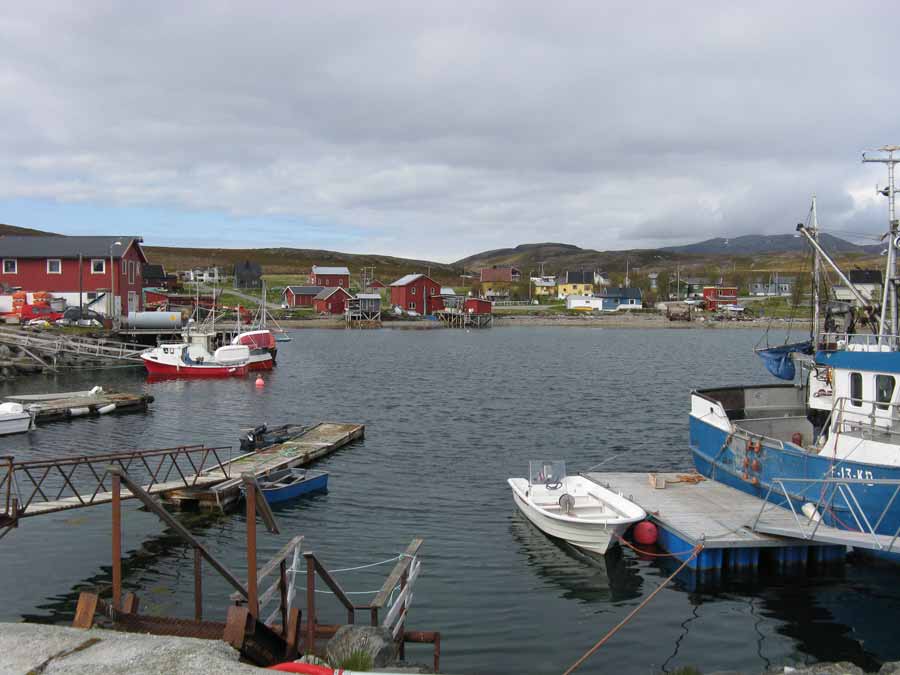
I then wandered through the village. It had about 10 permanent houses and they were remarkably well kept for Finnmark. On the shore side of the crescent shaped road round the bay were a lot of fishing sheds, some with jetties and a few with drying cod. The cod drying here would just be for local use and the locals would fish to supplement other occupations. Under some nets there were maybe 1000 cod drying.

The sheds had all manner of fishing equipment and parts of old diesel engines lying around. Many had a trolley or sledge to drag the boats up the shingle shore with a wire winch operated by an old engine.

I spoke to one man about the tides through the sound. He rattled off instructions so complicated my eyes glazed over and like many men the instructions went in one ear and out the other. He did say that the currents and tides here tended to wash things into this fjord. Judging by the number of whale ribs and backbones around the village I assume old and sick whales ended up on the beaches here quite often.

I packed up the tent, tinkered with some equipment and the rudder and eventually set off at 1800 just as the tide started to recede. There were a lot of red billed terns in the bay to see me off. It also seemed some of the locals had made nesting trays for kittiwakes on their cod drying racks.

Day 163.2 Setting off from Klubbukta to cross Repparfjord to Kvalsund in the middle distanceThe wind was behind me and I made good speed into the fjord. I was hoping to meet the current soon which would carry me through the sound. I met the current soon enough but it was going the wrong way. It was flowing towards me and piling into the small waves I was riding. I could not believe it. My speed halved and I had to paddle hard to reach the town of Kvalsund on the other side of the Repparfjord. My speed was now just 3 km per hour.

Maybe I was in a large eddy or maybe the basin the other side of Kvalsund drained north instead of south. This basin did contain the large Altafjord and maybe this was partly empting through the sound and against me. It did not match what the old man had told me or my intuition. I felt cheated as I had expected an easy ride after yesterday’s effort.

Day 163.3 The lush and pleasant dairy landscape around Kvalsund was refreshingEventually I reached the other side and the town of Kvalsund. This was a green and lush place with fields basking in the sun and tidy red barns along the road. This was more the cultural Norway I was familiar with.

Kvalsund is the centre of a dispute concerning the Finnmarks Law. The reindeer herders claim a quarry here cannot be developed creating many hundreds of jobs because their reindeer would lose pastures. However the reindeer owners are willing to accept compensation for their loss. Most people perceive this loss to be irrelevant compared to the compensation demanded and attribute it to greed. However the reindeer owners have the law on their side and are using it. It is one of many instances I have heard about where the Finnmarks Law has been used to demand compensation by the Lapp reindeer owners and this has earned them scorn.

After passing Kvalsund I went under the bridge. The current here was definitely flowing north but not very strongly. However it certainly was not going to assist me. There are so many factors when trying to calculate the tidal flow here it is almost an art rather than science. I think my plan in the future is not to plan for it but just go. If the tide is against me it will eventually turn and if it is with me then I am lucky.

I was feeling quite tired and without the anticipated current to help me decided to have a short day and get an early night and try and curb my nocturnal habit. I would start early tomorrow and try and develop a routine instead of starting so late and finishing even later. It does matter because it is a lot colder at night and if I do pass a town then the shop or accommodation are all closed as everyone else is asleep.

Day 163.4 The tiny hamlet of Beritsjord had a good campsiteShortly after the bridge I spotted a pebble beach with a grassy strip and some fields above that. It was the tiny hamlet of Beritsjord. I decided this would do despite a very short day so far. Indeed it was hardly worth packing the tent. I landed here and by 2100 had the tent up.

I wrote up the blog and had supper and was ready to go to bed at 2300. A cookoo was singing in the birch trees nearby. It was nice to be back in countryside with trees again.

It had been a short day. Perhaps it was necessary to relax and try and reestablish a routine again after a lot of late nights where I did not have any evening to enjoy.

Day 162. Havoysund to Klubbukt in Repparfjord

Thursday, June 11th, 2009

Distance 63km | Time 13hrs | Ascent 0m | Descent 0m

Day 162.1 Looking across the flodding tidal stream from Store Latoya to Lille LatoyaAs seems to becoming habit now, I did not get to bed until well after 0200 so I could not get up as early as I wanted. I eventually surfaced at 0900 and then after the final seagull egg for breakfast started to pack and carry things down to the kayak. I eventually set off at 1200.

I had missed the tide which was now just turning against me. However I had the wind with me. It was a force three. I would always choose a following wind over a following tide as the wind can be more taxing to paddle against. It was a beautiful day again.

I cruised down the west side of Havoysund with the tide almost stationary and the wind at my back until the open seascape to the south opened up. Far out to sea on my northeast were the islands of Ingoya and Rolvoya. Both were situated in a very rich fishing area and had viable communities on them still. Indeed Ingoya was having a cultural boost at the moment with good tourism and a well known pottery workshop on the island.

Heading south I could see the smaller islands of Store and Lille Latoya some 5 km across the sea. I aimed to pass between them. They were low and grassy and could be a haven for birds. However, when I arrived an hour later I saw very few here. There was a flooding current between the tides which made the small waves I was riding topple over. I kept to the lee of Store Latoya to avoid this stream.

From Latoya the wind was still in my favour for the 7-8 km crossing over to Bustadneset. I was making good time averaging nearly 7 km per hour. It was due to the following force three. Astor on Maasoy told me there was a nice harbour just south of here and I planned to stop for something to eat. Just offshore was the green low lying island of Reinoy which looked like it was grazed.

Day 162.2 The once thirving harbour of Bustad now has only two houses in disrepair and many derelictI paddled into the inlet at Bustad and went through some narrows. The other side of which was a large quiet small fjord completely protected from the sea. There were a number of houses here and the stumps of a ruined jetty. I pulled ashore in front of the houses and ate. Afterwards I explored the area.

Both houses were open and I had a look inside. They were cabins now, which a few groups used judging by the entries in the guestbook. A stoat had ripped a lot of the food packaging open. In one house was a photo from about the 1960’s. It showed both these houses in pristine condition with gardens and a large well kept white wharf and processing plant with some larger boats beside it. It seemed hard to imagine. Initially, I thought Bustad was just for reindeer herding although it was a very good harbour also. It seemed surprising a place could be abandoned and fall into disrepair so quickly.

One of the houses even had a piano in it with an old carpet on top of it to keep off the occasional drip. When I visited the ruined wharf I saw the stumps were all charred and the place must have been destroyed by fire some 20-30 odd years ago. I thought about staying in the red house but I had only done 20 km and the weather was in my favour although it was raining a bit now. I decided to cross the open sea of Revsbotn while I could.

The 10 km down the coast of Bustad peninsula were quite wild but also rather dull with craggy slopes rather than spectacular cliffs which I was starting to take for granted. There were quite a few sea eagles along this stretch. Sea eagles are very wary birds and fly off while I am still half a km away. I seldom see them perched with their vulture like silhouette.

It was pretty much a slow drizzle with no wind across the 10 km of Revsbotn. There were the odd tidal currents but I could not work out a pattern to them as I headed for the road less hamlet of Bekkarbukt with its 10 odd houses. I could see lights in the gloom but don’t know if anybody was living here. I passed offshore from it and paddled into the fjord like slot of Sammelsundet.

Day 162.3 Looking south down Sammelsundet late in the eveningI calculated I should be helped down this sound with the ebbing tide and the slight following wind. I was disappointed though and only did 4 km an hour. I could not understand why. I was aiming for the hamlet of Brennsvik to camp at as the other bays looked exposed should the winds veer north and increase.

Day 162.4 Looking north at the midnight sky from the entrance to SammelsundetAs I paddled down the sound I noticed a few scrubby birch trees. Soon these became larger and were covering the steep slopes. By the time I approached Brennsvik there were proper copses of 5 metre trees and many of them seem to be turning green. This was a much softer landscape than the incredibly rugged and weather harsh Nordkinn coasts a week ago.

Brennsvik was a bit of a disappointment. There were a couple of very small farms and fishermen’s sheds. The farms were surrounded by very small fields for grazing sheep or a couple of cows which would be fed on fodder brought in for the rest of the year. The beaches were boulder strewn and exposed and if the waves got up I would be stuck. I decided to continue but it was already after midnight.

At the end of this coast was a prominentary called Klubben behind it seem a very sheltered inlet. It was only 4 km away. I paddled along the remote coast with a couple of grey derelict houses from the 1960’s and past more boulder strewn shore to Klubben. I saw a fox foraging along the shore, perhaps looking for eggs, or even chick now, or fish carrion.

After rounding Klubben I paddled into Klubbukta. It had about 5 permanent houses and 20 fishing sheds and cabins. There was a breakwater here with about 5 fishing boats behind it. There was enough grass for me to camp and a pebble beach to land at. It was 0100 and completely windstill.

I put up the tent beside a tent. Despite the time and distance I was not that exhausted. Once I was in the tent and in my bag I opted to sleep at once rather than go through the palaver of cooking supper.

It had been a good long day; my longest day in distance but not in time or effort. I had won the kilometers quite easily with the wind behind me. It was nice to see vegetation again after the desolation of Osthavet and Nordkinn. I was now also in the relative shelter of the sounds compared to the open ocean. My life however was starting to become somewhat nocturnal though.