Archive for August, 2009

Day 224. Oklandsnes in Sveio to Haugesund

Wednesday, August 12th, 2009

Distance 30 km | Time 7.5hrs | Ascent 0m | Descent 0m
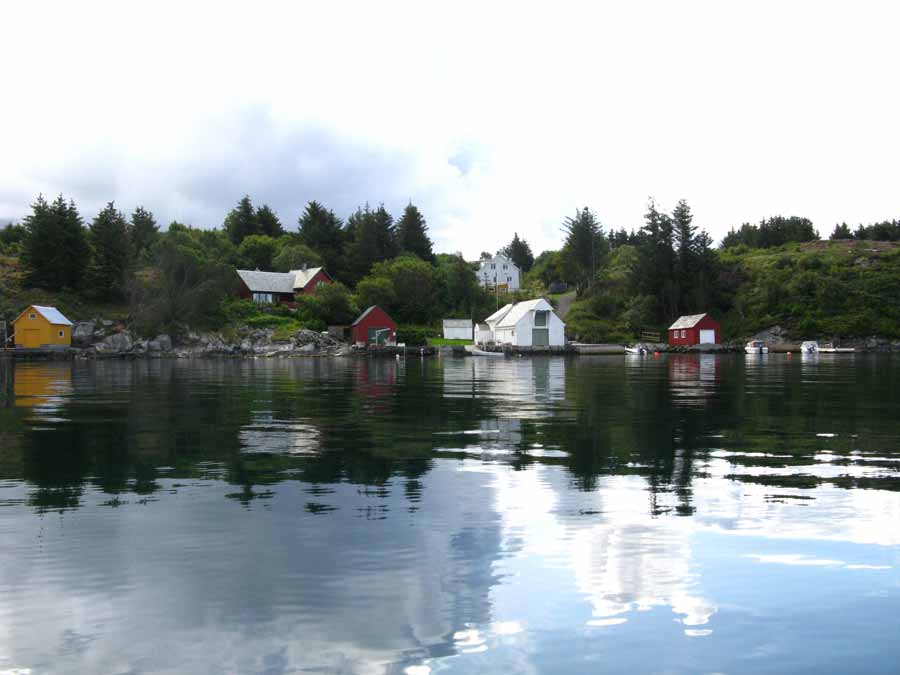
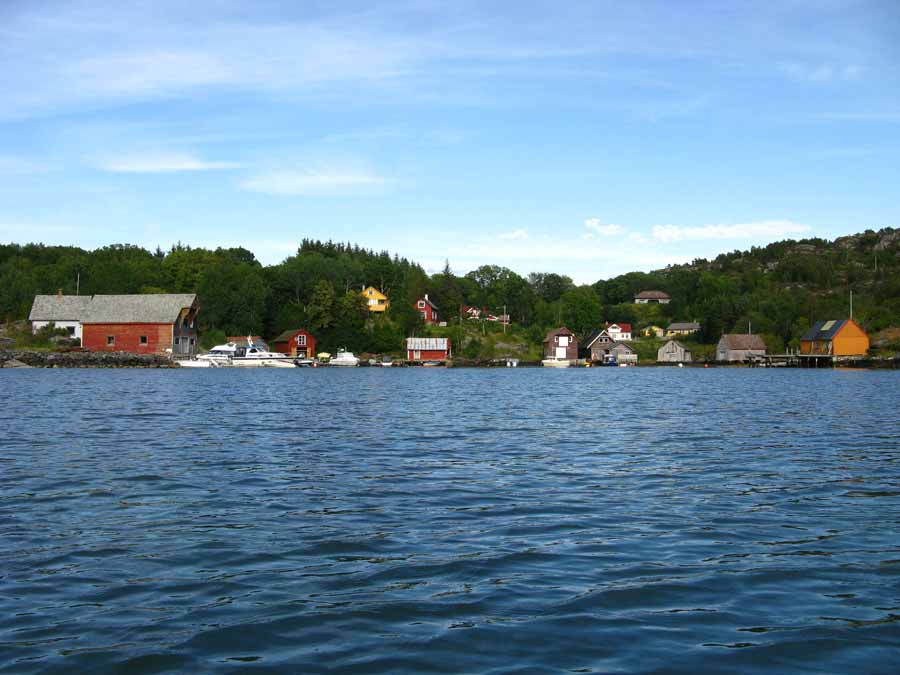
Day 224.1 The quiet tranquil sheltered bay at Lyngholmen just too the north of the exposed SlettaThe forecast said it would be calm in the morning and then the wind would gradually pick up in the morning to a force 5 and this would increase up a force seven in the late afternoon and continue much of tomorrow. Therefore when I reluctantly woke at 0630 I really had to get up and get going at once. The next stretch contained Sletta a 15-18 section of relatively exposed coastline. I had to pass it before reaching Haugesund.

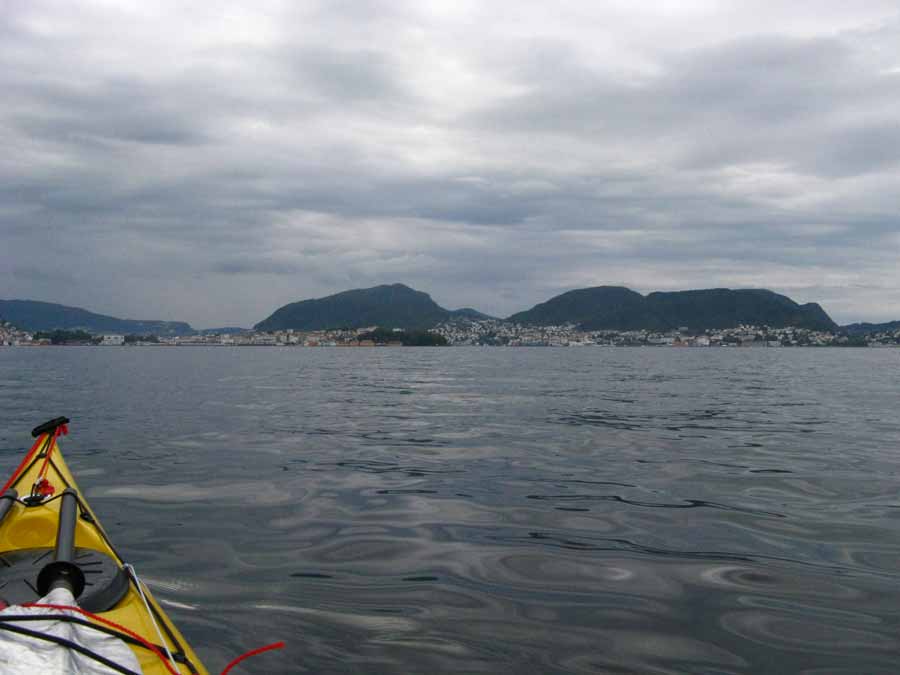
I took down the tent with one hand while the other smeared midges over my face, packed the kayak and was away by 0800 eating the breakfast biscuits as I paddled. It was completely wind still. The weather though was mixed. There was the odd shower but just across the 6 km Bomlofjord the island of Bomlo was almost invisible under a continual heavy downpour.

I made good time initially past the radio masts at Tjernagel and on to the islands in the bay by the hamlet of Buavag. I did not stop as the wind was increasing as forecast predicted and this made me paddle with extra vigour. I soon reached the very sleepy hamlet of Lyngholmen. This hamlet was well protected by a series of wooded islands and its old boatsheds were well maintained.

After I left the small islands protecting Lyngholmen I was into Sletta. In a good westerly wind the Atlantic swell comes right in and breaks on these shores. There were just a few small islands and skerries to take some of the force out of it before it reached the coastline. This was no Osthavet, Nordkinn or Stad though and there were plenty of escape routes if one should be caught out. Still it was probably not the coastline to attempt in a force five upwards. It was a force three when I started out.

Day 224.2 Ryvarden Fyr lighthouse lies in the middle of the exposed SlettaIn no time I reached the Ryvarden Fyr lighthouse. The keeper’s house was the usual white building with the rounded slates on the roof and the lighthouse itself seemed to be a wooden clad tower. It was an important lighthouse as it marked the entrance to Hardangerfjord and the inner shipping lane to Bergen.

I made a few phone calls from here as the support team of Hartmut and Oyvind were keen to know when I would finish so they could organize both their holidays and my homecoming. I will reach Oslo on Saturday September 5 at 1600 hrs. That gives me about 24 days to do the remaining 700 km which should be about right. I also arranged to forward the spraydeck, now arrived in Bergen, to Sandsnes where Platou also have a shop. Platou Sports had very kindly agreed to be an address to receive this from England and were going out of their way to be helpful, especially Stian.
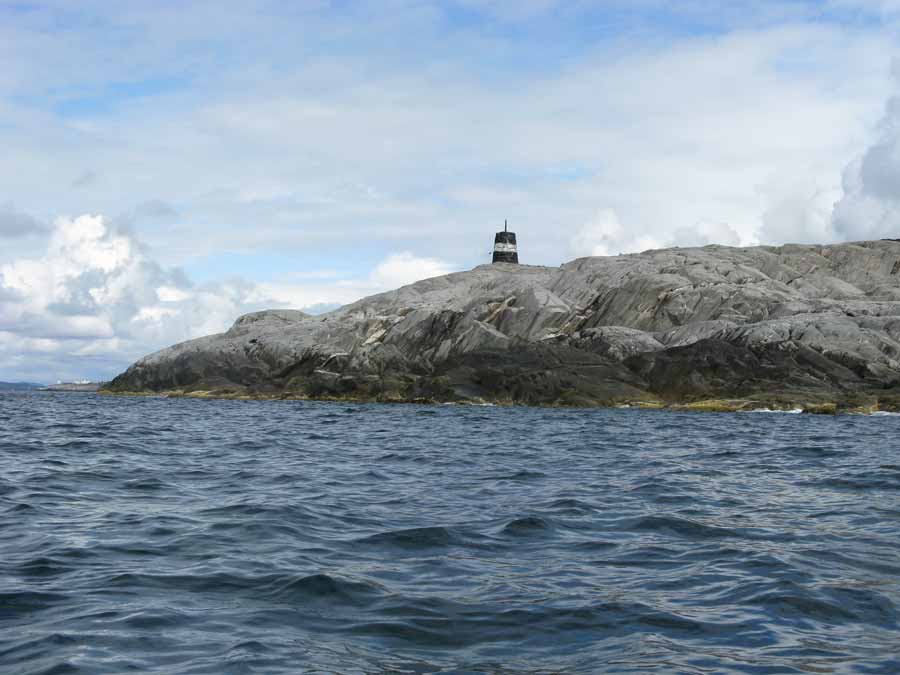
Day 224.3 Most of the headlands along the Sletta coast have old cairns to orientate previous sailorsAs I carried on south down the coast I could see that this place did get some impressive weather. The rocky coastline was bare for many tens of metres where the swells had lashed it and prevented any vegetation growing and there were cairns on all the headlands. It was still a force three for me however so it was easy.

Eventually as I approached the northern end of Haugesund sound the small swell disappeared completely. I paddled into a bay at the very north of the town. There was a tall monument here to Harald Harfagre the first king of Norway who united the kingdom and created 12 sub kingdoms under him about 1000 years ago. He was from this region. There was a hidden gravel beach here near two boatsheds and I landed the kayak there.

I went through a field up to the camp site. They had no huts available and wanted 300 kroner to pitch a tent as it was the annual Haugesund Jazz festival. I decided to camp at the gravel beach by the kayak and boatsheds and in the field with sheep. But the very nice young team at the campsite let me use the showers and a small room to write at and charge batteries for a nominal fee.

I went for a small wander to the shop to get dinner and then returned to the campsite to write. Unfortunately the room was the TV room also and the Norway versus Scotland football match was on. There was only one Norwegian in the room but he cheered and clapped so much I had to tell him to shut up. He must have thought I was just pissed off because Scotland got hammered, but the needless noise distracted me. I eventually finished at 2300 and returned in the dark to the tent down by the shore.

It was a good day but not a classic at all. Sletta was not that interesting but Ryvarden Fyr lighthouse was dramatic. It was quite a short day which I probably needed.

Day 223. Storebo in Ausetvoll to Oklandsnes in Sveio

Tuesday, August 11th, 2009

Distance 58km | Time 11.5hrs | Ascent 0m | Descent 0m

Day 223.1 A gaff rigged sailing boat in SelbjornfjordLate last night I got a text message from a journalist in the local paper and we arranged an interview at 0730. When the time came I was still asleep and she had to phone me from outside the tent. We went up to her nearby office where a couple of coffees helped. We chatted for a good hour while she took notes and looked at my webpage.

After that we returned to the tent in the drizzle and she took some photos while I started packing. It took a while in this weather but eventually I was ready to go at 1030. The drizzle was intermittent but there was a good wind. It seemed to be a northerly which was what I wanted.

I set off round the north of Rostoy and then turned south. The wind was indeed behind me and it was a good force 5. The tide was against me but the wind completely overrode this and I was doing a good 7 km per hour down the west side of the peninsula towards Selbjorn Bridge.

By the time I got to the bridge there was quite a swell behind me and I managed to surf a few waves. It was quite wet though and water was pouring into the cockpit through the inferior ‘seals’ spraydeck. At the bridge itself this swell met the flowing tide and caused the swell to rise steeply and break. I kept to the side to avoid it.

Just after the bridge on the west side was the village of Bekkjarvik. It was a small delightful harbour with a mix of old warehouses and traditional boats and exclusive sailing boats and a nice looking but expensive hotel. It looked a mix of traditional local and yachting fraternity. I ate lunch in the kayak here before going back into the northerly wind.

The wind had eased a bit which was good as I set my sights on Fornno island across the 5-6 km wide Selbjornsfjord. It was an easy crossing and it was only towards the last km that the waves started to break over the back of the kayak slewing it from side to side.

Day 223.2 The rocky slabs on the islands to the north of StokksundI thought it best to head further west now passing Teloy and Ivarsoy until I got to the top of Alforo island. This was a perfect route as I threaded through outcrops of grey rock islets with calm channels in between. I slowed down again as I explored the region. There were some old homesteads here with very little green land to cultivate. Long ago fishing must have been the only livelihood here. Now many of these homesteads were leisure homes and there were many newer cabins in addition. It was a delightful and idyllic paddle.

Day 223.3 A lighthouse amound the islands to the north of Stokksund near the hamlet of HaslevikBy the time I reached Agasoster I had crossed right over to the large island of Bomlo. I was now back in the more open water and still had the north wind behind me. In addition now the tide was with me. I was starting to move quite quickly again at 7 km per hour. I soon had the bit between my teeth and sat up and started to paddle strongly. I was flying along.

I took just a couple of hours to blast down past the town of Rubbestadneset and further down Stokksund. On my west was Bomlo and on my right was the large island of Stord. Stord was both an agricultural and industrial island with an airport. However the west side of it looked pretty grey and barren. By the airport Stokksund sound narrowed and although the wind had died away the tide and my vigorous paddling kept the good tempo.

Before long I was approaching a series of three bridges which connected Bomlo to Stord. Many barrels of oil must have paid for these bridges as two were massive suspension bridges. When the oil runs out I hope there is enough money to maintain this vast infrastructure of tunnels and bridges which Norway has wisely built to keep the small island communities viable and stem the urban drift.

Just after the most westerly bridge on the south side was the village of Royksund. Long ago the villagers here built a canal connecting Stokksund to Boroyfjord so they could take the fishing boats through here without having to go into the more exposed Bomlofjord.

I thought about taking it but then decided to continue under the middle bridge and round the east side of the small Spyssoy island. From there I could cross over to the east tip of the Moster peninsula. The tide was just turning now and I was getting tired so my speed was back to 5 km per hour. It was however turning into a beautiful still evening.

As I reached the eastern tip of Moster I could look up Bomlofjord which then changed its name to Hardangerfjord. Hardangerfjord is perhaps together with Sognefjord the most significant of Norwegian fjords. It features heavily in a lot of Norwegian art and literature, In summertime it is the epitomy of a fjord with green farms along the water’s edge with cherry blossom on the many orchards here.

Day 223.5 The evening sun on the conifer forest by Slettene on the south side of BomlofjordThere were two cruise ships coming out of this fjord when I crossed due south to the wooded peninsula of Slettene. The sun was going down now and the whole forest here was lit up in an orange glow together with the farms of Oklandsnes. It was approaching 2130 now and the shore looked rocky and devoid of campspots for a while ahead. So I decided to head along the shore and camp as soon as possible.

Day 223.4 The fertile farms on the south side of Bomlofjord by Oklandsnes bask in the evening sunI had to go a while before the coast went into a bay with some islands. I followed the coast round and the farms of Oklandsnes gave was to boatsheds and newer exclusive cabins. Tucked away in the far corner was a gravel beach some flat grass and many conifers. It was perfect but probably a midge nightmare on this still night.

Day 223.6 The sunset from the bay at Oklandsnes  with  Bomlo island on the horizonI had the tent up and was in before they noticed the carbon dioxide I was producing and could home in. I did not bother to even turn the laptop on or have supper. After admiring the sunset I crashed out around 2230.

It had been a great day. Very good paddling with the large following sea initially and then through the archipelago of islands north of Stokksund. I had also managed a respectable distance despite the 1030 start.

Day 222. Tyssoy in Sund to Storebo in Austevoll

Monday, August 10th, 2009

Distance 25km | Time 6hrs | Ascent 0m | Descent 0m

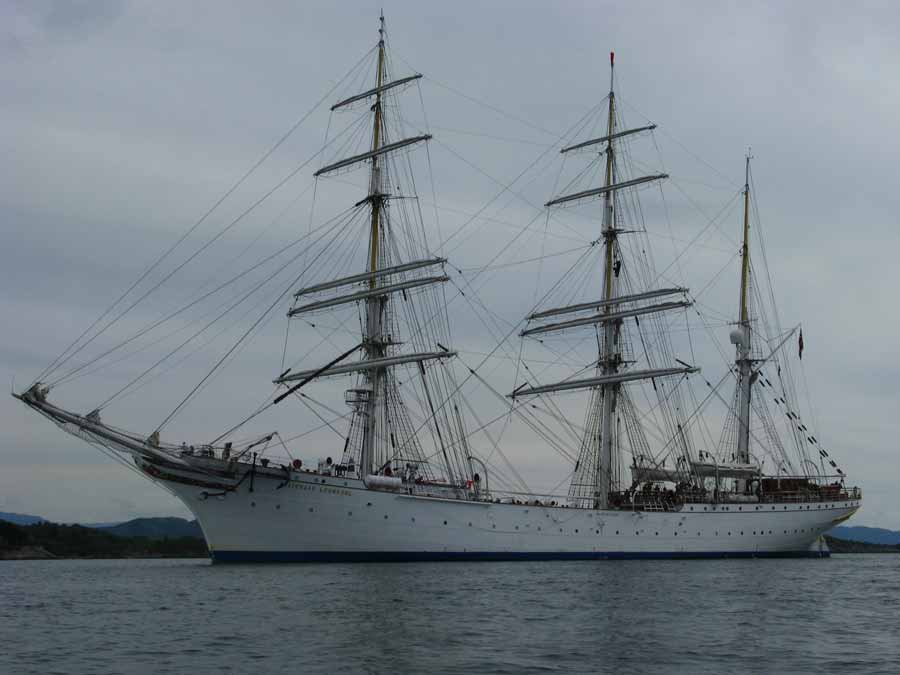
Day 222.1 The magnificent Statsraad Lehmkuhl sailing boat by the town of SundI slept surprisingly long. Everything in the tent smelt of smoke and I had a sore throat from sitting downwind of the fire occasionally last night. It was 0830 when I eventually got up. Ann Grete and Gabriel were already up. We ate breakfast on a rock together.

After breakfast I asked Gabriel if he wanted to paddle about the bay in the kayak while I packed everything. He was widely enthusiastic. He was not yet 8 but once I had pushed him off with the most basic lesson he grasped it quite quickly. It was an extremely safe bay so I and Ann Grete just let him get on with it. After half an hour I was ready to pack and he came in. Already he was asking Ann Grete if he could get a kayak.

I set off at 1100. It was a good paddling day. Overcast and dry with just a slight wind against me. However I felt lethargic despite the two previous short days of just 20 km each. For the first time I was getting a bit fed up and bored. There was too much paddling in safe water now, the scenery was predictable, putting the tent up and down was getting tedious and the writing was a chore.

I was longing for more of a challenge. I could of course get it by heading 20 km west and going down the outside of the skerries on the Atlantics fringe but this would slow me down. There are 2 more exposed bits coming up soon at Sletta and Jaeren in a week or so and I am looking forward to them.

I crossed Raunefjord to the small island of Leroy where there was a salmon farm. I seem to be passing about 4-5 large salmon farms a day at the moment. I would guess that there are well over 1000 in Norway all together each with an average of 6 large cages. As I reached the narrow section between Leroy island and Sund town a fantastic sight came round the corner and the tedium was relieved. It was the Statsraad Lehmkuhl.

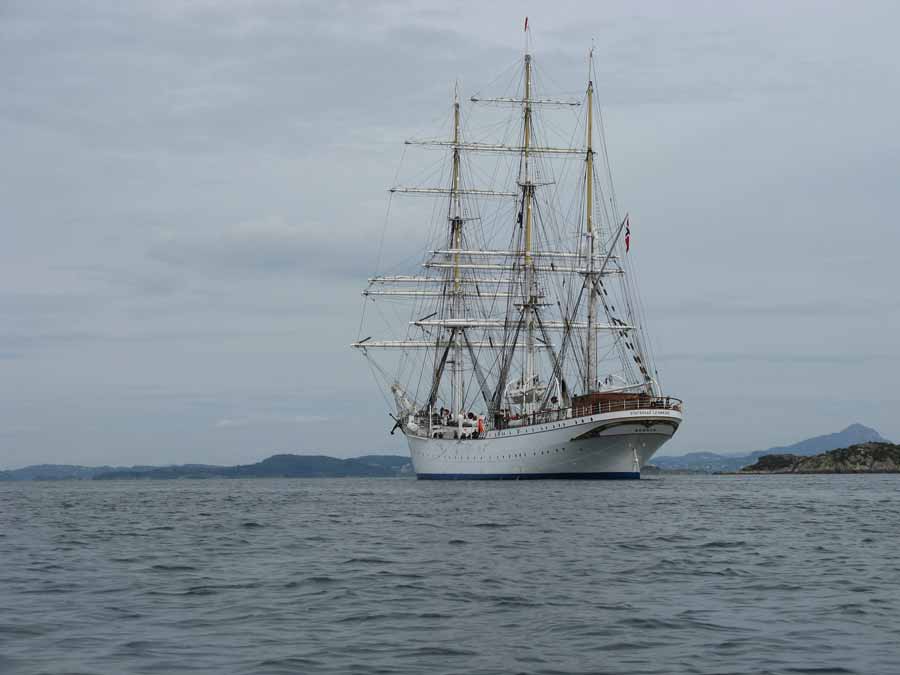
Day 222.2 Another look at the Statsraad LehmkuhlThe Statsraad Lehmkuhl was a Tall Ship. It was registered in Bergen. It was a huge 3 masted, steel hulled sailing boat which must have been nearly 100 metres long with the massive bowsprit. I counted rigging for 15 massive large canvas sails. In full sail this would have been a formidable and graceful sight. Even with all the sail down it was quite breathtaking and special. There were a lot of people on board and I guess that it was a training ship which specialized in taking teenagers on sailing voyages where everyone was expected to work.

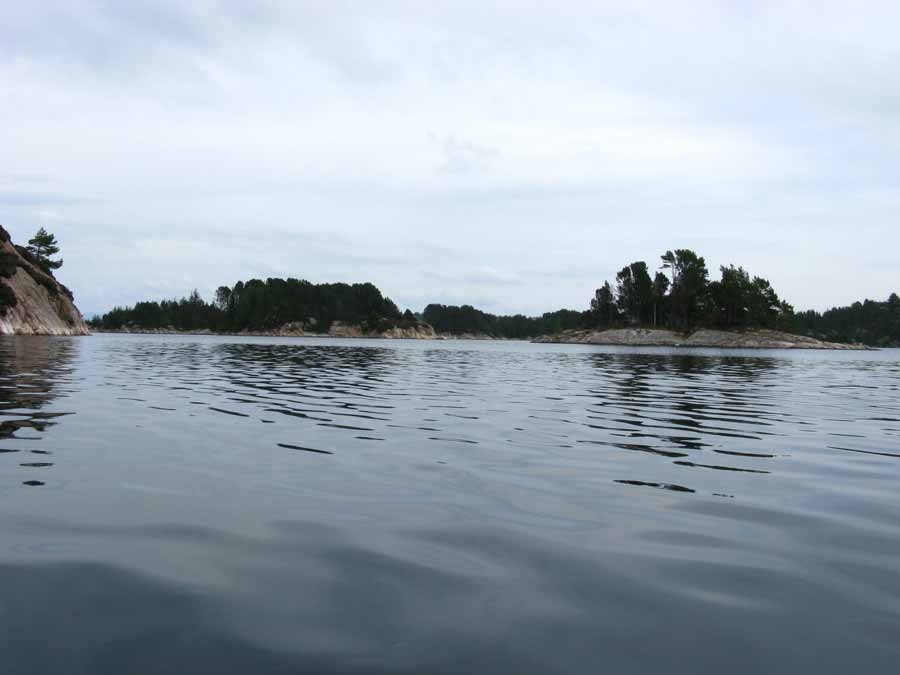
Day 222.3 Some of the small islets to the south of Skorpo island in AustevollAfter she passed I carried on to the south end of the peninsula which was the south end of the island of Sotra. Here I had a 5-6 km crossing over the Korsfjord to the small island of Skorpo, which was the most northernmost island in Austevoll council. This council was essentially an archipelago of over 1000 islands and was renowned as a beautiful area.

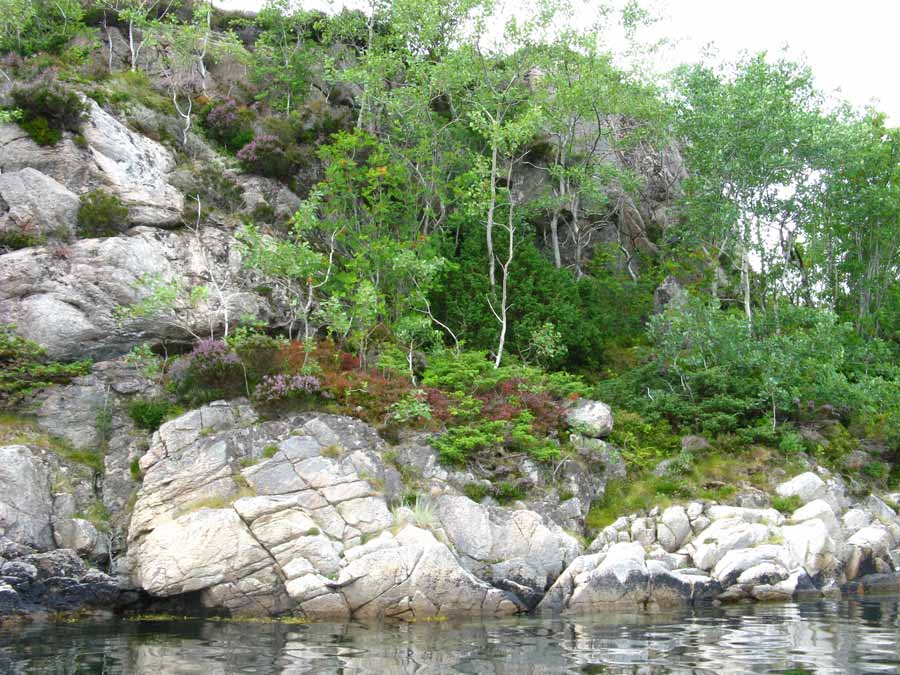
Day 222.4 The rich vegetation on some of the small islands near Skorpo islandI paddled round Skorpo and then entered a fascinating area of small islets and channels. The islets were covered in pines, rowans now red in berry, and aspen. It was so still that not even the aspen leaves were quivering and flickering. I paddled slowly now and weaved and explored as I went. There were a few cabins here and there.

There was someone painting the jetty at one of the cabins. He was the typically friendly, capable and modest older Norwegian one cannot but like and admire. I asked him if there was a shop at Austevoll just to hear it confirmed. No he said it closed last year but there is one at Storebo. We started chatting. As usual he asked the question ‘are you on a long tour’ and I said ‘quite long’. Then as usual he said ‘where did you start’ and I said ‘Kirkenes’. This always produced an expression of astonishment. We chatted more and then I left for the shop in Storebo some 6 km away.

After a couple of km he reappeared in his boat. His wife had sent him to see if I wanted a coffee or beer or even stay overnight in a guest cabin he had. He was embarrassed he had not offered earlier. It was a very nice gesture but it would have meant doubling back some 2 km. I thanked him but said it was a long way to Oslo and I could not really dally. We said our goodbyes again.

It was a long 6 km to Storebo with the wind against me. I got there around 1700 and met a couple of people there from the local kayak club. They had an impressive shed in the small boat harbour. I chatted with them as I beached the kayak and then went up to the shop. I bought food for the next 5-6 days.

When I returned to the kayak it was 1800. I thought is it really worth going on or shall I just camp here in this small quiet marina where there were some picnic tables. There was enough of a breeze to hold the midges at bay if I wrote outside, so I opted to stay.

Within an hour I had the tent up on some wooden decking and I was established and writing. A few people showed up soon afterwards. I was the local kayak club for an evening tour. Naturally we got chatting. They seemed a very enthusiastic and proficient bunch with a range of kayaks. Most were British and none had a rudder. I looked around there large council funded shed which had some 20 kayaks in it.

Once they had disappeared for the evenings paddle I took the opportunity to write and the rain kindly kept at bay. When they returned I had pretty much finished writing and chatted with many of them. They even gave me a free club tea shirt and one had a shot in my boat. The club was called Havstril Padleklubb Austevoll.

It had been a trying day where I started feeling quite bored and a bit low but as the day went on I felt better and better.

Day 221. Bergen to Tyssoy in Sund

Sunday, August 9th, 2009

Distance 21km | Time 3.5hrs | Ascent 0m | Descent 0m

Day 221.1 Setting off from the hidden jetty near the express boat terminal and te Admiral hotelI did not manage all the writing and office work the previous evening so after breakfast at the hostel I carried on writing. By 1200 everything was up to date and all the emails done. I was clean shaved and had washed all my clothes. The only thing I still needed to do was shop and that could wait. I gave Tone a ring to see if she was around but she was on babysitting duty still until late in the evening. There was little point hanging around as the weather was good and the tide was about to ebb.

By the time I finished chatting with the friendly Swedish family in the hostel and packed everything it was 1330. I then carried everything to the hidden jetty by the Admiral Hotel where I left it. I left at 1430 but had to return to change paddles. My expensive Epic paddles needed glued. I had never been that impressed with the quality of them since I started using them a few months ago. Chinese rubbish masquerading as German quality.

Day 221.2 An offshore supply boat and a cruise ship were just a small selection of the ships around the busy Bergen harbourAs I left Bergen there was a mass of activity in the harbour. Many ships and boats were docking or setting off. Cruise ships were mooring on the outer wall and the Hurtigruten was returning after its 11 day round tour to Kirkenes. There were local sightseeing boats setting off and returning and cabins cruisers weaving through all this. I kept to the side to Nordnes point and then headed down the south side of Byfjord to the large bridge over the fjord to Askoy island.

The current was very much on my side and even with a slight head wind I was doing 7 km per hour. I was only when I got to the second large bridge at Knarrvika after nearly 2 hours paddling did I lose the current as the tide started to slow and then turn. By then I was in the wider Kobbaleia sound. I kept to the east side and paddled past suburbs which seemed to be getting more and more exclusive and leafy.

Day 221.3 Paddling down Kabbaleia I past old buildings and new villasI decided to go the west side of the two islands of Bjoroyna and Tyssoy as the ships and express boats seemed to be going the other way. This seemed to be the best choice and it was quiet down this side. Here were many older hamlets with traditional wharfs and boat houses interspersed with newer villas. Mostly this side of the island had a rural feel to it. By the time I got to the south end of Tyssoy it was 1800. There was a slight wind against me and the current was also against me. I thought I would camp in a bay I identified on the map.

Day 221.4 One of the traditional hamlets with old boat sheds on Bjoroyna islandThe bay was great. It had a small beach and some grass around this. It was owned by the council and run as a recreation area. It was largely deserted except for a couple of families who were swimming. I measured the water temperature. It was 19.9 degrees.

I put the tent up beside the only table so I could write and sorted myself out. By then everybody else had left except for a woman and a friend’s boy she was taking on an outdoor treat, and they were staying here for a few days in a large Lavu tent. I chatted with them for a good hour. I then thought I had to write. Just then the skies got a bit darker, and then wind stopped and out of the damp grass came millions of midges. This compared to some of the worst Scottish scenarios. Writing was out of the question. The woman, Ann Grete, leant me some repellant which made little difference.

The only solution was to go into the tent or make a fire. Ann Grete had already collected some green pine and there was a bit of damp drift wood in the seaweed. After persevering for a good half hour I eventually got a fire going. It kept the midges at bay.

We sat around the fire until 2300 when the boy and Ann Grete went to bed. I did not even consider writing and would postpone it until tomorrow. I crashed out well before midnight and slept well.

It had been an OK day. The morning was squandered by office work and then the afternoon was a good paddle with a great campspot. I had cut my stay in Bergen to a minimum as my friend was otherwise busy and I did not feel like wandering around Bergen as a tourist for a day. I was not ready to even have a taste of city yet and wanted to return to the skerries.

Day 220. Haoya in Meland to Bergen

Saturday, August 8th, 2009

Distance 19km | Time 3.5hrs | Ascent 0m | Descent 0m

Day 220.1 Approaching the old Hanseatic town of  BergenIt was raining heavily when I woke. People in Bergen sometimes complain about the weather but it only has 3 metres of rain a year compared to 4 metres on the West of Scotland. By the time I got up at 0700 the rain had stopped. I was in the kayak at for 0830. I only had about 4 hours paddling to Bergen to pick up the spraydeck from Platou Sports before they closed for the weekend. It would be an easy journey down wider fjords to the city centre

The area I had been paddling through yesterday and today’s paddle to Bergen, and for a good 40 km south of Bergen was a geologically unique area. It was known as the Bergen Arcs. If you look at the map you will see the land curving round with Bergen at the centre. This was caused during the Caledonian collision some 400 million years ago when the tectonic plates of Baltica (Scandinavia) and Laurentia (Greenland and North America) collided.

In this violent collision huge mountains were created some 10000 metres high which have since been eroded down to their stumps. Huge chucks of rock were thrust up onto the gneiss platform of Baltica. In a few places Baltica was pressed under Laurentia, or subducted. The area around Bergen was one. It was pressed deep into the earth and parts of this chunk got bent as the centre snagged relative to the rest. Deep down in the earth’s crust this rock got baked and transformed into the Lindas nappe. Then this nappe was exhumed as the rocks above it slid off and were then eroded as the continents drifted apart again. Glacial erosion happened along the weaker lines of this Lindas nappe to carve out the channels I had paddled through yesterday and today.

As I approached Bergen it became more and more populated. Houses were perched on every buttress overlooking the fjord. Many of these house owners seemed to have an obsession to build a boat shed despite the difficult terrain. Therefore there were many buildings on waterside shelves at the foot of crags. Here there was an almost inaccessible shed and a winch to hoist small unkempt boats onto the damp concrete platforms. Access to these sheds was down precarious steps and even ladders bolted onto the cliff face.

The rain and sun swapped the whole time I paddled down the craggy sided Osterfjord past the residential suburbs of Salhus, Tertnes and Brevika until I approached the centre. I was still undecided what to do when I entered Bergen. In the end I paddled right into the central harbour in the middle of town and was lucky in finding a floating jetty where I could lift the boat onto in a reasonably secure place next to a major hotel. It was pouring rain now.

I then vaulted a fence and was in the middle of a large city. I felt a bit bewildered. I had not seen anything like this for over half a year. I was still in my wet kayaking cloths and faded jacket, totally unkempt and unshaved, pretty wet and smelling like a dead animal. Like this I wandered through a sophisticated city of well groomed beautiful people. Even at Platou Sports they gave me a second look. The spraydeck as predicted had not arrived although it had apparently cleared customs and was en route. It would have to be forwarded I thought.

Bergen as a city is very old at about 1000 years. It vied with Trondheim at the time to be the most important city on the coast of Norway, which at the time was a largely coastal country. Oslo was at the time was not that important. Bergen was built on cod, more specifically dried cod. It managed to establish a monopoly on the dried cod trade from northern Norway to mainland Europe. Mainland Europe was largely Catholic at the time and the whole population needed fish every Friday and a major source of this fish was dried cod from Norway.

Bergen also became an enclave of the powerful Hansa group based in Lubeck in Northern Germany. These Saxon merchants established a near monopolistic trading network across northern Europe and the Baltic region in the 13th Century and kept their position for a couple of hundred years. The Hansa merchants had their own enclave in the town and had the exclusive rights to trade cod with northern Norway. In return they traded flour from Europe.

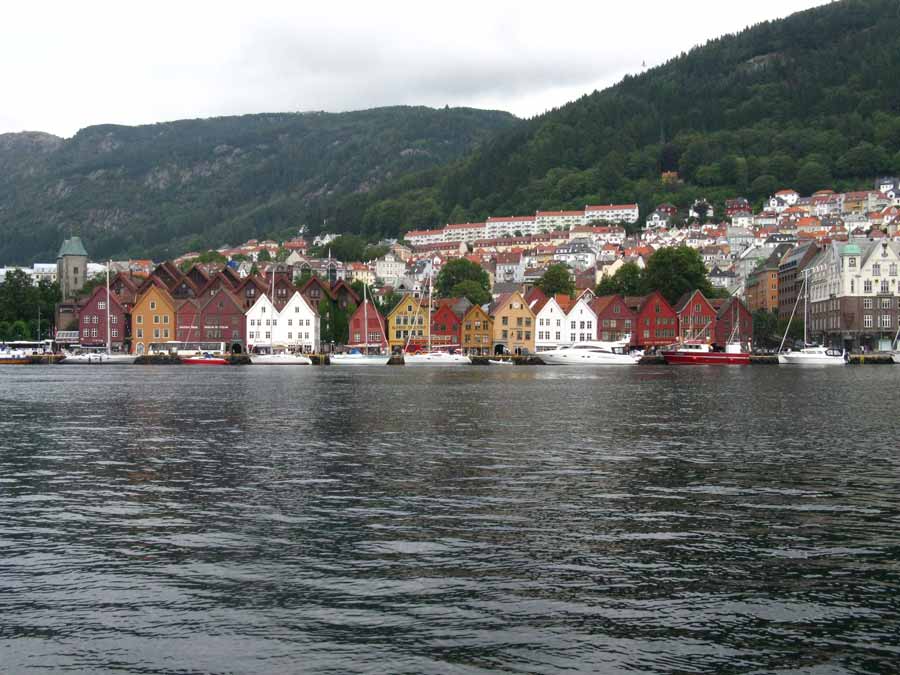
Day 220.2. Looking across the harbour to the old Brygge which is perhaps the star of Bergens many old buildingsBergen remained stable throughout this time with a steady population but in 1702 nearly the entire city of tar covered wooden houses burnt down. Much of the present city was built after that, including the famous Brygge. Like all cities it expanded rapidly in the 19th century and today has a population of around 250,000.

It is situated in a pleasant setting beside fjords and among the 7 hills of Bergen. It was European city of the year in 2000 and this legacy lives on as Bergen punches well above its weight on the cultural scene, with many musical bands and innovative theater groups emerging from a cultural surge called the ‘Bergen Wave’

As I could not contact a friend, Tone, I checked in at the youth hostel and revisited the boat to bring a few handfuls of stuff back to the hostel. After I had sorted myself out but before a shower, shave and cloths change another friend Arne arrived from the mountains. We went out for a coffee and bumped into Tone who was on babysitting duty over the weekend with nephews and nieces. I was good to see them both. We had spent many happy summers walking and climbing in the Jotunheimen while I was doing the 2000 metres summits here some 8-4 years ago.

Tone left to take the brood back to the brood’s home outside town and I chatted with Arne for another few hours until I had to leave to do the writing and other pressing office work. I tried to finish that evening but by midnight I still had a day to go and postponed it until tomorrow.

It had been a wet day with a fair bit of stress finding a place to moor the kayak and finding somewhere to stay in the pouring rain. There was the inevitable disappointment about the lack of spraydeck and how to forward it for the next stage in this saga to minimize and further hassle and detour. In the afternoon however it was great to catch up with Arne and Tone before I returned to try and clear the office work.