Archive for August, 2009

Day 219. Mjomna in Gulen to Haoya in Meland

Friday, August 7th, 2009

Distance 50km | Time 11.5hrs | Ascent 0m | Descent 0m

I managed an early start from Mjomna and got away by 0800. It was overcast but dry and virtually wind still. I thought if I could do the lion’s share of the distance to Bergen today I might be able to reach Platou Sport before it closed on Saturday afternoon. This was the shop which kindly agreed to receive my new Reed spraydeck from the UK.

The first part of the day was more of the larger channels between grey rocky islands of gneiss which I experienced yesterday. It was easy paddling and not at all challenging. I soon reached the end of this wider channel by the hamlet of Gravika. From here I had to cross the 7-8 km wide Fensfjord. There was a slight south easterly wind blowing now and it had an evil smell.

This smell turned out to be the refinery across the other side of the open Fensfjord at Mongstad. It was just 7-8 km away. It was a large refinery with a few flare towers and some ships unloading their thick black cargo. The smell of the refinery was quite powerful and the sight was quite a shock after the relatively pristine last 2000 km with just a hint of industry compared to this. Luckily I was not going past it and as I paddled over the fjord it soon disappeared from sight. The smell lingered though.

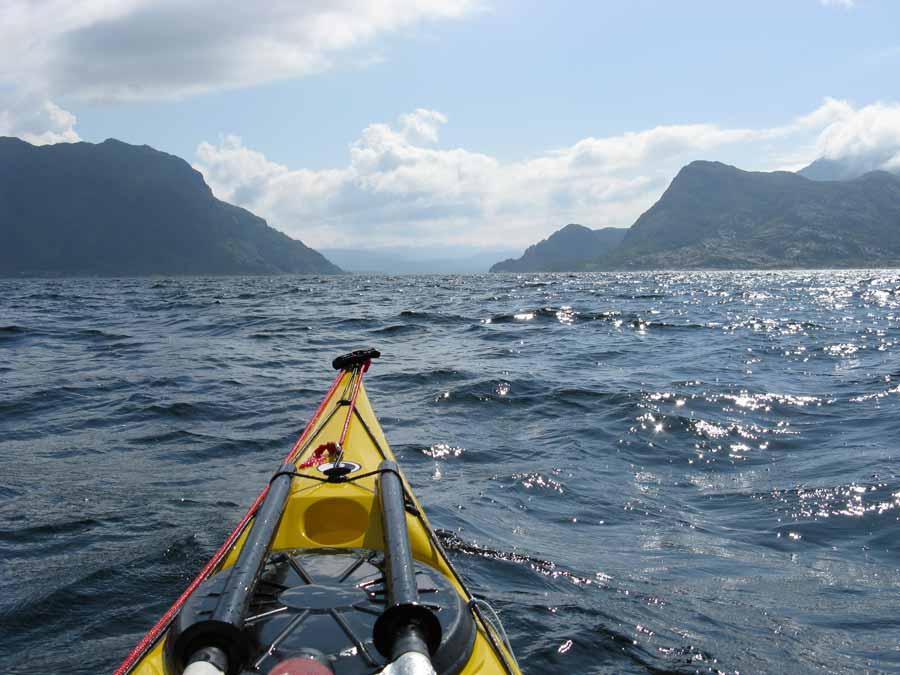
The crossing of Fensfjord was also easy but the increasing south east wind started to produce a few waves and through a few rain showers with it. The wind never reached force four and it hardly impeded me and I soon reached Kilstraumen.
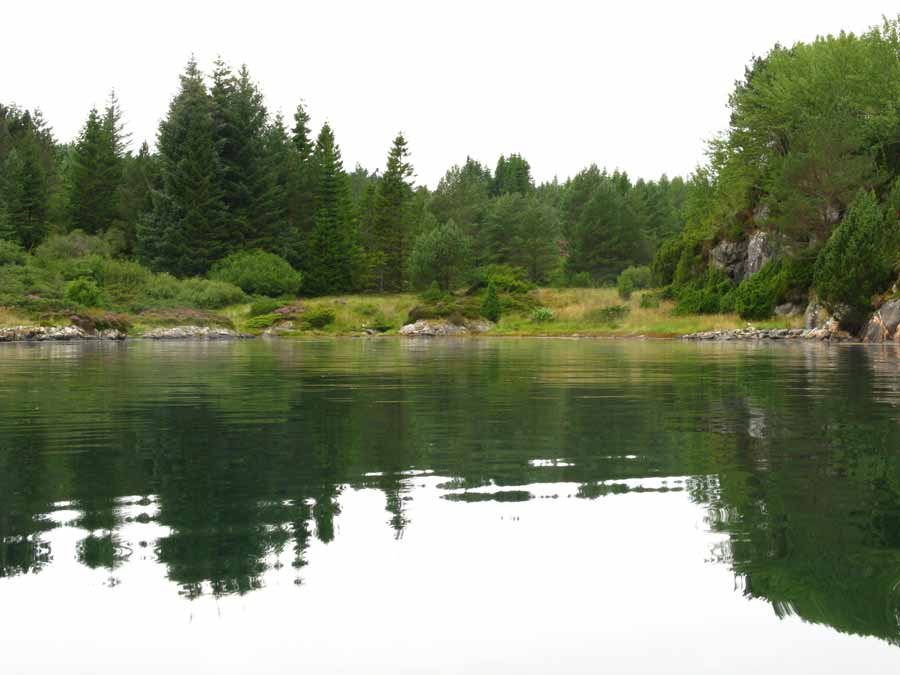
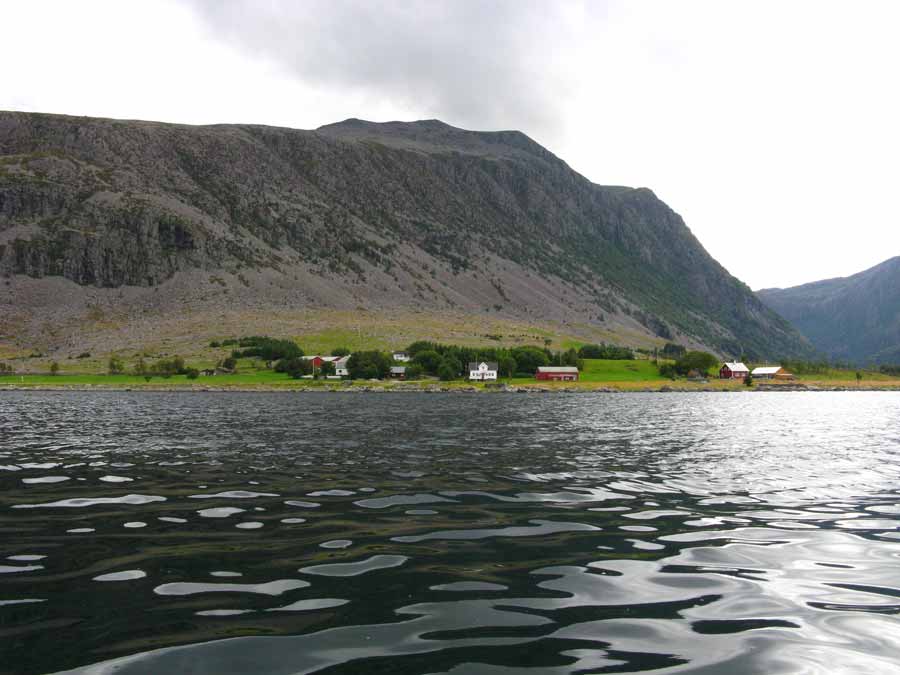
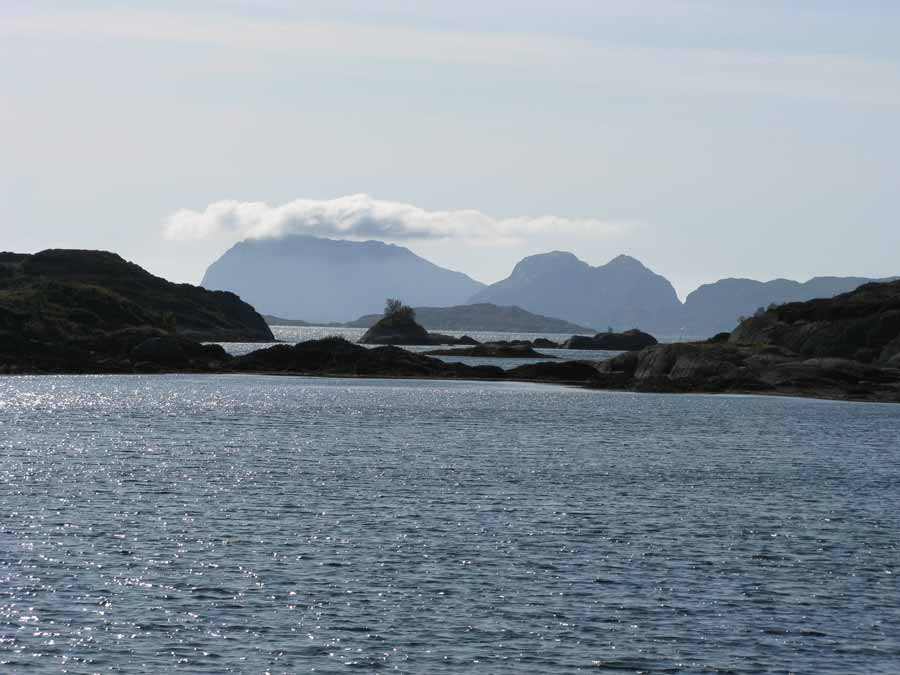
Day 219.1 Some of the lush islandscape along some of the quiet channels in west LurefjordHere for once there was a good current flowing and it was in the direction I was going. There was a large basin of water ahead called Lurefjord. This basin only had three narrow channels connecting it to the sea and this one at Kilstraumen was one. The water was flowing in like a mature river through the 100 metre wide channel trying to fill the basin and I rode along on it for a brisk 2 km.

It eventually spilled me into the basin of Lurefjord which was another land altogether. This had the feel of an inland lake. It was only the jelly fish and seaweed which gave it away. There were masses of small islands covered in tall spruce and pine and the undergrowth was thick with willow and rowan.
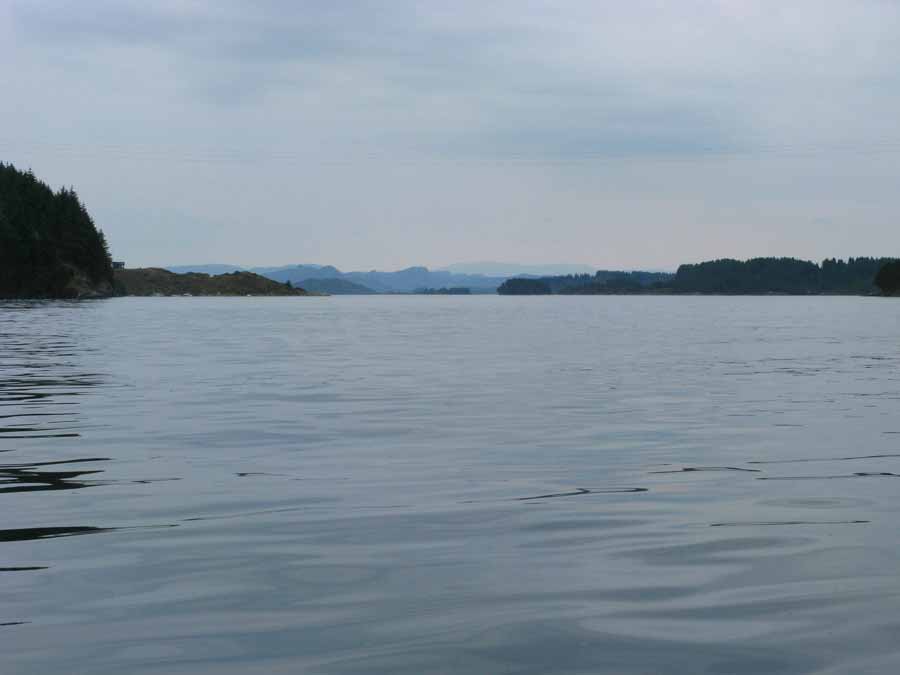
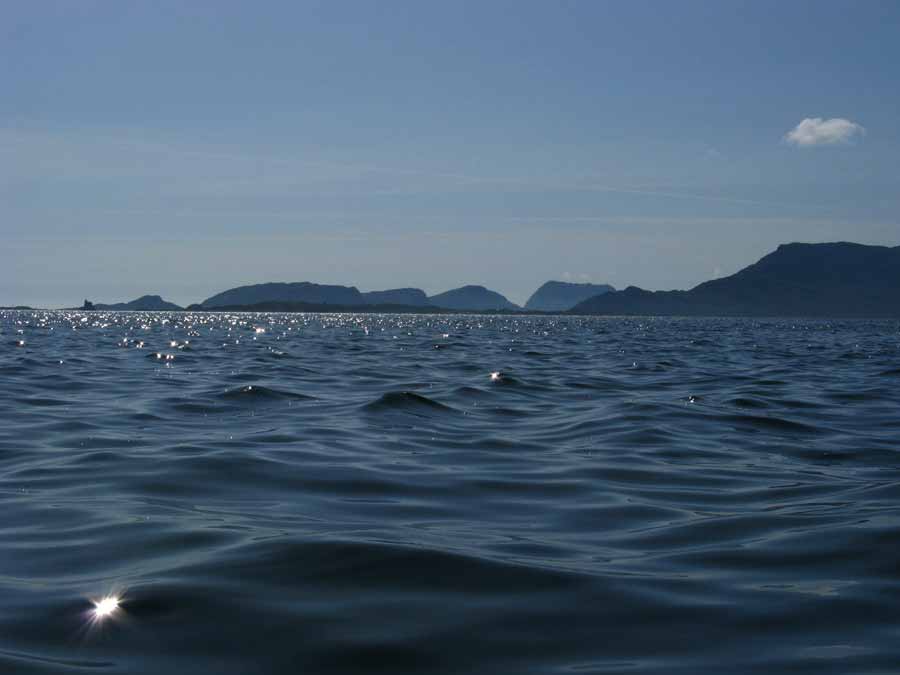
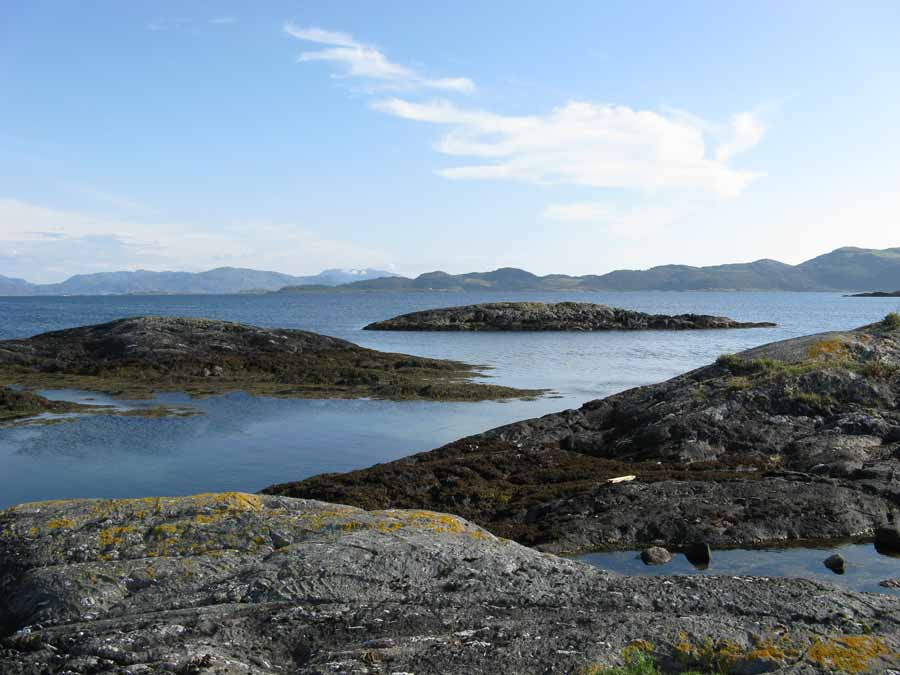
Day 219.2 A view in Lurefjord along a wide channel and beyond to islands across the fjordMy pace slowed considerably now as I weaved in and out of the islets and islands stopping to take photos and admire the lush surroundings. It was a bit like paddling in the Stockholm archipelago. I deliberately sought the smaller channels even if it was not the most direct route just to explore. I was sitting back now and reclining in the seat. There were a few cabins here and there tucked away in forest glades.

When I got to Vallerneset I managed to ask someone if the channel I wanted to go through later was navigable. He confirmed it was so I headed south down the west end of Luroy island to the hamlet of Instebo where a friend of mine in Bergen hails from. It was the usual hamlet with a couple of still operating small farms and the other farms now being leisure homes.

The channel started across the water from Instebo. It was called Grunnesund, translated as Shallow Sound. It was a quiet and enchanting strip of water which was at times only 20-30 metres wide and a metre deep. The whole of Grunnesund was about 3 km long. There were a few cabins along the side to the east end but otherwise it was deserted all the way to Radsund at Festo.
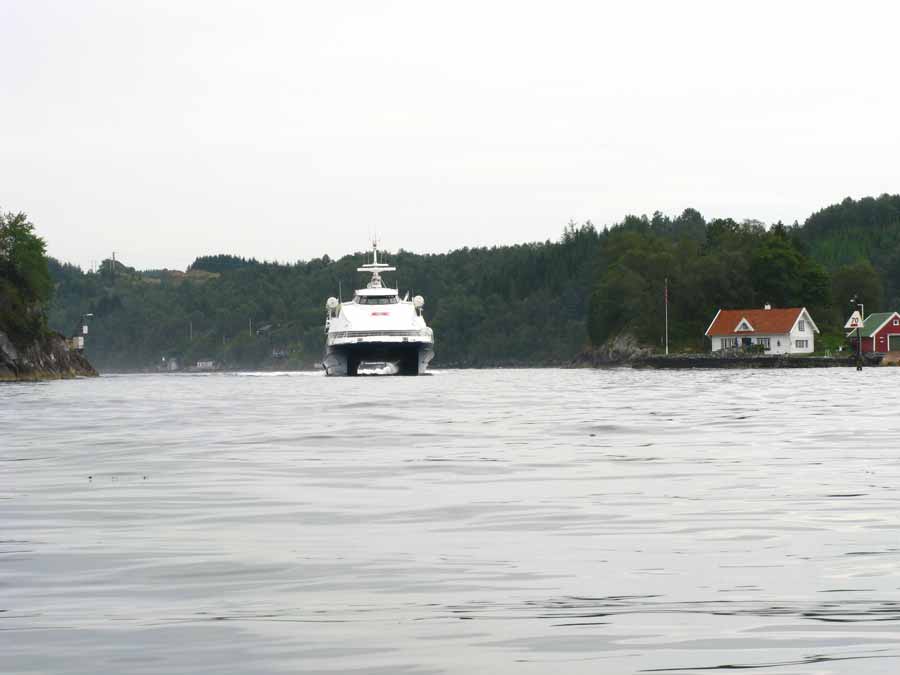
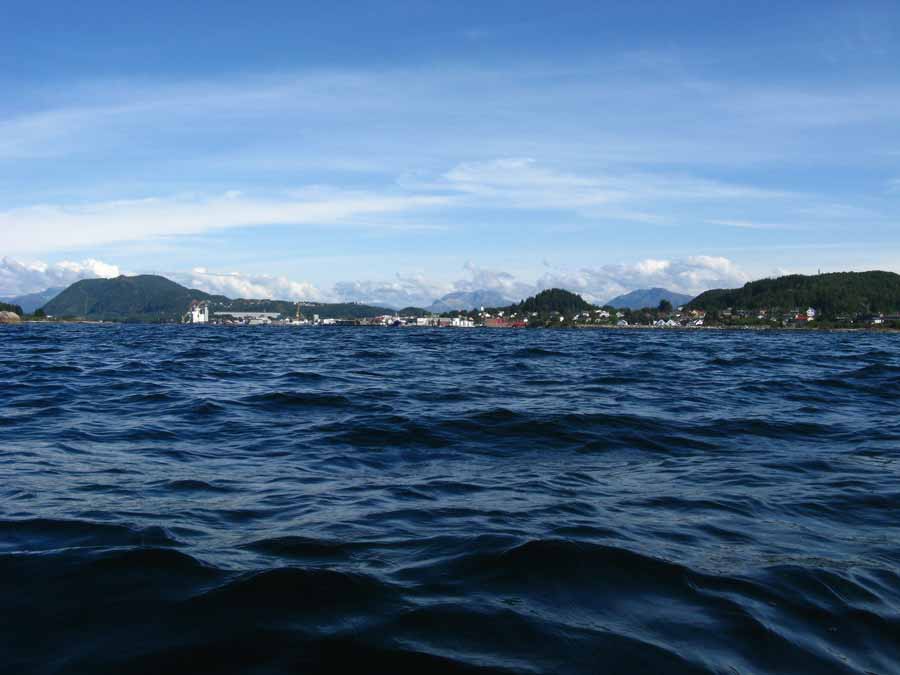
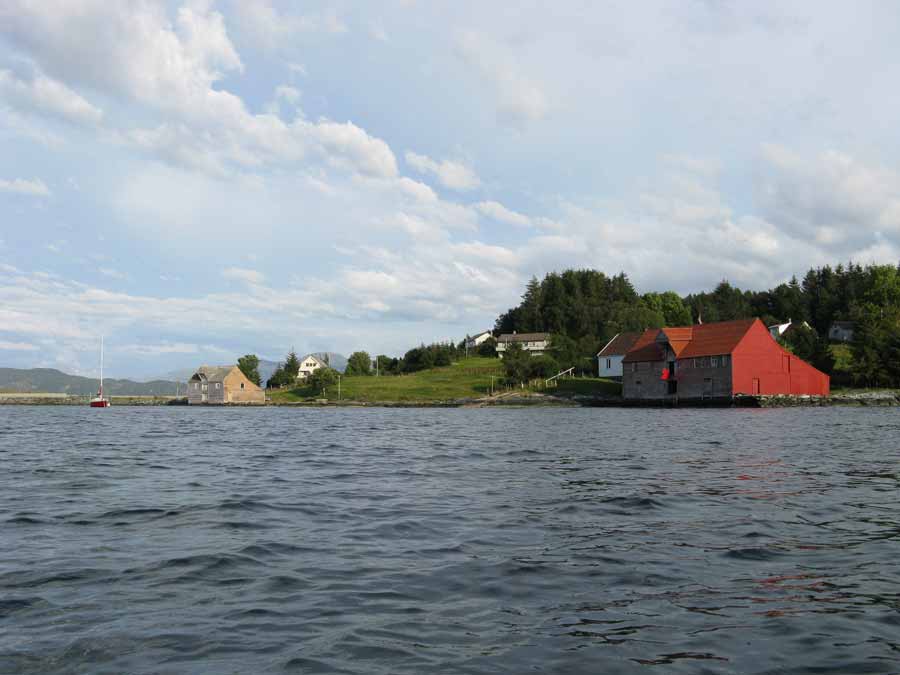
Day 219.3 Radsund was a busy trtoughfare for boat traffice heading north of BergenRadsund was anything but deserted. It was like going straight from a farm track onto a motorway. The whole sound was buzzing with cabin cruisers mostly heading northwards. It was Friday late afternoon and everybody would be heading up to their cabins on the islands in the basin of Lurefjord. There was a constant wash. Then suddenly from around a corner appeared not one but two of the large high speed express boats. There was a speed limit here otherwise crashes would have been inevitable.

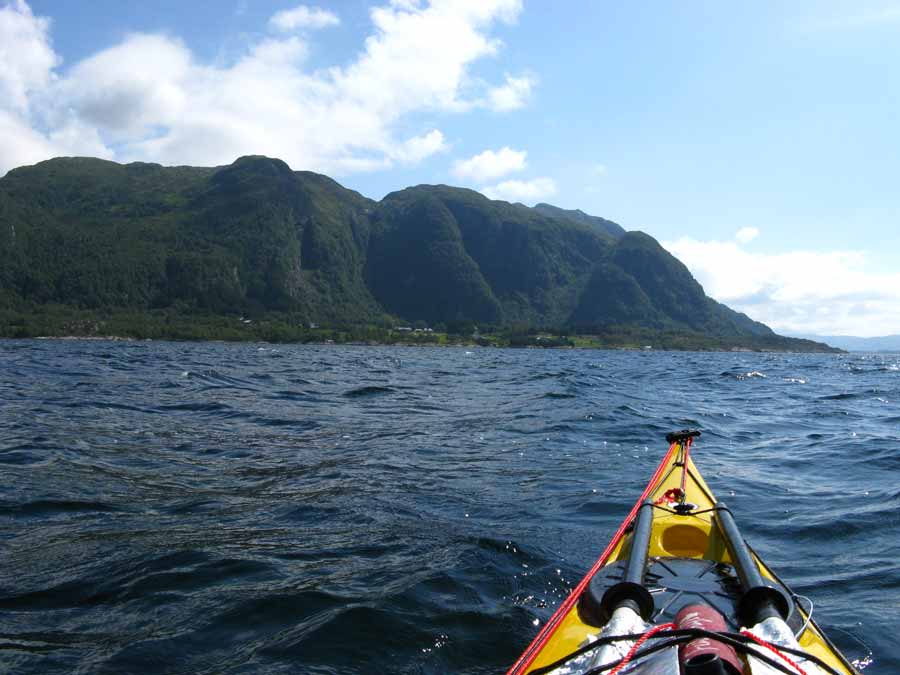
After Festo, Radsund opened up a bit for the next 10 odd km, with farms on each side of the sound and the odd hamlet along the steepening shores. It was not really good fishing grounds here compared to the outer isles along the coast but there were still quite a few older boatsheds. The nearer I got to Alverstraumen the larger the hamlets got with some house perched high above the water with steep steps down to boat sheds.
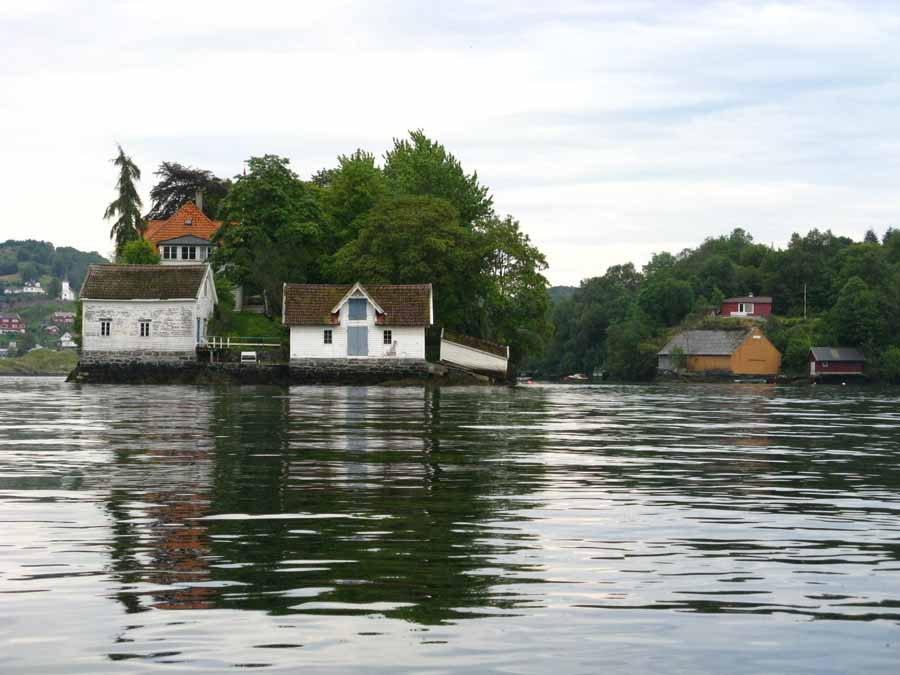
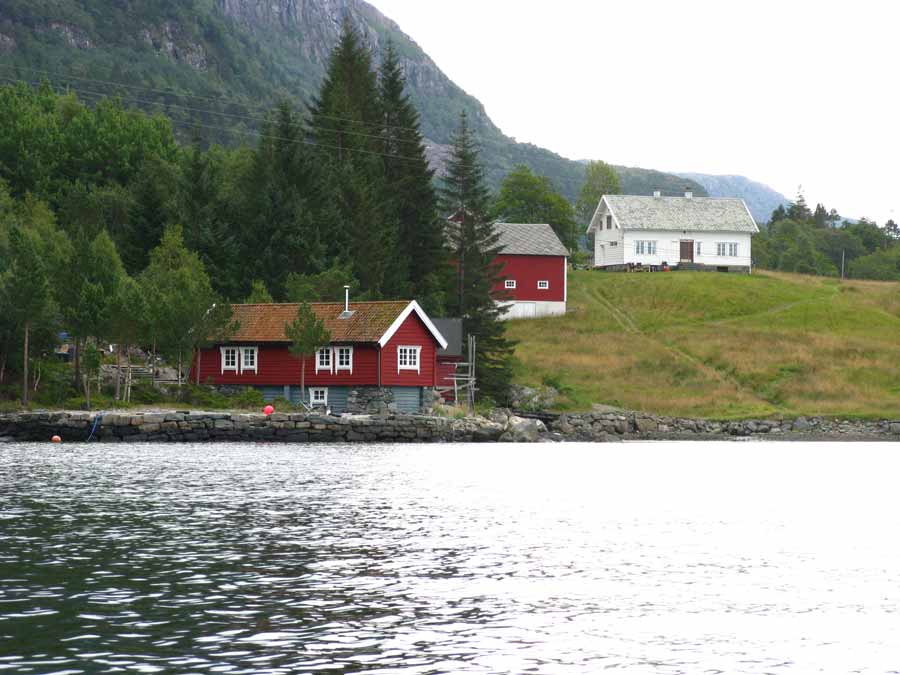
Day 219.4 One of the islands in Radsund near Alverstraum which were adoened in lavish houses and exotic gardensAt Alverstraumen there were some more islands again and some were formed into nice gardens with a lavish older house among more exotic deciduous trees like copper beech. There were many other houses along the bank with all manner of boatsheds from decorative wooden ones to large old corrugated sheds with a mess of broken moss covered boats beside along the damp bank.

There was quite a current here and it was against me now as the basin was filling again. It lasted for about 2 km and at times I had to paddle hard to keep moving forwards. Eventually I passed under the high bridge and paddled into the relatively still waters on the larger Radoyfjord.

It was now getting late and I needed somewhere to camp. The trouble was it was getting quite built up now and the sides of the fjord were steep, and it was difficult to find a suitable place which was not a garden. I found something which looked flat and unpopulated on the map on the island of Flatoy a few km ahead and decided to head down to it. From there Bergen was within easy striking distance.

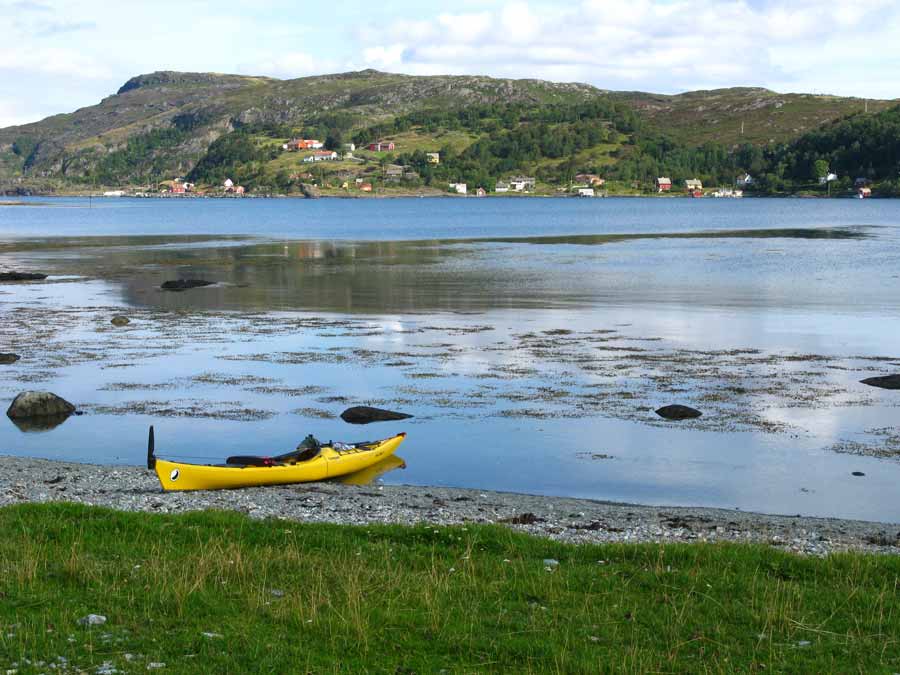
I paddled into the sound south of Haoya and past a hotel and marina on Holsnoy island called Litle Bergen which looked exclusive. As I paddled round Haoya and before I got to Flatoy I came across a grassy lawned area with a couple of stone jetties and a tiny beach. It was a quiet recreation area belonging to the council. It was on the site of ruined barracks and artillery emplacements which went back many centuries. It was getting late and would be dark soon and this was the perfect camp spot. What a stroke of luck.

I put the tent up and started to write at a picnic table while I cooked. The midges however drove me mad and I had to abandon it and get into the sanctuary of the tent. Here I soon felt drowsy and crashed out.

It had been a very good day. The paddling was easy to almost be boring but the wonderful scenery in Lurefjord was enchanting and idyllic.
Day 218. Leknessund in Solund to Mjomna in Gulen

Thursday, August 6th, 2009

Distance 39km | Time 8.5hrs | Ascent 0m | Descent 0m

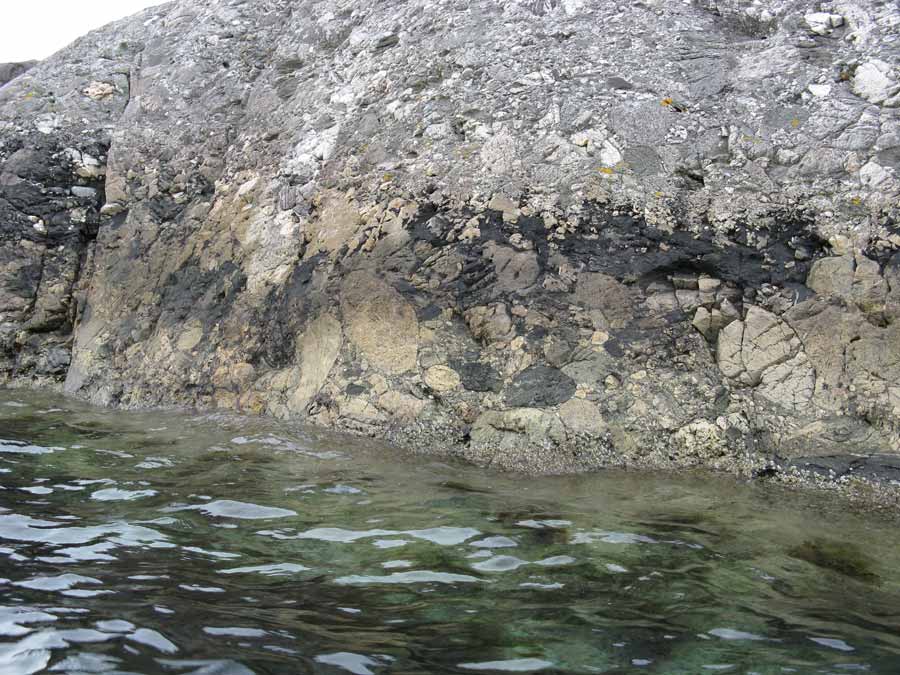
Day 218.1 The pebbles cobbles and bounders made up the conglomorate rock in Solund on the north of SognesjoenThe weather forecast said it would be wet and windy in the morning but it was much better than predicted and my lie in was scuppered. I got up at 0800 and had the kayaked packed and on the water for 1000. As I paddled out of the bay I chatted with a local who was cleaning some old wooden crab pots. It was not this road to Leknessund but the next on west to Avloyp which was the Millionaires Road I mentioned yesterday.

I rounded the corner and paddled the km I battled with yesterday. There was a slight wind but I made much better time. This was a grey and wild landscape with barely any earth where trees grew let alone for cultivation. As I paddled down Hersviksund the village of Hersvik appeared. It was a green oasis in the grey landscape. There were a few fields here but this would have been a former fishing community.

I left this sound and went north round the top of Huoy island where there were many islets, and a few even with trees and cabins. There seemed to be a lot of mink here which would have hammered the bird population nesting here.

I noticed that all the rock here was conglomerate. That is pebbles, cobbles and boulders which have been laid down in a river bed or estuary and then the spaces in between filled with sand and silt. This whole deposit which could have been even a kilometre thick and as vast as the Nile or Amazon delta now was then metamorphosed into rock by tremendous heat, pressure or both. This conglomerate rock extended the whole way to Sognesjoen.

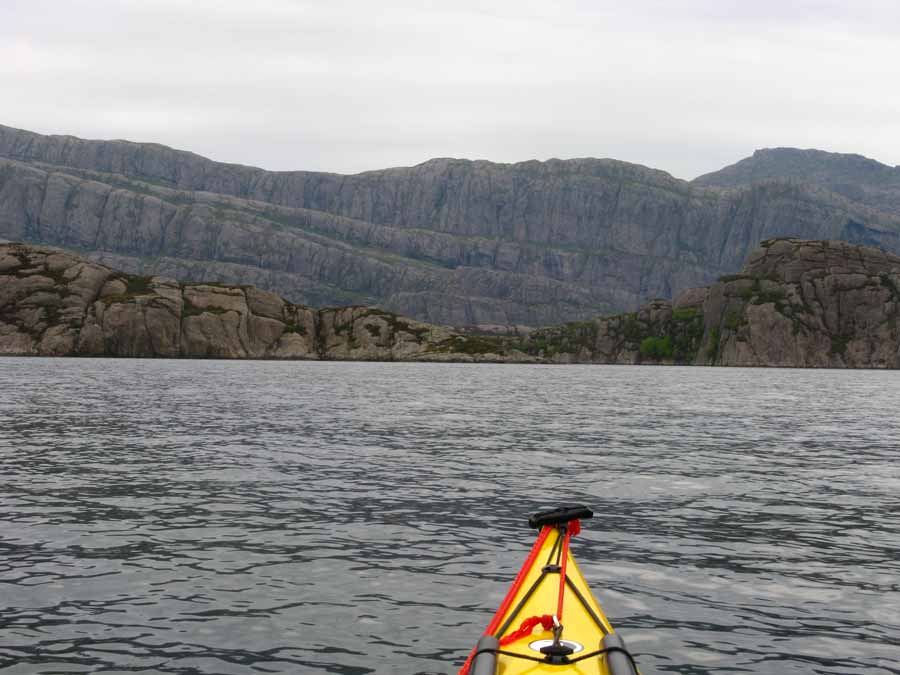
Day 218.2 There was a mass of skerries islets annd islands around Sula island in SolundI crossed the barely open Lagoyfjord for 4-5 km and reached the tiny hamlet of Avloyp. The wind was almost absent and the weather clement. After Avloyp I entered a mass of small and medium sized islands. Rich Lennox in Askvoll had been right to send me this way. I slowly paddled through channels between this conglomerate rock looking at the constituent pebbles and boulders and marveling at the barrenness of the archipelago. There were a few pockets of spruce where earth had accumulated but mostly it was sparse heather and grey rock. You could see it had not been long since the ice retreated from here.

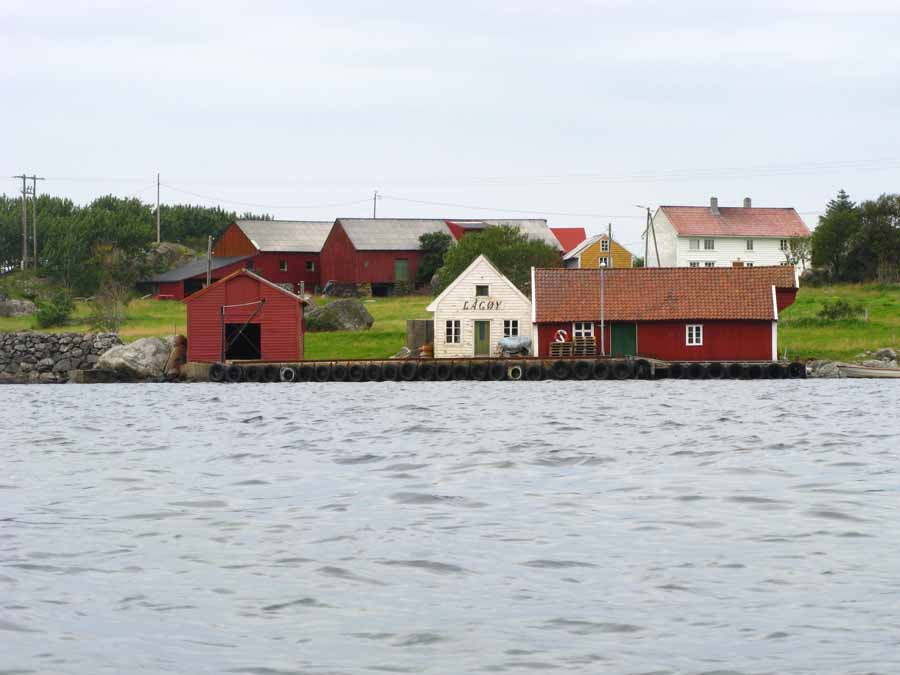
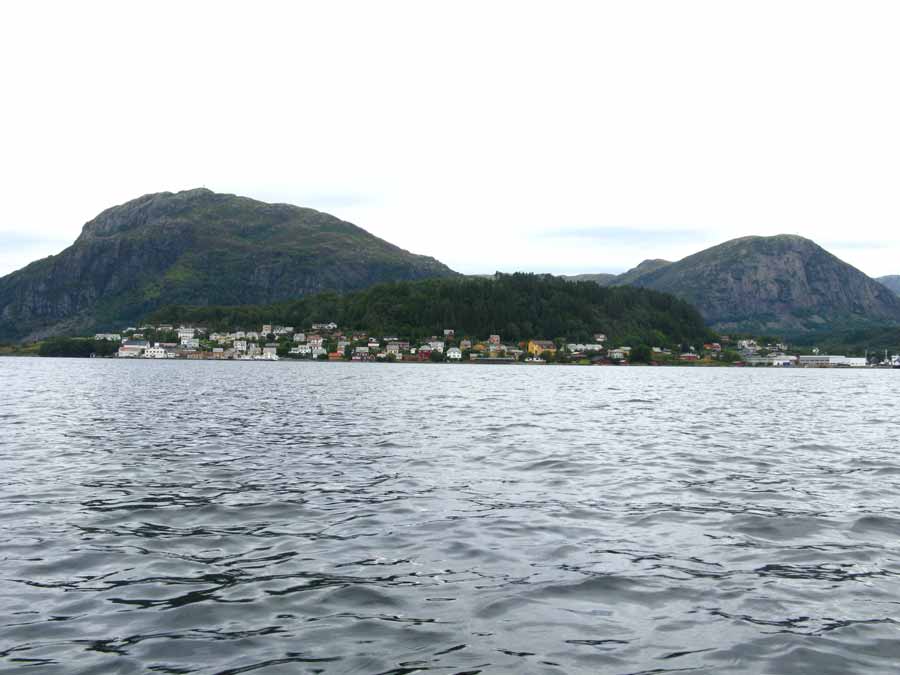
Day 218.3 The pictureesque jetty and farm on Lagoy was an ossis of green in a grey worldI paddled over to Lagoy, where someone had tried some farming once, and then headed down the Liasund sound towards the town of Solund. On the way down the sound I passed many other islands including Faeroy until the sound narrowed. There was the very pretty sheltered town of Solund on the east side with a few shops and the main church of this council. While on the west side was the village of Steinsund. Both these places were refreshingly lush and green but the grey outcrops even burst through the spruce woods and lawns here.

I paddled under the bridge connecting these two settlements and then headed south down Indre Steinsund until it opened up into Sognesjoen. Sognesjoen was the sea end of Sognefjord, perhaps the longest, largest and deepest fjord in the world. From the sea to the very end of one of its arms called Lustrafjord it is 250 km long. It has about 15 arms many of which are famous fjords in themselves. The total coastline of Sognefjord must be over 2,000 km.

It was made by a river of ice which drained a large part of the icecap westwards. This river scoured a deep trench into the rocks until it reached the sea. The river of ice then started to float and carve icebergs which drifted away. Therefore at the very west of this fjord where it meets the sea it is not that deep, as the ice did not carve the rock so relentlessly here. Further east in the fjord the ice has carved a trench well over a km below the current sea level. When the ice melted the sea flooded into this trench and created the fjord.

Today there are a few dozen glaciers and an ice sheet which feed the rivers which flow into the fjord so there is a tremendous amount of fresh water flowing into the fjord. It all has to leave through the 5 km wide mouth across Sognesjoen. In addition to that the whole fjord has to fill up and empty with at least a metre of tidal water twice each day and these create strong currents.

These currents then flow into the oncoming swell and waves and it can become a difficult sea. I was therefore keen to cross while I could. As it was today it was perfect. I hardly noticed a tide, there were no waves and the swell here was just a metre and within an hour I was on the other side by the island of Hille. I stopped here for a pause and rang Tom Amundsen who was also paddling the Norwegian coast. He finished yesterday so I congratulated him and hope to see him when I paddle past Sandnes in about 10 days.

There was no conglomerate rock here but a return to the old gneiss basement which forms the bedrock of Western Norway. The conglomerate north of Sognefjord would have probably have been sitting on this far older gneiss. The remnants of the Caledonian Mountains in Norway which virtually run its whole length are huge chunks of rock which were pushed up onto this gneiss platform.

Otherwise the landscape on this side of the fjord was similar to the archipelago on the north side. There were masses of grey rocky islands and most were not that high. Between the islands in the channels and sounds were plenty of salmon farms.

The seagull chicks were almost full grown now but retained the juvenile brown plumage and beak. Nearly all could fly quite well. They still could not catch food and whined continually for their parents to regurgitate food. They followed their parents across the skerries whining and jabbing the parent’s beak with their own with relentless insistence.

Day 218.4 The grey barren landscape down each side of Liasund on the way south to SolundAs with the north side of Sognesjoen there were very little camping spots. The ice scoured rock did not offer good landing places either and there were no beaches at all. I therefore homed in on the hamlets among the islands where there was usually some landing place and a field or two. So I set my sights on Mjomna some 6-7 km further south.

Mjomna did indeed have a beach and a field and I had the tent up by 2000. There was also a hardware shop here and an old Lutheran church which was the usual white. I think there were about 20 houses and I should imagine the population was around 50. There was virtually no mobile reception however so I could not update from here that evening.

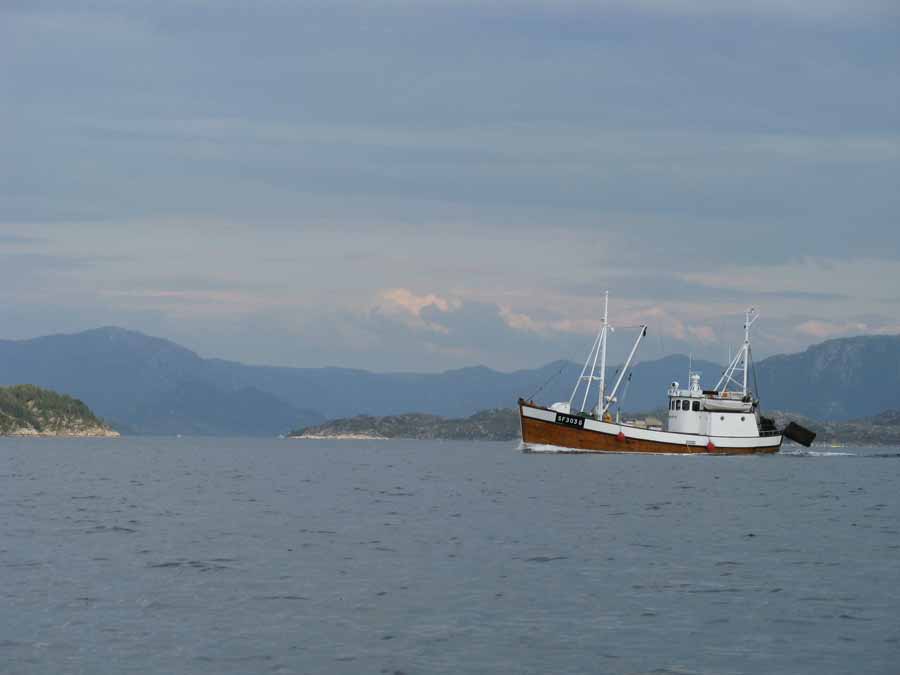
Day 218.5  An old fishing trawler heading through the mass of grey islands on the south of Sognesjoen near MjomnaI sat outside on a table near the hardware store and on the jetty where the express boat arrived from Bergen and then minibuses ferried the passengers to the outlying communities from here. I had finished the blog by 2200 and then went back to the tent to make the usual simple supper.

It had been a very good day paddling through the almost alien landscape which was different to but just as barren as Finnmark.

Day 217. Askvoll to Leknessund in Solund

Wednesday, August 5th, 2009

Distance 21km | Time 5.5hrs | Ascent 0m | Descent 0m

Day 217.1 The small charming town of Askvoll seen from the bay to the southAfter a much too late a night where I got into my sleeping bag and fell asleep with Rich still telling outdoor stories and talking, I still felt drowsy when I woke at 0700. I had to have another couple of hours sleep. At 0900 Rich made some great and powerful coffee and I had the breakfast from the shop. We chatted while I packed and then Rich helped me carry the bags to the kayak. I eventually launched at 1130.

It had clouded over a bit from the perfect blue skies of the early morning and there was just the slightest south east wind. Looking back to Askvoll I could see it was quite small for a town and was more of a large village. It was a busy port however with the express catamaran ferries coming from Bergen and then local ferries radiating out after its arrival.

Day 217.2 Looking up Vilesfjord to the mainland and the deep slot where Dalsfjord cuts into the mountain plateauI paddled out past a couple of islands which were nature reserves and then started to cross the open 7-8 km of Vilnesfjord. Vilnesfjord was really the outer portion of the 40 km long Dalsfjord which cut a deep slot inland from Askvoll. The tide was going out and there was quite a current flowing west from it. When I paddled over Vilnesfjord I found I was doing about 7 km as opposed to the usual 5.5 km per hour.

I made a line for the west end of the peninsula where there was a small hamlet of Eina. It was a relatively easy and quick crossing but towards the end the wind was up to a force three from the south and I had to put on my jacket for the splashes. At the end of this peninsula were a couple of medium sized islands called Lammetu and Lutelandet.

I entered the sounds between Lammetu and Lutelandet and it was a world of small channels and islets. Some islets were ice-scoured and bare yet others were covered in pine and spruce. The nearer the mainland the more forest there was. It was a lovely area to explore and I saw an otter here. I crossed under a simple suspension bridge connecting Lammetu to the mainland and then turned into the sound between Lammetu and Lutelandet, called Folsund, which was more bare ice scoured rock. The wind however was still increasing and it was almost a force four now.

At the west end of Folsund I had to leave the protection of the islands and venture out into Bufjorden. The obvious route was to the south down Krakhellesund, but Rich had advised against this as it could be a boring slog in a headwind and it was also the shipping lane. He suggested I head out to the islands of Solund where there were masses of channels and islets and much better nature. He was very knowledgeable so I believed him. However it meant crossing Bufjord.

As I set off on this 6-7 km crossing the wind was a force four with quite a few white caps. The wind had now also veered to a south south west and was pretty much against me. I could see the main channel down Krakhellesund to the south. It was a deep slot in grey mountains and the wind would have been squeezed up it. There were about three ships in Bufjord coming out of and going into this channel.

I set off keeping an eye out for these three ships and initially made good progress into the weather towards Leknessund on the other side. However about half way across the force four plus increased to a force five and then up to a six. The sea was now covered in breaking white caps and the near metre waves were steep as they piled towards me.

The kayak was slicing through some of the waves but generally was rising up and slapping down into the next. Spray was everywhere and was lifting off the whitecaps and forming streaks on the water. It was sometimes difficult to see. My progress ground almost to a halt and I was just making 2-3 km per hour. I could not build any momentum as the oncoming waves just knocked me back. Frequently a wave would run up the deck and green water hit me in the torso. I had to keep the paddle blades quite low to avoid them taking on a will of their own in the wind.

Day 217.3 The view south to the Wagnarian landscape around Krakhellesund from the relatively sheltered LeknessundIt took about an hour to complete the remaining 3 km of this otherwise simple crossing and it was not until I was only a few hundred km from Leknessund that the waves and then the wind eased. To the south the main channel and the rest of the island of Sula looked very dramatic and stark. That was not an idyllic landscape of green fertile soils and fjord but towering buttresses of bare grey rock over a dark fjord. It looked very Wagner.

Reasonably wet with spray I reached the quiet of Leknessund. It was idyllic and the hamlet fringed the quiet sheltered waters of the bay. About 20 herons took off when I paddled past an islet. There were some modern houses here and some traditional ones with old boatsheds lining the water. There was plenty of spruce forest on the land helping to shelter the hamlet.

There was no road here previously as the council deemed it too expensive to make. Then a resident of the hamlet won the lottery and gave the council an interest free loan to build the road which it did. The road is locally called ‘Millionaires Road’.

I paddled through the sound and under the narrow bridge which connected both sides of the sound and had lunch in the kayak here. The wind had dropped off again. As I ate a sailing boat moored up nearby. After the late lunch I set off again and paddled past the sailing boat round the point and into Hersviksund. The wind was back and it was powering up this sound. In half an hour I went a km and I was really looking to camp as paddling was futile.

Day 217.4 Looking from Leknessund the island of Alden should look like a house and is given the name Norske HestenWith nowhere to camp and very little prospect of campspots ahead along this ice-scoured landscape I decided to turn back to Leknessund. I completed the returning km in well under 10 minutes. I paddled past the sailing boat and chatted briefly with them. They said they measured the wind at 16 metres per second which is a force seven but I don’t think it was so much.

I found a place to camp near the bridge where I ate an hour previously and had the tent up by 1730. By now it was raining too. I initially had a snooze and then at 2000 started to write. The wind continued to rattle the tent and the showers pelted it from time to time. I was done by 2200 and looked forward to an early night and with this forecast a possible lie in.

It had been a mixture of a day. The slow start was compensated by the rapid crossing of Vilnesfjord and the islands of Lammetu and Lutelandet were lovely. The crossing of Bufjord will be memorable and the decision to stop early and camp was for the best.

Day 216. Tansoy in Flora to Askvoll

Tuesday, August 4th, 2009

Distance 20km | Time 5.5hrs | Ascent 0m | Descent 0m

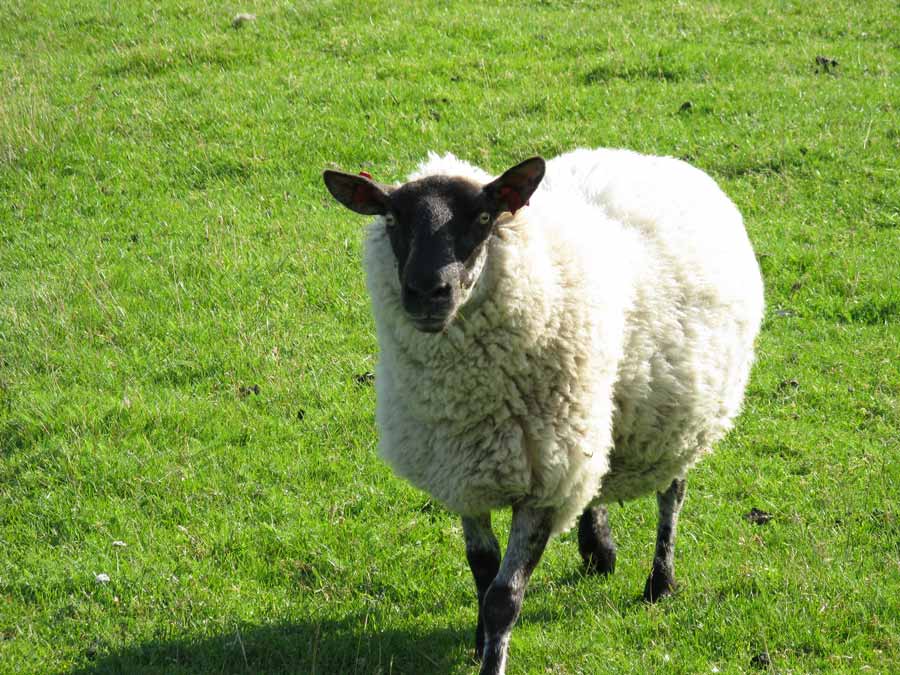
Day 216.1 Healthy sheep on the island of Tansoy came to investigate my campI got up at 0800 and was out of biscuits for breakfast so had a pack of chilli nuts. I started packing up the tent around 0900. A number of the sheep grazing in the pine forest nearby came down to investigate and hoped I had some biscuits or salt.

Day 216.2 The beach where I camped looking north to the hamlet on the south od Askrova islfndIt was an exceptionally nice camp spot with a great view across the bay to the south side of Askrova from the beach on the west of side of the much smaller Tansoy. I set off at 1000 and paddled out of the bay between islands heading south. The islands here had a many copses of pine and spruce on them.

It was a beautiful still morning as I started to head across Stavfjord. It was the outer part of the long and deep Fordefjord which cut inland for some 50 km. As a consequence there was a bit of a tide flowing into the fjord which I noticed.

I was crossing a shipping lane where the occasional catamaran ferry went so I decided to cross it and head to the hamlet of Holevik on the peninsula opposite rather than the tip of the peninsula. About half way across the wind suddenly got up and it was soon a force four. I had to stop and put a jacket on as I was getting soaked in the spray. The last 4 km took well over an hour as I slowly pulled myself towards this hamlet.

There was nowhere to land when I got there so I had to paddle round the tip of the peninsula and then past another hamlet called Stavenes. There were a couple of islands here and just enough depth of water for the kayak to pass through the calm sheltered sunny sounds. I had lunch here before heading down the sound to Askvoll. The tide was definitely going out as I had lunch.

Day 216.3 Heading down the windy Gransund sound between the mainland and the island of AtloyAs I set off down the sound the wind returned and I had to put the jacket back on. Curiously I noticed that the tide was now against me heading north. There are so many local variations with the tides it is best to ignore them.

Day 216.4 Looking down Gransund to the farming hamlet of EimindI paddled across Strongfjord with its steep sides and a green mantle along the shore where there were active farms. This fjord cut deep into the high mountain plateau surrounding it for a good 10 km. It was typical green summer fjord landscape and looked off a postcard.

After crossing Strongfjord I was back in the sound between the mainland and the island of Atloy. The wind and current were still against me and when I relaxed and leaned back and paddled less vigourously I was down to about 3 km per hour in the force four against me. When I noticed I sat up and paddled hard for a few minutes but I was soon slouching again.

Eventually I got to the bottom of the sound and headed east to the quiet peaceful town of Askvoll. I needed to stop here to buy the supplies to Bergen. There was someone standing on the jetty so I asked him where the shop was. He spoke perfect Norwegian but was British.

We started chatting. He was an outdoor instructor called Rich Lennox and lived in Bergen 2 weeks and then worked here as the ambulance boat driver for 2 weeks. He had paddled much of Norway’s coast. We chatted for a good half hour at the jetty before I landed the boat to go and shop.

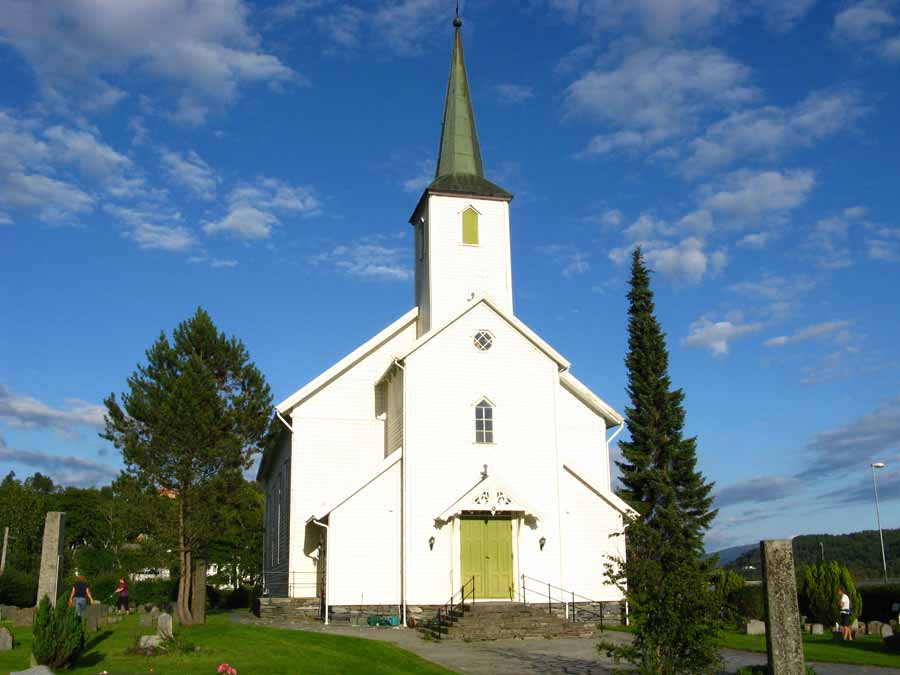
Day 216.5 The Lutheran church in Askvoll was in keeping with the rest of the pretty townRichard lived beside the jetty so I went for a tea. An hour later I decided that stay in Askvoll and sleep on his balcony overlooking the water. I went to the shop and had a look round the town. It seemed an old traditional town which was quite a sleepy holiday place in the summer.

After shopping I went to have a look round the ambulance boat. There were two of them which served the outlying islands where some 500 people lived. The council paid nearly half a million pounds a year to have these two boats on standby with a crew of two always on call. Each boat had 1600 horse power engines and could even operate in force eleven gales.

In the evening Richard cooked supper while I wrote the blog and then we chatted more. He knew the coast between here and Bergen and beyond to Bomlo like the back of his hand and gave me a lot of good tips about the more scenic and interesting ways to go.

It had been a short day and the headwind disappeared in the late afternoon so I had squandered a good three hours paddling. However it was good to meet Richard hear about his previous outdoor work in Scotland and Bergen and his present job hurtling around the islands here in all weathers at 40 knots.

Day 215. Gulestøa in Bremanger to Tansoy in Flora

Monday, August 3rd, 2009

Distance 35km | Time 9.5hrs | Ascent 0m | Descent 0m

Day 215.1 The green fields of Botane contrast with the otherwise barren grey hillsideI slept well in the comfortable bed and did not get up until 0800. It was then the usual camping breakfast of biscuits and blackcurrant juice. Simple, sweet and easy. I took a bit of time packing up and eventually had the boat loaded and ready by 1000. The wind was a force 3 south westerly and the tide was also against me so I was in no hurry as both were destined to change in my favour later.

I went up to say goodbye and thanked Johanna Gulestø for her kindness and the great cottage, which was once the old homestead home. The cottage was over 100 years old. I eventually set off at 1030.

The going was very slow for the first two hours as I slowly pulled my way round the peninsula. If I stopped to take a photo I was suddenly 50 metres back again with the tide and wind against me. My average speed was just 3.5 km per hour. Still it was a great day weatherwise except for the wind with blue skies and sea views which were getting better and better. As I went round the peninsula various islands appeared.

The shoreline here was rock and grass with a few birch trees but as I paddled past the bay of Botane pines became more and more frequent until the whole shoreline was a thick pine forest. It was very green in the sun. While on the west side was the island of Hovden with its out-of-sight bird colony and numerous other islands all the way down to Alden with the distinctive Norske Hesten mountain on it. I felt like I was back in Helgelandskyst.

Day 215.2 In contrast to Botane Husefest was a forested lush place just 4 km down the coastWith progress slow I stopped early for lunch and a stretch at Husefest. Here there was a small hamlet and a shallow inlet. The fields were not cut and the tall grass was rippling in the wind but the houses and boat sheds were well maintained. The inlet was full of the very yellow seaweed which contrasted well with the emerald green pine forest.

I left here and continued south. After a short time I met a kayaker coming towards me. He was Ole Fredricksen. He had come from Bergen and was heading up to Lofoten for a month’s jaunt. We started chatting and he did the same Rope Access work (Tilkomstteknikk) which I used to do for a decade on the oil platforms. It basically involves a lot of abseiling and climbing up ropes to reach the inaccessible work place, where one then has to do the task. We chatted for a good half hour and I took his mobile number to send him tips.

The rest of the coast down to Arebrot was much the same except the wind was easing and the tide was now with me for what it was worth. There were a few islets at Arebrot which added to the Helgelandskyst feel.

Day 215.3 Looking out from Husefest to some of the islands to the west of FloroI now had a small fjord to cross to reach Florø. It was only about 3 km but Florø was a town of about 10000 and with the outlying islands there was a lot of boat traffic. I crossed without any boats or ships coming near me. Florø looked quite a pleasant place with a great location. There was a huge shipbuilding shed at the east end of town and another factory on the tip of the peninsula in the west. The islands, both near and far made up for this industry.

Day 215.4 The town of Floro had some industry but was locasted in a great location surrounded by islandsBy now the wind was veering to the north and was behind me. I had made slow progress so far today and needed to paddle to Tansoy at the south end of the island of Askrova to get a respectable day. Ole recommended the place to me and had spent the night here.

Day 215.5 The view from Oddane west past the small islets to the islands of Reskta and KinnI left through the maze of islands just south of Florø and then started paddling across the 3 km to a small cluster of islands called Oddane. They were flat and covered in heather and all the islets were ringed with seaweed. Had there been more beaches it would have been Helgelandskyst again.

Day 215.6 Looking south from Oddane to the south of Askrova island and the mainland peninsula beyond thatFrom here it was another 3-4 km to the east coast of Askrova island. Askrova was a beautiful lush island with plenty of pine forest, especially at the south end. It was surrounded by large basins of water and other islands. While on the mainland were the steep mountains on the south side of the large Fordefjord.

Day 215.7 The bay to the west of the folding bridge between Askrova and Tansoy islands  contained alot of cultural artifacts and buildingsI got to the south end and started looking for somewhere to camp. I paddled through the sound between Askrova and Tansoy which was a charming area. There were old fish wharfs and boathouses, a country shop, many older houses in green fields full of sheep and a bridge to connect the islands which could be lowered and raised to let sailing boats past.

I could not see anything here but nearby was a beach with a flat grazed green field. It was perfect. I paddled over and at 2000 I put up the very wet tent for it to dry in the evening sun. It soon had everything sorted and the camping equipment which got so wet at Indre Fure was laid out drying. I started to write at 2130 and was done by 2330 by which time it was almost pitch dark.

It had been a good day but it was a slow and lethargic start in the morning. I was lucky to find such a nice camp spot on the west side on Tansoy.