Day 127. Grasbakken to Neiden (Bike)
Posted by: James on May 7, 2009Distance 63km | Time 8hrs | Ascent 640m | Descent 620m
 I did not really feel on top form last night and had snoozed a fair bit in the evening. The result was the blog got postponed until this morning. I had breakfast at 0730 and then started on it.
As I wrote I could see the weather out of the window was not that pleasant. There was a good easterly wind with the occasional snow shower. By the time I finished the blog and had tidied up the cabin it was 1100 and the weather was still the same.
I initially cycled east for 10 km along the road. The wind was directly against me and progress was very slow. There were plenty of white horses in the fjord and the wind must have been a good force 4. It took a good hour to do the 10 km to Byluft village. The wind was sapping my strength and the overcast sky was sapping my spirits.
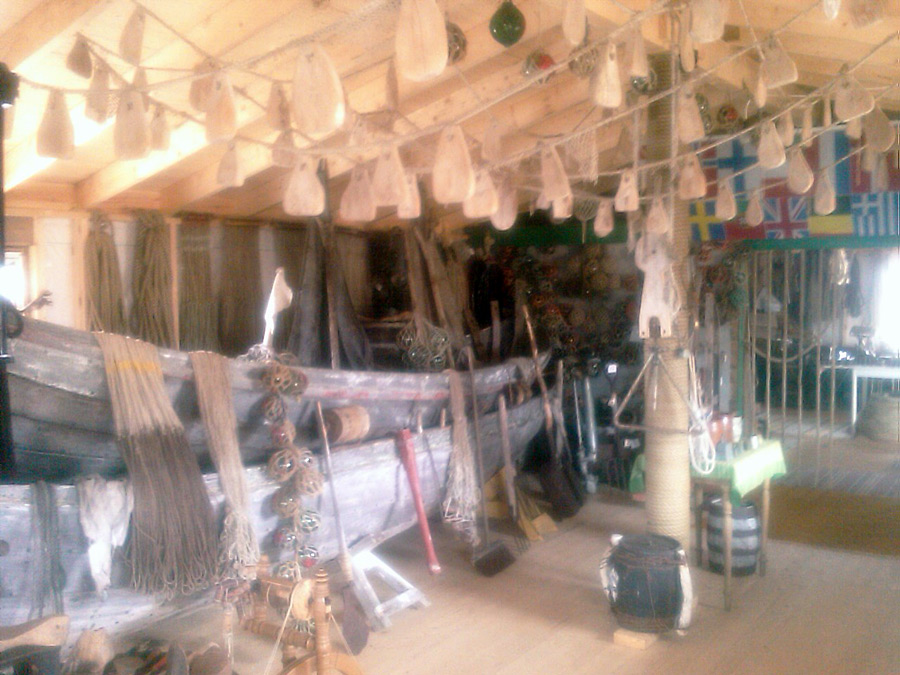
At Byluft there was a sign for a Sea Lapp Museum. Usually I would just cycle past but thought I should go into this one. At the least it would give me a couple of paragraphs to write about. As it turned out it was quite fascinating.
The museum was owned and run by Helmer Losoa. He was a Sea Lapp and had grown up and liverd at this spot for some 70 years. During this time he had amassed, collected and beach combed a large shed full of artifacts from coastal life in Finnmark.
This area was a Sea Lapp stronghold and many of the hamlets I had been through and on the north side of this Varangerfjord were entirely composed of them.
Helmer was rightly proud of his heritage and also his collection. There were the traditional Nordlandsk boats which the Sea Lapps would fish from, old fishing nets with pieces of wood and bags of sand as floats and weights respectively. Longlines with a hundred hooks were everywhere. Glass buoys filed the boats. There was a wall with Sea Lapps costumes including his mothers dresses. Many old skis and the traditional Lapp shoe with the curled pointed toe to fit under a strap on the ski binding. There were many farm instruments and also a Sea Lapp gamme, or turf shelter. I could go on such was the richness of his collection which were just genuine articles.
After looking through this collection we went out. It was nearly a blizzard so he invited me in for a coffee. We chatted a lot mostly about the plight of Sea Lapps. He did not say but it seems Sea Lapps and River Lapps are the poor lower status Lapps while the Reindeer Lapps are the richer, higher status Lapps who consider themselves a cut above their more sedentary cousins. Such is the self appointed importance of nomads throughout history over their sedentary agricultural neighbours.
The blizzard soon stopped and I continued to Gandvik bay battling agains the wind for another 10 km or so until I got to Brannsletta, which was a geographical feature rather than a place. Here there was a turn off to Bugoynes som 20 km out on a peninsula to the east.
Brannsletta was a protected area. It was a glacial delta some 12000 years ago. As it flowed into the sea, channels under the ice deposited large amounts of sand and gravel in ridges called eskers. When the ice withdrew these eskers became exposed and further transformed by glacial lakes bursting and the erosion of sea waves. Stranded ice was also found here as icebergs and stationary glacial remnants and these left depressions seen today, often fill with water. With the ice gone the land had risen some 100 metres so the old beaches are now exposed well above sea level. It was a fascinating delta and valley for glacier enthusiasts.
 From here it was still some 40 km to Neiden but thankfully the route was much easier and the wind disappeared as I went inland. The first 20 km were up this glacial valley and then over a pass before the descent to Burgoyfjord. This dairy hamlet had about 10 farms and 20 houses and was located at the end of a very steep sided fjord more reminiscent of south west Norway.
From Burgoyfjord the road followed two huge open valleys. It was sleeting heavily again but between showers I could see two vast marshes on my west. The first was Sakrismyra and the second was Ferdesmyra. Both seemed to be at least 5 km across or 25 square km. These would be very important breeding grounds for numerous marsh loving bird spices in a month or so. The latter more southerly marsh was protected as a nature reserve.
From this second marsh there was an easy descent to Neiden. There was a spectacular set of rapids crashing over rocky shelves and ice buttresses in the middle of the hamlet as the large Neidenelv river plunged towards the sea.
After many phone calls and an hour I at last managed to track down the owners of the locked hotel. It was scruffy as it had been closed for a number of years and recently reopened. Inside however it was much better but not worth the price. It was a long way that evening to Kirkenes however.
After opening the hotel he made a nice simple salmon meal. He was an outdoors man and had 23 Alaskan huskies which he raced in Scandinavias big races. We chatted about this, Norge Paa Langs and the rotting condition of Norwegian youth facilitated by oil wealth.
I went to my room at 2200 and tried to write the blog but only managed about half before my eyelids felt heavy and I had to crash out in the large but spartan room. It was still bright enough outside to read at midnight despite the fact it was overcast.
It had been a good day. I was glad I got the cultural input from the museum. The weather was not up to much though and the bicycle continued to be sore and hard work. It only had another 40 km to do me however.
May 8th, 2009 at 9:21 am
Hi James
Sounds bloody tough! Weather here in Ft William only marginally better than you’re having it – windy, wet, cold and snow down to 600m. Nearly deep enough for decent ski-ing.
We’re thinking of you
Tony and Elizabeth Laidler