Day 186. Vag to Kunna
Posted by: James on July 5, 2009Distance 42km | Time 7.5hrs | Ascent 0m | Descent 0m
I slept well, woke early but fell back to sleep again and did not get up until 0830. It was yet another glorious day and the wind was very slight. The forecast said it should be a good force five which would build up to a force seven in the day. There was no sign of that.
After breakfast I found a small shed near the campsite and used for the passenger ferry which called occasionally. It had a table and chair so I unpacked the office here and wrote from 1000 until 1330. I was squandering good paddling weather but perhaps I needed the rest also.
By the time I finished the café opened at 1400. The food there was quite wholesome without a burger in sight. I had lunch here bought a little in the attached shop and then packed up the tent. I did not cast of until after 1600. The wind was still minimal and the weather fantastic.
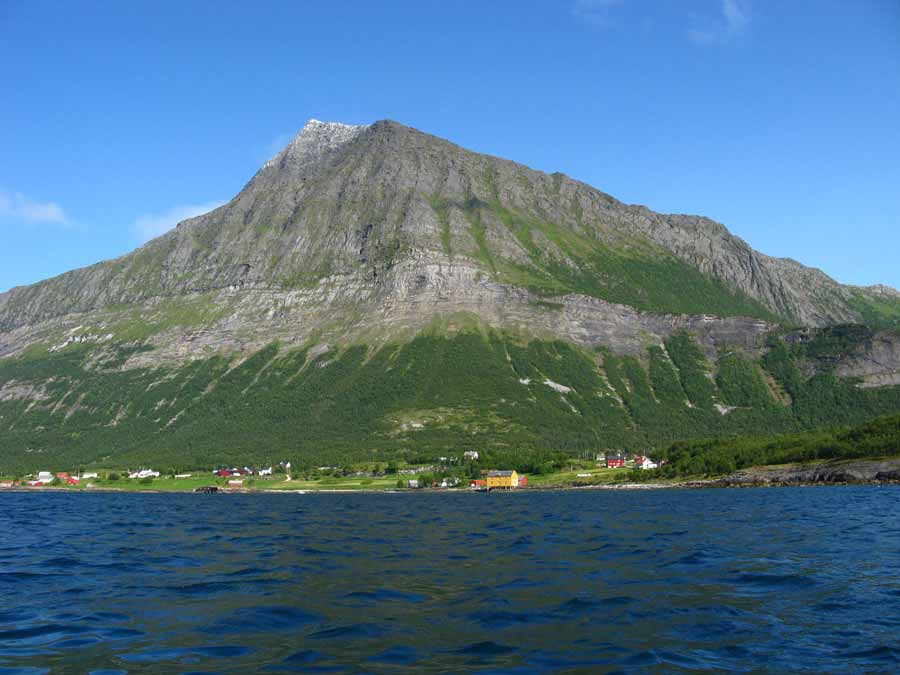 Initially I paddled past the neighboring village of Lekanger which looked typical fjord landscape with a pretty village surrounded by green fields and then impressive mountains rising above that. There were a few small islands here with sandy beaches and coves.
After passing Lekanger I headed off over to the island of Femris. I was going to go down the east side but the force four wind and choppy wavelets encouraged me to the top of the island where there was a beautiful channel between Femris and the smaller Rossoya to the north of it.
This channel opened out into a sheltered basin where there were a couple of lush farms above a quiet beach. The tide was low with a bit of shiny brown kelp leaf glimmering in the sun. It looked a good area for ducks but I did not see any. The basin then narrowed again into a channel and I paddled through it to the lee side of Femris island.
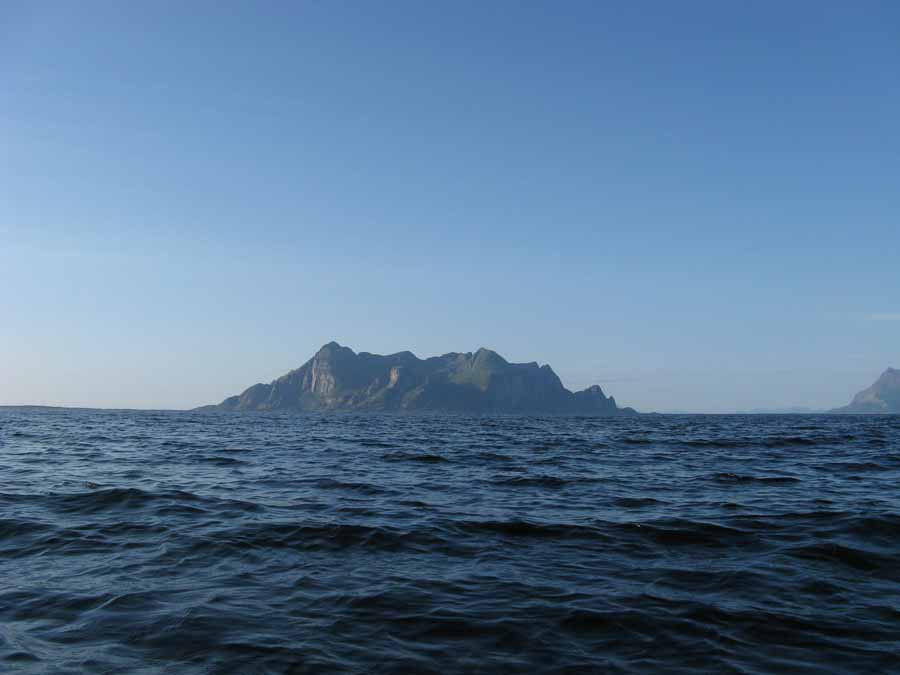 To my west was another larger craggy island with mountains up to 765 metres. It was called Fulgoy (Bird Island) and uninhabited. It almost certainly contained a couple of bird colonies as they were marked on the map and the sea was full of puffins, not in rafts but clusters of 10 or so.
Puffins spend all year in the ocean and return to land to nest and rear young in burrows on islands without mammal predators. They are excellent underwater swimmers and only need to fly in the summer months while nesting and bringing up the young. The rest of the year they are bobbing about in the Atlantic. Their wings and overall shape are therefore more suited to swimming and diving but they are OK fliers. On land, and whilst taking off and landing they are however somewhat clumsy.
When I approach they sometimes dive and sometimes fly. Those that fly beat their wings and splash across the waves with their feet splayed. They do not become airborne at once and crash from wave crest to wave crest until they finally bounce off one and are airborne. The red feet stay splayed like a BASE jumper until they have enough speed and then they tuck these take off aids together and accelerate. Once they are in the air they are fast, but not really acrobatic.
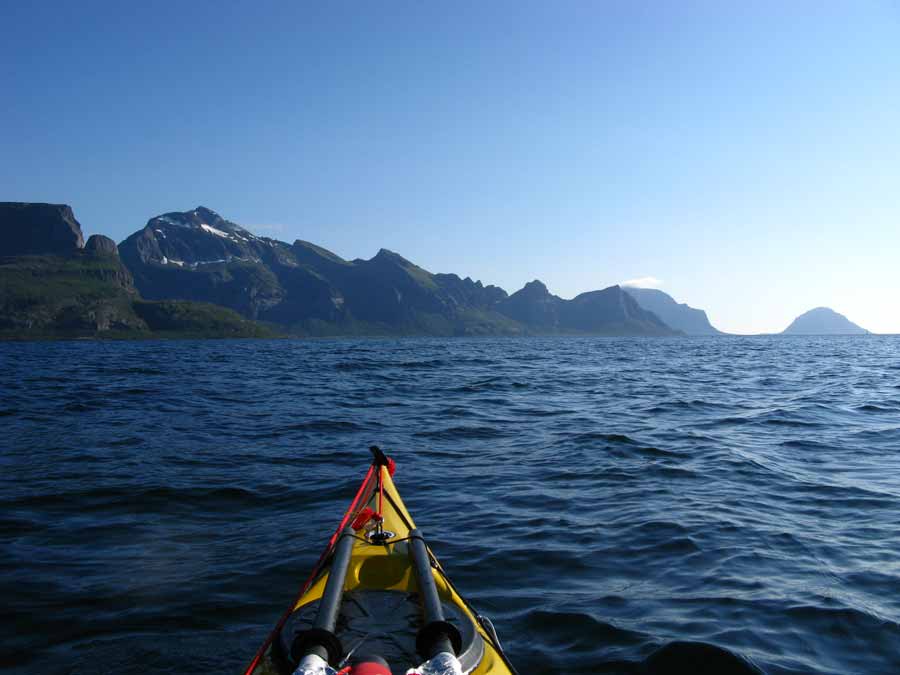 I continued down the west side of Femris towards some very spectacular mountains along the edge of the coast here. Some of them rose steeply up for 1000 metres and there were many immense buttresses which almost gave an escarpment appearance. I paddled in the tranquil weather along their base having to lift my head back to see the tops. The slopes at the base of these cliffs were covered in birch forest before the rock rose up vertically. Unusually, much of the geological strata was horizontal. This was not because it was undisturbed, as this coast has seen violent geological forces at work twisting huge areas, but because of coincidence that these forces left them horizontal after twisting, crushing, stretching and bending them.
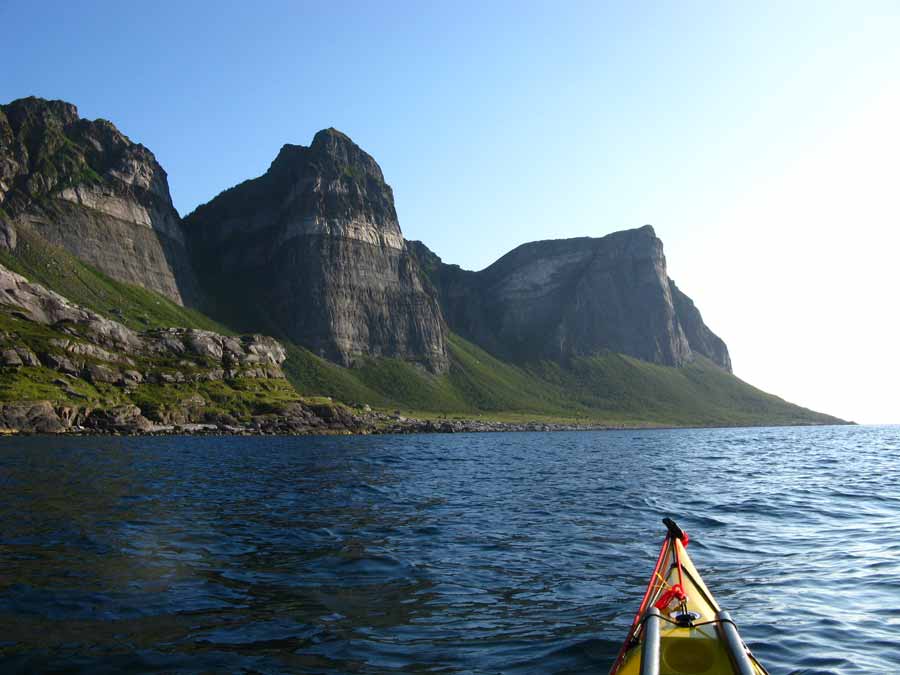 I paddled along the base to Finnes at the end of these cliffs. I was going to land here for a stretch but there was a bit of a swell coming in from the west now and the shore was rocky. I saw a seal here. I have seen remarkably little seal and otter so far on this trip. Perhaps a hundredth of what I would see in Scotland on a comparable trip. This surprises me at the seas here are full of fish.
With the wind increasing slightly to a force three I paddled over the bay towards Grimstad and then veered towards the north side of Kunna. Kunna was a large clump of rock; a mountain on its own connected to the mainland by a sandy isthmus 2 km long and 400 metres wide. I could easily have portaged over the isthmus but I would have needed three trips with the gear and one trip with the kayak. About 3 km of walking; so perhaps an hour. Round the coastline it was perhaps about 6 km so also an hour. Also I did not want to portage on this trip, so paddle round it was.
I expected it to be quite choppy round the north of the Kunna peninsula. I was now at the very edge of Vestfjord and the shelter granted by the string of Lofoten islands was negligible. Indeed the other extremity of this fjord, the tip of the lobster’s claw on Moskenesoy at the end of the Lofoten Islands which enclosed the vast Vestfjord, was perhaps 100 km away now. It was essentially open ocean and the swell was almost 2 metres.
It did indeed get choppy with lots of rebound clapotis. As I approached the north west corner there was a skerry to go round. Here the swell was both meeting the final stages of the incoming tidal flow and was being influenced by underwater skerries. The wind was now a force five with spray flying everywhere. Claws of white sea were snapping at my kayak from all directions and occasionally one would break on it. It was like the rounding of Slettnes Fyr some 4 weeks ago in miniature.
The tide was against me and I paddled hard for a good half hour before I was through the worst of the unpredictable mayhem. Sometimes the waves were well over 2 metres and very steep also but luckily none of them caught me out. This was not the type of sea to anticipate anything so I was prepared to say goodbye to my hat should I have to roll. When I eventually started to get into quieter waters my mouth was not dry with fear as it had been at Slettnes Fyr but my jaw was clamped tight in concentration.
I then paddled into the bay on the south side of Kunna isthmus, where there would be a sandy beach, at around 2300. However it was a windswept place and the wind was a force 6 now with the occasional gust of seven. I therefore decided to continue south down 3 km of rocky coast to a headland which would offer protection. I did this and found a small beach with a flat grassy birch forest above it which was great for camping.
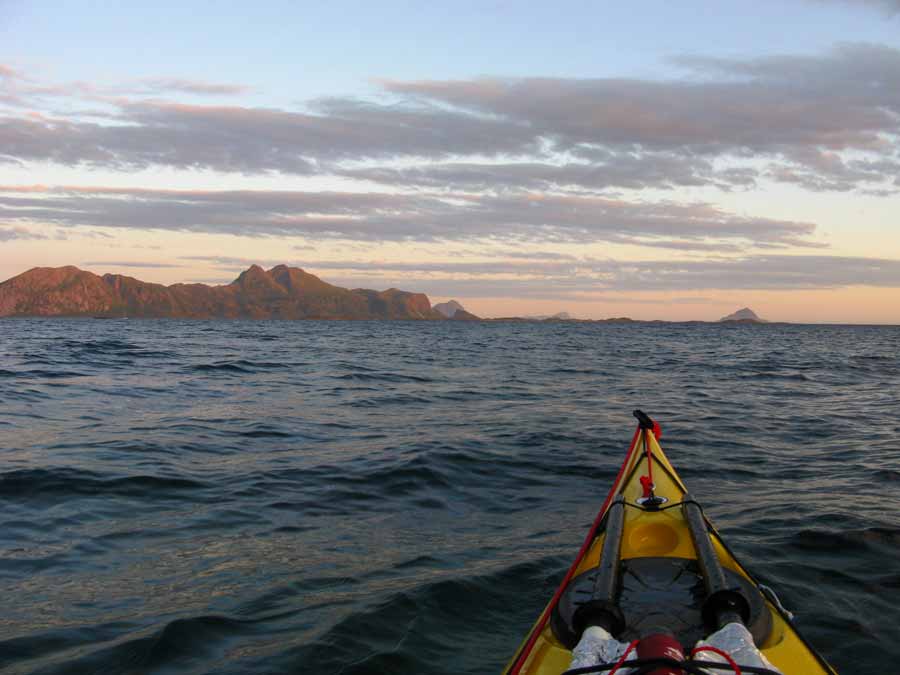 I put the tent up here and enjoyed the view southwards. It was of the Northern parts of the very picturesque Helgelandskyst, and it was basking in the glow of the midnight sun. Helgelandskyst is the next stage and it is reputed to be the best bit of the Norwegian coast and one of the top five kayaking destinations in the world. It is a mass of some 20,000 islands which offer beaches and protection. I have been looking forward to it for ages.
 It had been a nice day with the benefit of some excitement at the end. There was a lot of dithering and writing in the morning but the kayaking was great. It would certainly have been easier to portage over Kunna isthmus – but not as sportif.