Day 185. Kjerringoy to Vag
Posted by: James on July 4, 2009Distance 59km | Time 10.5hrs | Ascent 0m | Descent 0m
 I had a tremendous sleep in a comfortable in the complete dark. It is rare is seen darkness at the moment. I woke at 0700 and had the breakfast the guesthouse provided. Then I packed up the few belongings in the room, looked at the sea full of white horses from the balcony and went down to the kayak. It was a breezy day with a northeasterly force five at least. But it would be directly behind me.
I set off at 0930 and paddled out of the harbour breakwaters. It was not as bad as it looked and I could hug the coast for much of the way. There was quite a small fetch to the north so the waves were not large at about a metre, but many were breaking.
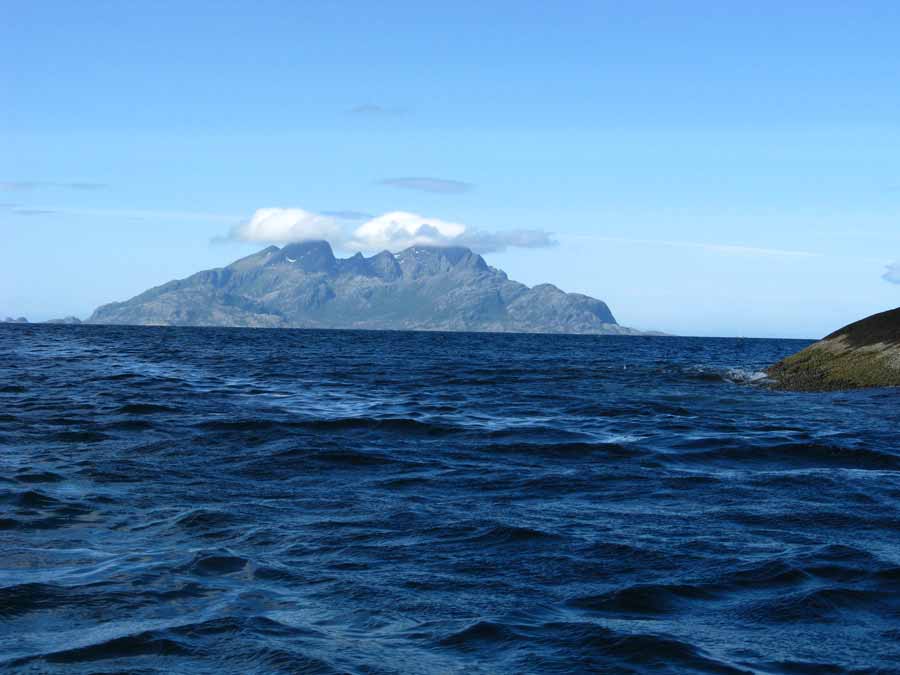
Out to the west was the steep island on Landegode. It was very craggy. One of Scotland’s most craggy islands, Rhum, would have been comparable in size but Rhum would have looked flat beside it. And Landegode was just one of hundreds of such islands in Norway! I draw this comparison because I think it was from Landegode that the sea eagles which were reintroduced into Scotland and placed on Rhum some 30 years ago came from this island.
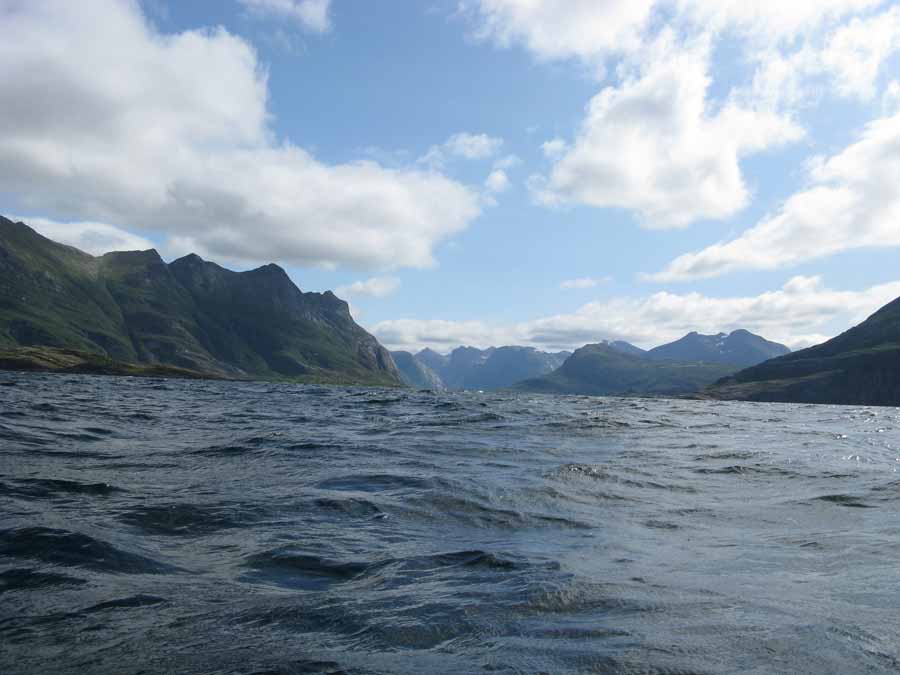 As I came down the coast there were a few headlands to go round where the sea was pretty bumpy but there were also a few islands to find shelter behind. When I reached Mistfjord I could cut across the mouth outside the islands as I was largely protected from the infant swell by the group of small islands and islets which almost formed a peninsula near Fjaere. Looking up Mistfjord showed some classic fjord scenery with a U shaped valley, now flooded with the sea and steepening birch forest rising above this to the steep slopes of bare rock and alpine peaks around 1000 metres obscured by vanishing cloud.
As I entered the sound of Landegofjorden between Landgode island and the mainland the wind increased up to a force six. It was still behind me and I was getting blown along at a tremendous rate sometimes. The waves tented to slow me down as although I could surf down the occasional one I was also sliding down the back of the wave passing under me into the trough. The waves where going at least twice the speed I was. This resulted in a wallowing motion of stopping and starting. If I caught a good surf wave I was doing 12 km an hour for a burst.
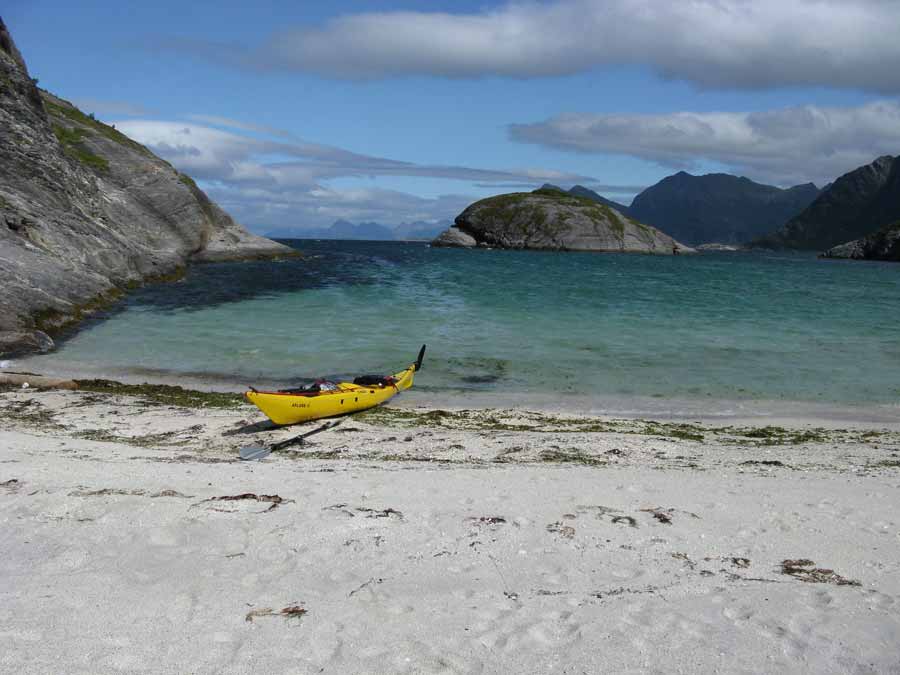 I came to one peninsula, south of Mjellefjell mountain, with a rocky islet at the end separated from the rest of the peninsula by a sandy spit. I stopped on the spit and the rising tide soon covered the spit allowing me enough time to stretch. With a good force six now blowing I was fortunate to find shelter south of this peninsula with a group of low grassy islands grazed by cows at Vagoy.
After this I approached Bodo. There was village on the outskirts called Skivika and a steep hill called Bratten. There was no protection here from the one and half metre waves. There waves were hitting the base of the cliffs on Bratten and rebounding causing erratic clapotis. In addition to this there were a small tidal current and the force six wind blowing the spray off the crests. It was a very choppy, bumpy sea with masses of drama. I was now thankful for my load lugging barge as it was extremely stable in such seas and looked after me well without too many support strokes. It was the Volvo of kayaks. I thought of the girls in their hard chinned sports cars who maybe passed by earlier.
After this I was into a sound with the diminishing sea behind me, Hjartoy to the west and the unfolding urban scenery of Bodo to the east. The trouble with large towns is that it is difficult to find places to land near somewhere to stay. Then you have a 100 kg kayak and contents to deal with and secure and inevitably a way to walk to the accommodation. It was quite a palaver in Tromso. It looked ever worse here. Outside of towns you have the relatively stress-free option to just ram the kayak up the beach, put up the tent and carry the empty kayak up above the high tide.
Bodo was second only to Tromso as the largest town in North Norway and was a fast growing town with 40,000 inhabitants. It looked like it had a nice centre in a very secure harbour as I paddled past the mouth of the harbour. There werte many nice buildings, mostly new, along the harbour front together with the expensive chain hotels like Rica and Radisson. Much of old Bodo was destroyed in the war.
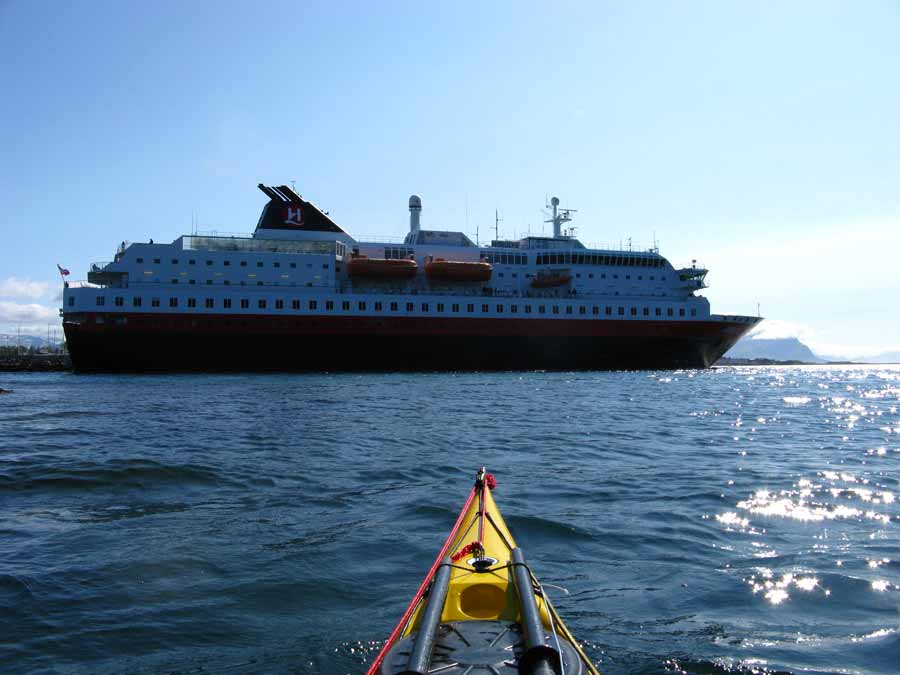 I was about to cross the harbour mouth when the Hurtigruten ferry streamed out. It was one of 13 boats which take 11 days to do the Bergen-Kirkenes-Bergen run with a northbound and southbound ferry passing each of the 25 odd ports each day. Today’s ferry was the Nordlys. The one I had a near encounter with at Berlevag some 5 weeks ago. I wonder if it recognized me.
I paddled right past the whole of Bodo and was thinking to go round the peninsula and up Saltfjord to camp at an official campsite near the shore. It was a bit too risky to cross the open 10 km Saltfjord in this force six wind. However as I came to the tip of the peninsula I noticed that the wind had dropped off to a force four and that the sea was more protected. I stopped among some islets, ate a late lunch and considered the options. The girls had reached Bodo at 0900 and called it a day here and were lucky with a campsite in the main harbour area.
Just 20 km up the Saltfjord was a narrows and then after the narrows the Skjerstadfjord. The incoming and outgoing tide have to pass through these narrows to fill up and empty Skjerstadfjord. The height difference can be a metre. The resulting tidal flow is the strongest in the world and I have heard people say it reaches 40 km per hour. There are many eddies and whirlpools as the tide reaches its maximum flow every 6 hours and then a short period of calm water as the currents change direction.
I decided to cross the Saltfjord while the going was good given the forecast for the next days with strong north winds. As I was about to go a large Nordlandsbat went sailing past. The Nordlandsbat is a traditional wooden boat from this area. They come in many sizes. It is perhaps the most graceful boat afloat with it high bow and stern. It uses a large square sail, the canvas of which later provides the shelter at the front boat when it is anchored or in harbour. This one was large, about 40 foot, and went by under a square sail at a tremendous speed and looked like something out of the Viking era.
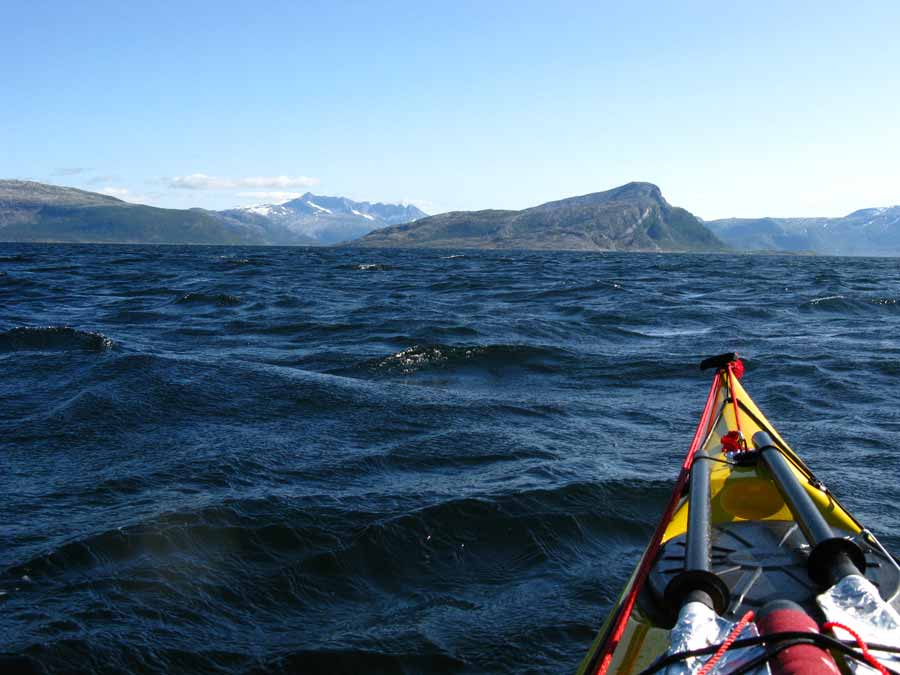 The crossing was easy. With the good wind I made very good time and the waves never really built up. It took just over an hour before I was approaching the other side. I did not land here but veered off to the west passing to the north of some flat islands and heading to the light house on the tip of a peninsula north of Marnes. This would mean I would be in the protection of islands for the first half of the next leg to Kunna.
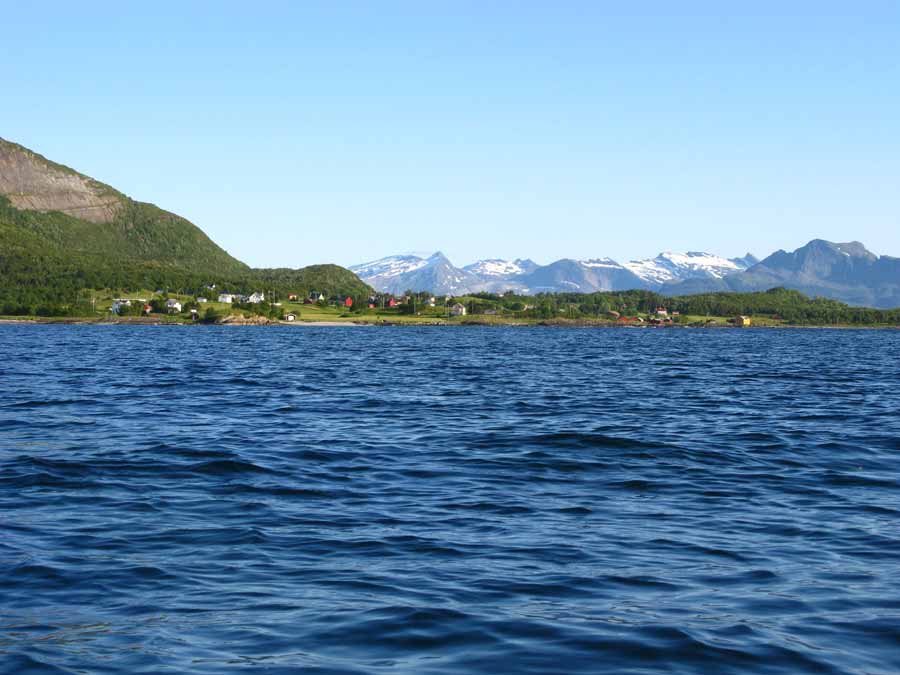 I rounded the lighthouse and then started down the sound with the wind behind me. I didn’t really pass any beaches on this rocky coast until I had done some 5 km and reached the village of Vag. There was a harbour, beach, closed shop and campsite here. It would do nicely as it was nearly 2030. Despite the distance today I did not feel tired mostly due to the following wind.
I put up the tent when a guy approached from a large group of 30 odd people. As usual in North Norway it was a friendly hospitable visit and he invited me to supper. We chatted a bit and he was the rescue winchman in a rescue helicopter based in Spitsbergen. I went over to the group who were all from Fauske small boat club and had come here in their boats for the evening. They were grilling and all in good spirits. I was given a lot of food and tried to join the conservation but it was too fast and I was too tired to concentrate on the dialect.
After a great dinner we all went down to the old Nordlandsbat which some of them had sailed from Fauske. It was a Fembøringen, the largest of these splendid boats. The square sail was down over the front of the boat in a tent type arrangement and some 20 people gather underneath with guitars and healthy voices. It was a nice evening. After chatting with the guardian of this community owned boat and learning something about their history I had to excuse myself to write the blog as it was already midnight and the sun was now just kissing the horizon. However once in the tent I could not face the blog and crashed out soon after.
It had been an excellent day again and it was nice to have a bit of excitement after the beautiful but placid sounds of Troms and the quiet weather of the last few days. It continued to be an exceptionally dramatic area with islands and skerries and then very steep mountains.
July 5th, 2009 at 7:39 pm
Hi James, I am leaving you here for two weeks paddling in Uummannaq fjord on west Greenland. I am very interested in what you think about Helgelandskusten. I really want to go there sometimes, perhaps next summer. Or, do you have other suggestions, after you have seen it all.
Have a nice time paddling downwards the Norwegian coast.
Camilla